Which Bra Is Right for You? Learn More


Most high-impact sports bras fail the same way, and it is not a defect. Elastic stretches. That is what elastic does. A bra that gets its support from fixed elastic is at its strongest the day you buy it, and the support drops a little with every wear and wash from there. Agent Athletica, a long-distance runner who has worn through more sports bras than most of us, pegs the practical lifespan of a fixed-elastic bra at six to twelve months [10]. If you have owned four or five bras marketed as high impact and found each one gave up on you, the label was not lying. The elastic just did what elastic does.
At SHEFIT, we built the Ultimate Sports Bra around a different idea: the support you set is the support you keep. The band and the straps, the two parts that actually hold you, are the two parts you adjust yourself, on your body, and re-adjust as the bra ages or as your body changes. That is the whole argument for this bra. Everything below is the case for it.
It is also why the bra keeps turning up in independent testing aimed at exactly the women it was built for. SELF names it Best Overall in its running sports bra roundup, citing multiple SELF Activewear Award wins including a Reader's Choice Award [1], and Garage Gym Reviews gives it Best Sports Bra for Running for Large Breasts, the C-cup-and-up bracket [2].
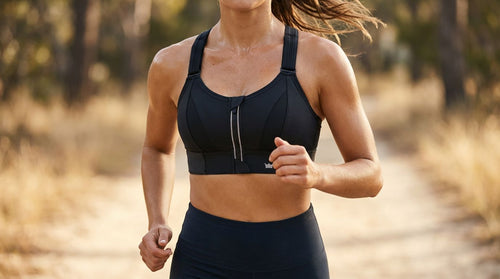
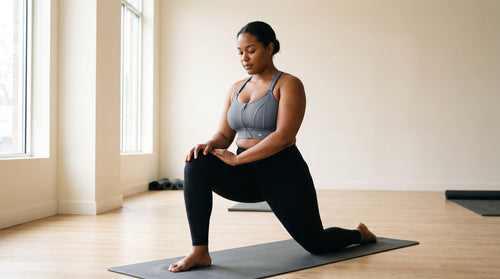
One thing to say up front. We built this bra for the woman who is a C cup or larger and who runs, does HIIT or CrossFit, rides horses, or does anything with enough vertical movement in it that a pullover bra becomes a problem she thinks about mid-workout. If your training is yoga, walking, or anything where the movement stays low and controlled, you do not need this much bra. Our Emerge Sports Bra, built on the same adjustable band and straps with a lighter all-day cup, will serve you better, and we would rather tell you that now.
Where a Sports Bra's Support Actually Comes From
Start with the size of the problem. In three dimensions, breast movement during running can reach 15.2 centimeters, and during jumping it can reach 18.7 [6]. That is the displacement a bra is being asked to control several thousand times per workout.
Now look at where the control comes from. The band carries the majority of a bra's support, roughly 80 to 90 percent. Jené Luciani Sena, the bra-fit expert whose framing we have leaned on for years, has a shorthand for it that is worth keeping: check your back before you check your rack. The part of the bra you never look at in the mirror is the part determining whether the bra works. Everything above the band is either working with that anchor or failing without it.
The research backs the mechanism. REI's fit guidance notes that wider bands and adjustable straps generally deliver more support than narrow, fixed ones [4]. A peer-reviewed study of 98 sports bras tested on 77 women found breast movement reduction ranging from 36% to 74% across the sample, and an adjustable underband was among the five construction characteristics most associated with the higher end of that range [5].
Here's what that means for you. The two parts of a bra that matter most for support, the band and the straps, are the two parts most sports bras fix in place with elastic. They cannot be tightened when they loosen, and they will loosen. That is the design problem we set out to solve.
How the Ultimate Sports Bra Is Built to Be Re-Set
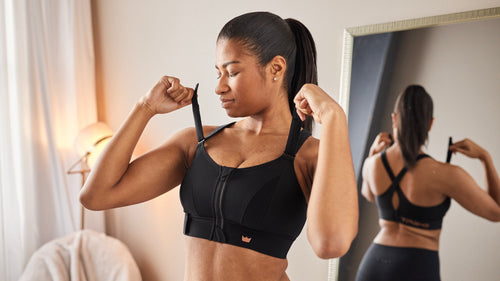
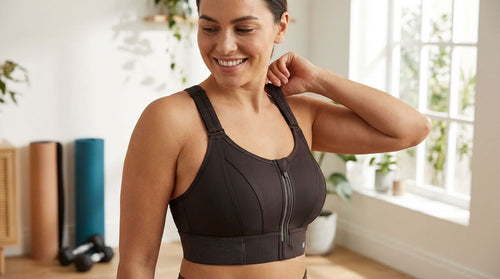
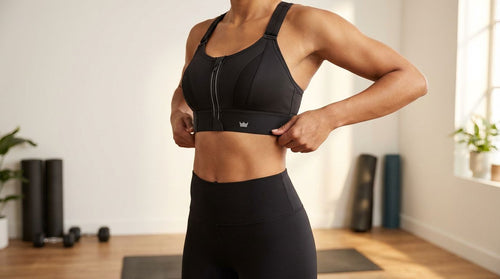
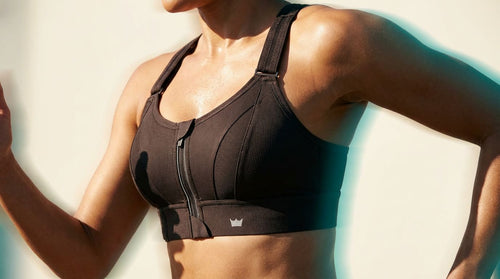
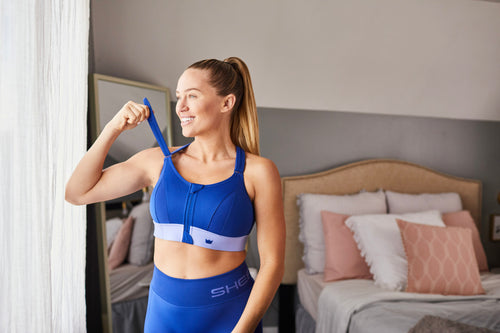
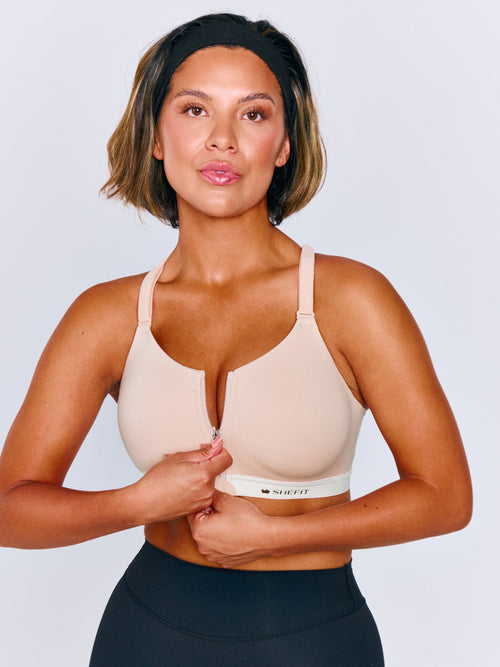
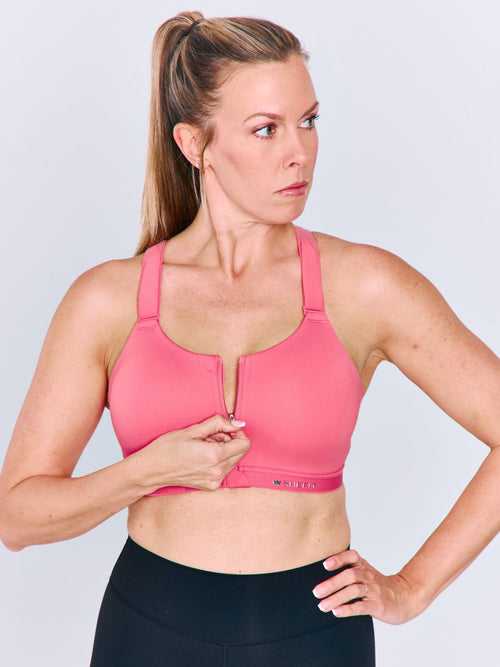
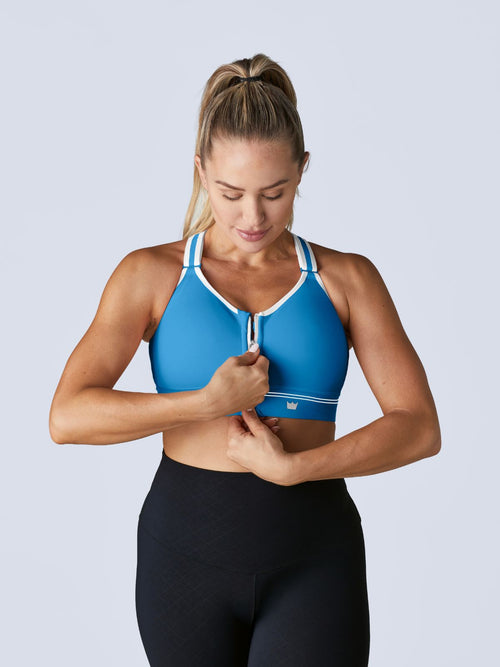
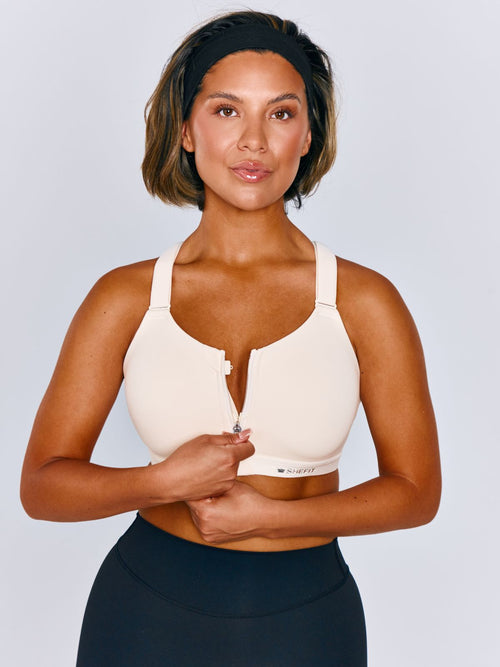
The system we patented is called Zip. Cinch. Lift.®, and the name is a description of three separate parts rather than a slogan. Zip is the front zipper. It opens and closes for easy on and off, and that is the whole of its function; you do not tighten anything with it. Cinch is the Velcro rib band around your torso, and that is the control that sets compression and support. Lift is the pair of adjustable non-stretch shoulder straps, which set how high the bra holds you and can be worn in an X or an H configuration on the back.
Read that against the previous section. The band, which carries most of the support, is a cinch you set. The straps, which set the lift, are non-stretch and adjustable. Neither depends on elastic holding its tension over time. When the bra has been through a year of washes, you cinch the band a little tighter and take up the slack. When your body changes, you do the same thing in the other direction. REI's guidance points at this same relationship between adjustability and usable lifespan [4].
The rib band deserves its own note. It runs two inches wide and carries a hidden hook-and-eye fastener underneath the zipper, an extra closure layer that independent reviewers single out as uncommon in the category. Most sports bras give you one closure. This gives you two working in series.
The cups do the other half of the work. They are wire-free and individually seamed, so each breast gets its own supportive space rather than being pressed flat as a unit. There is no underwire in this bra, or in any sports bra we currently make. The support comes from the band and straps, and that is a structural choice rather than a cost decision.
The rest of the construction, briefly:
- Fabric: a 100% polyester shell over a power-mesh lining that is roughly 86% nylon and 14% spandex with two-way stretch, per Teri Lyn Adams's material breakdown [3]
- Pads: removable, so the shape is yours to set
- Price: $69
The Ultimate Sports Bra comes in a range of colorways at that price, and the full set lives on the Ultimate Sports Bras collection page if you want to see them together.
Why It Uses Both Encapsulation and Compression
The research on sports bras sorts construction into three types, and this bra's design maps onto two of them at once. Individually seamed cups are an encapsulation trait. A cinchable band that presses is a compression trait. The Open University's synthesis of the research compares the approaches directly [7]:
| Construction type | How it works | Measured movement reduction |
|---|---|---|
| Compression | Presses breast tissue toward the chest wall as a single unit | Up to 55% |
| Encapsulation | Supports each breast individually in its own cup | Up to 73% |
| Combination | Encapsulates and compresses at the same time | Between the two |
A note on what those numbers are, because they are easy to misread. They come from a volunteer test of generic bra types, measured against the movement of an unsupported breast, and they describe categories rather than any single product. Our bra does not appear as a row. The Ultimate Sports Bra has been measured in its own right, in a different comparison: University of Memphis researchers recorded vertical breast motion in it at more than 50% below the values previously reported for high-support sports bras from other leading sportswear brands [11]. Those are two different yardsticks, so the 55% in the table and the 50% in that study are not the same measurement. What the table shows is why we did not pick one approach. Encapsulation gives each breast its own space. Compression anchors everything to the band. The adjustability of both is the part the categories do not capture at all. If you want the construction types unpacked properly, we wrote a longer piece on encapsulation sports bras and who actually needs one.
One more finding worth knowing before you shop. A study comparing compression and encapsulation designs across walking and running speeds found compression styles were perceived as more comfortable at higher gait speeds but less comfortable standing still [8]. The bra that feels best in the fitting room is not automatically the bra that feels best at mile eight, which is one more reason a band you can set for the workout, rather than for the mirror, matters.
What Long-Term Wearers Report
Short reviews tell you how a bra feels. Long ones tell you whether it holds up, and this is where the design argument gets its proof.
Agent Athletica has worn the Ultimate Sports Bra across roughly three years and six bras and reports that the support has not degraded from where it started [10]. Teri Lyn Adams has worn hers through two pregnancies and the postpartum and nursing months after each, which is a body-change test most sports bras are never subjected to [3]. Lex at flecksoflex.com ran a first marathon in hers and came back reporting no sweat retention after 20 miles [9]. Different bodies, different stress tests, converging results.
A reader quoted in SELF's roundup put the case in fewer words than any of us could: "This is the first and only bra that actually holds me together while still being comfortable... keeps my 38Fs from hitting me in the face during a full marathon." [1]
Adams's verdict on who it is for is about as direct as anyone's: worth it for a C cup and up who needs real support for running, HIIT, or high-impact training, and overkill for low-impact activity where cheaper alternatives do the job [3]. We agree with her, including the second half.
None of which makes it a perfect product, and we would rather list the tradeoffs than have you find them yourself. Garage Gym Reviews's con list is fair: hand-washing is recommended, the band can run slightly large, and the colorway and pattern selection is narrower than some competitors offer [2]. At $69, the bra also sits toward the higher end of what the category costs. A commenter on a separate review asked about a possible air gap where the zipper sits; the reviewer said the zipper can poke up slightly but it doesn't bother her [9]. Those are real. For a low-impact wearer they would not be worth accepting. For the runner in the first paragraph of this article, they generally are.
Getting the Fit Right the First Time
A bra you can re-set only works if you start from the right size, so here is the short version of how to land on one.
Sizing runs XS through 6Luxe, AA through I cups. We use Luxe rather than Large, which is our own size language and not an industry convention. 2XS and XXS have been discontinued, so the current range starts at XSmall.
Measure rather than guessing from the cup letter you wear at another brand. Bra sizing is not regulated, so the letter is not portable. Take two measurements in inches:
- Bust: wrap the tape around your back and slide it to the fullest part of your bust, just above the nipple, keeping it flat and level against your body
- Band: same process, but positioned directly under your bust on the ribcage
- Round each to the nearest whole number and cross-reference both against our inches chart
If you land between two sizes, the rule is simple: the larger size for more coverage, and the smaller size for more control. Independent testers note the band can run slightly large, which is worth accounting for when you decide which way to go. If you are between sizes for reasons of band-and-cup arithmetic rather than preference, our sister size guide walks through how those equivalents work.
One fit reaction catches nearly everyone the first time, and it is worth naming before it happens to you. When this bra lifts properly, you will probably see armpit skin you are not used to seeing. That is your bra doing its job, not a sizing failure. Spillage is a different thing entirely: it means breast tissue pushing over the top or the sides of the cup, and it means the size is too small. A third thing that looks similar is the band riding up into your armpit and chafing, and that one means the bra is too big. Three lookalikes, three different answers.
How It Compares to the Rest of the SHEFIT Lineup
The Ultimate Sports Bra sits at the top of our range for impact, but it is not the only bra built on the adjustable band and straps. The Flex and Emerge Sports Bras share the same architecture; the difference is cup construction and how much support each one is engineered to deliver, not adjustability.
| Bra | Price | Impact level | Cup construction |
|---|---|---|---|
| Ultimate Sports Bra | $69 | High | Wire-free, individually seamed, power-mesh reinforced, removable pads |
| Flex Sports Bra | $69 | Medium for C+, high for A-B | Wire-free, smooth non-padded cup, power-mesh lined |
| Emerge Sports Bra | $69 | Medium for C+, high for A-B | Wire-free with an integrated pad |
Reading that table by activity rather than by row: if you run, ride, or train hard at C cup or above, start with the Ultimate Sports Bra. If you are in that same range but doing moderate work, or an A or B cup doing high-impact work, the Flex and Emerge Sports Bras both cover that ground. Choose the Emerge Sports Bra if you want its integrated pad and an all-day feel, and the Flex Sports Bra if you want a smooth, non-padded cup with the same adjustability. Either one is also the better call for the days that are not training days at all.
SHEFIT Ultimate Sports Bra Questions, Answered
Is the SHEFIT Ultimate Sports Bra actually high impact?
It is built for high-impact activity and independently tested as such: SELF put it at the top of a running-bra roundup and Garage Gym Reviews awarded it the large-breast running category. It has also been measured directly. In a University of Memphis landing study, vertical breast motion in the Ultimate Sports Bra came in more than 50% below values previously reported for other leading brands' high-support bras [11]. The construction traits the research associates with high support, an adjustable band and individually supported cups, are the traits it is built on.
Why does the support last longer than other bras?
Because you set it. Fixed-elastic bras lose tension as the elastic stretches, and there is nothing to do about it but replace the bra. On the Ultimate Sports Bra, the rib band cinches and the non-stretch straps adjust, so when the bra loosens with age you take up the slack yourself.
What's the difference between the Ultimate and Flex Sports Bras?
They are built differently by design. The Ultimate Sports Bra is engineered for the highest support we can build, so its construction is different from the Flex Sports Bra's: individually seamed cups, removable padding, power-mesh reinforced cups, and a two-way stretch body fabric. The Flex Sports Bra has a smooth, non-padded cup made from four-way stretch fabric and lined with power mesh to reinforce the support. That makes the Flex Sports Bra more supportive than other brands' high-support bras, but not as strong as its sister bra, the Ultimate Sports Bra. Its rating follows cup size: high impact for A and B cups, medium for C and up. Both use the same adjustable rib band and shoulder straps and both cost $69.
Does the Ultimate Sports Bra work for large busts?
That is the audience it was designed for. Garage Gym Reviews awarded it the large-breast running category, meaning C cup and up, and the size range runs to I cups and 6Luxe.
How do I know if I have the right size?
Measure your bust and band in inches and cross-reference our chart rather than assuming your cup letter from another brand carries over. If you are between sizes, take the larger for more coverage and the smaller for more control. Our Fit Advisor gives a quick estimate, and a free virtual fitting with a SHEFIT fitter is available if you want a person to walk you through it.
Does it have underwire?
No. Support comes from the two-inch adjustable rib band, the hidden hook-and-eye fastener beneath the zipper, and the non-stretch adjustable straps.
The Variable Worth Changing
If you have been buying high-impact bras and returning to the same complaints six months later, the thing to change is probably not the brand on the label. It is whether the band and straps are something you can set yourself. That is what the Ultimate Sports Bra is built around, and it is why the women who have worn one for three years talk about it the way they do.
Measure first, then decide. When you are ready, the Ultimate Sports Bra is waiting, and our Fit Advisor will get you to a starting size in about thirty seconds. Find your fit.
References
[1] SELF. "Marathoners Swear By These Supportive Sports Bras." SELF, 2026. https://www.self.com/story/best-sports-bra-for-running
[2] Garage Gym Reviews. "Best Sports Bra for Running (2026)." Garage Gym Reviews, 2026. https://www.garagegymreviews.com/best-sports-bra-for-running
[3] Teri Lyn Adams. "SheFit Sports Bra Review: Is It Worth It?" terilynadams.com, 2026. https://terilynadams.com/shefit-sports-bra-review/
[4] Paige Frederick-Pape, REI Co-op. "Sports Bras: Sizing & Measuring." REI Expert Advice. https://www.rei.com/learn/expert-advice/sports-bras.html
[5] Norris M, Blackmore T, Horler B, Wakefield-Scurr J. "How the characteristics of sports bras affect their performance." Ergonomics 64(3):410-425, 2021. https://pubmed.ncbi.nlm.nih.gov/32981459/
[6] adidas. "How Should A Sports Bra Fit." adidas, March 2026. https://www.adidas.com/us/blog/how-should-a-sports-bra-fit
[7] The Open University. "Supporting female performance in sport and fitness: Session 5." OpenLearn. https://www.open.edu/openlearn/mod/oucontent/view.php?id=116022§ion=5
[8] Chen X, Gho SA, Wang J, Steele JR. "Effect of sports bra type and gait speed on breast discomfort, bra discomfort and perceived breast movement in Chinese women." Ergonomics 59(1), 2016. https://pubmed.ncbi.nlm.nih.gov/26256619/
[9] Lex. "Lex Reviews Sports Bras: The SHEFIT Ultimate Sports Bra." flecksoflex.com, 2026. https://flecksoflex.com/lex-reviews-sports-bras-the-shefit-ultimate-sports-bra/
[10] Agent Athletica. "SheFit Ultimate Sports Bra Review." agentathletica.com, 2026. https://agentathletica.com/shefit-ultimate-sports-bra-review/
[11] Fong HB, Nelson AK, McGhee D, Ford K, Powell DW. "Increasing breast support is associated with a distal-to-proximal redistribution of joint negative work during a double-limb landing task." Journal of Applied Biomechanics, 2022. https://www.memphis.edu/healthsciences/pdfs/jab-biomech-2023.pdf