Which Bra Is Right for You? Learn More


Which sports bra brand can you trust to hold you still through a sprint, a box jump, or a long trot on horseback? That question sits behind every search for the best sports bra brands, and the honest answer fits in one line: a brand name tells you less than five things you can check for yourself.
Most brands make more than one kind of bra. The same label can sit on a bra that keeps you locked in and on one that lets you bounce through your warm-up, so a list of names never settles the question. Support is what most women weigh first, too. In one survey of 438 American women and girls, the amount of support was the most important factor in choosing a sports bra, named by 46.2% of respondents [1].
At SHEFIT, we design adjustable sports bras, so we know how much of the answer lives in construction rather than in a logo. This guide judges sports bra brands by how their bras are built, using five checks you can run on any product page before you buy. Then we show you where our own three bras land on those same checks.
What to Check Before You Trust Any Sports Bra Brand
Brands describe their bras in their own vocabulary, and very little of it is standardized. What you can compare are the parts of a bra that do the work. These five checks cover them, and none of them depend on the logo stitched into the band.
| Check | Why it matters | Where to look on a product page |
|---|---|---|
| Support construction (compression, encapsulation, or both) | Decides how breast tissue is held: pressed close as one unit, cupped separately, or both at once | Product description, cup and lining details, photos of the inside of the bra |
| Adjustability (band and straps) | Being able to re-set the fit keeps support where you need it as the bra ages and your body changes | Closure type and strap details, with the band and shoulder straps each called out as adjustable |
| Size range (band and cup sizes, beyond S-XL) | Brands size differently, and alpha sizes alone hide which bodies the bra was built for | The size chart: band and cup combinations, plus how the brand asks you to measure |
| Evidence for bounce control | A "high support" label is a claim, while measured breast motion is evidence | Research citations, testing methods, independent reviews that explain how bras were tested |
| Durability (how support holds up through washing) | Elastic stretches over time, and a worn-out bra stops supporting you | Care instructions, fabric content, wash-testing or lifespan details |
None of these checks require a lab. They require reading past the headline of a product page, and they work the same way whether you are comparing two brands or two bras from the same brand.
Adjustability deserves a little extra weight if you wear a larger cup size. Runner's World notes that whatever the chest design, an adjustable band and shoulder straps help improve overall support when you have larger breasts [2]. A bra that adjusts in two places can be tuned to your ribcage and your shoulders separately, which a fixed bra cannot do.
The rest of this guide follows these five checks in order, starting with how a bra holds you in the first place.
Compression, Encapsulation, or Both
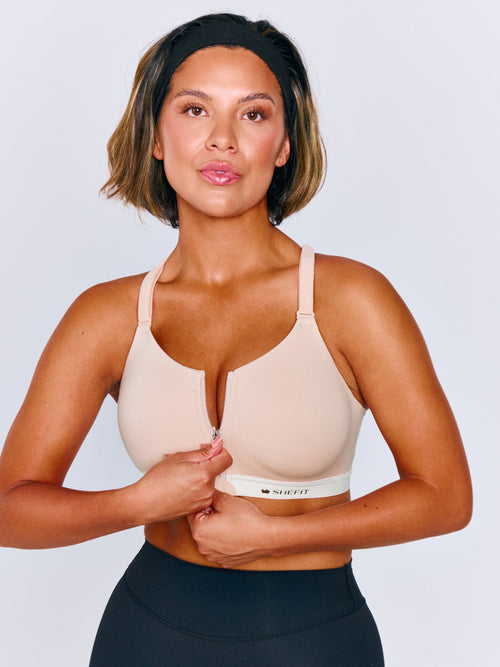
Every sports bra controls movement in one of three ways. Compression holds both breasts against the chest wall as a single unit. Encapsulation gives each breast its own cup, so each one is supported separately. A hybrid does both at once.
Sports Medicine Australia (SMA) sorts sports bras into the same three designs, calling them crop top, encapsulation, and hybrid. It also notes that encapsulation and hybrid designs come with an adjustable band and straps, while crop tops do not [3].
| Design | How it limits movement | Band and straps | Often suits |
|---|---|---|---|
| Encapsulation and compression together (SHEFIT Ultimate Sports Bra and Flex Sports Bra) | Gives each breast individual cup space, then holds the whole bust close to the body | Adjustable | Higher-impact training, larger cup sizes, anyone who wants separation and lockdown together |
| Encapsulation | Supports each breast in its own cup | Adjustable | Larger cup sizes and women who dislike a pressed-flat feel |
| Compression (crop top) | Presses the bust against the chest wall as one unit | Not adjustable | Smaller cup sizes and lower-movement sessions |
Both our Ultimate and Flex Sports Bras use encapsulation and compression. Each breast gets its own space, and the whole bust is held close to your body, so tissue has less room to shift between cups or move as one heavy unit. The Flex Sports Bra does it with smooth cups for a sculpted look under a tank or tee.
Comfort plays a part here as well. The same Runner's World guide points out that many women with larger breasts prefer encapsulation because they find it more comfortable. Separation means nothing gets squashed together, which matters a lot more over an hour-long session than it does in a fitting room.
Here's what that means for you as a shopper: the design tells you how a bra works, but most product pages bury it. If a listing only says "high support" and never mentions cups, compression, or what adjusts, that silence is information too.
Why "High Support" on a Label Proves Less Than You Would Think
No shared standard defines "high support." Two bras with that exact phrase on the tag can be built on different designs, from different fabrics, with different amounts of adjustability. The words match. The bras do not.
The Telegraph's testing shows that gap in practice. A panel of international netball players tested a range of sports bras with the jumping and quick changes of pace their sport involves. A bra sold as high support did not control bounce as well as netball-style movement needs, and a bra named for ultimate support did not control bounce effectively enough for a tester with a larger cup size [4]. Both scored 3 out of 5 and were left out of the main guide.
The same piece carries advice from biomechanics professor Joanna Wakefield-Scurr of the University of Portsmouth, whose short version is "less stretch means more support." Her suggestion is to check the fabric and the underband before you buy, rather than trusting the label alone.
Measurement is a stronger kind of evidence than a label. University of Memphis researchers tested SHEFIT sports bras with 35 female athletes performing a double-limb landing task. Vertical breast motion in our Ultimate Sports Bra, the study's high-support condition, was 33% less than in the low-support condition, and more than 50% less than values previously reported for high-support sports bras from other sportswear companies [5].
We share that study as an example of what real evidence looks like. It does not prove every other bra falls short, and plenty of brands make bras that hold well. The label just cannot tell you which ones. When you are weighing a brand's support claim, look for these three signals:
- A named method. Who measured the bra, how many people wore it, and what movement they did.
- Construction you can verify. Low-stretch fabric, a firm underband, and shoulder straps you can tighten.
- Testing on bodies like yours. Results from testers across a range of cup sizes.
The same questions run through our guide on how to tell a real high-support sports bra from a marketing label, which puts them side by side with what a product page usually shows you.
Size Range and Fit: Where Brands Quietly Differ
Bra sizing has no industry standard, and brands do not follow the same measurement conventions. A cup letter that fits you at one brand does not predict your size at another.
That is why we size from measurements in inches, using each brand's own chart, instead of carrying a cup letter over from a different label. Your traditional bra size, the band-and-cup number, is a starting point for reading a chart, not a sports bra size.
Getting this wrong is common. In one study of 104 women, 85% were wearing ill-fitting bras, and the sizes the women picked for themselves, or got from bra-sizing measurement systems, differed significantly from their correct size [6]. Professional help is rare for sports bras in particular: in the survey of 438 women and girls, only 3.7% had ever been professionally fitted for one [1].
Size range is where brands differ most quietly. Runner's World notes that it is rare to find a high-impact bra that goes above a 42DDD, and names SHEFIT among the few brands that manage it [2]. Our own range runs XS-6Luxe in AA-I cups, so if you usually hunt for an XL, look for Luxe instead.
Once a bra arrives, a quick fit check tells you more than the tag:
- The band stays put when you raise your arms or twist, and you cannot pull it more than about 5 cm (2 inches) away from your body, a check the Telegraph gives.
- The shoulder straps feel firm without digging into your shoulders.
- All of your breast tissue sits inside the cups, with nothing pressing over the top or sides.
- The bra stays in place when you jog on the spot and reach overhead.
One distinction trips up a lot of women. If you see armpit skin, that's your bra doing its job, lifting you up. Spillage is different: it means tissue pushing over the top or sides of the cup.
If you land between two sizes on our chart, the rule is simple: larger size for more coverage, smaller size for more control. Our size charts read inches directly, and the fit quiz gives you a starting size in a few minutes.
Adjustability and How Long the Support Lasts
Adjustability usually gets sold as comfort. Its bigger job is time. SMA describes adjustable bands and straps as a way to optimise both the fit and the lifespan of the bra. Elastic relaxes and bodies change, and a bra you can re-set keeps up with both.
Washing is a big part of that story. The Telegraph reports that Prof. Wakefield-Scurr's research found a sports bra's support can drop by approximately one-third after around 25 washes [4].
The peer-reviewed study behind that work, published in Sports Biomechanics, found support was reduced after 25 washes and that wear compounded the loss [7].
The SMA fact sheet adds that many women keep wearing sports bras past their "use by date," once the elastic is overstretched and the material worn out, and that those bras need replacing [3]. A fixed bra has no way to win back support it has lost. An adjustable one lets you take up the slack.
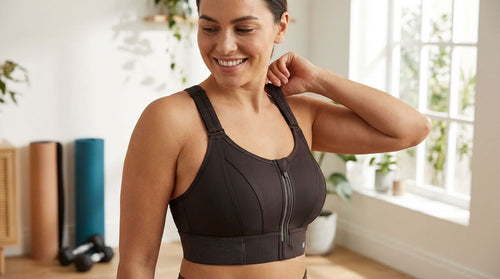
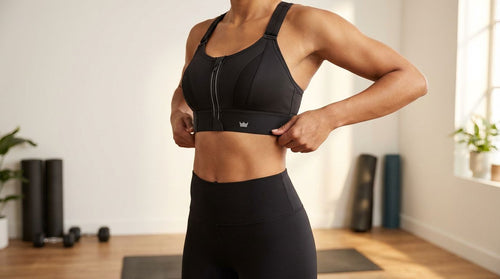
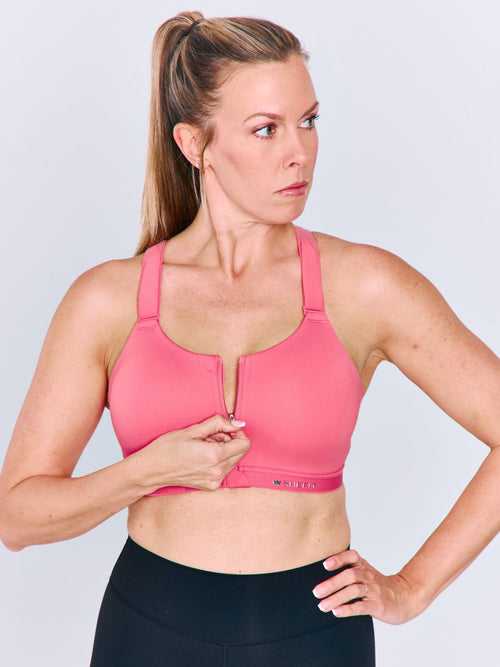
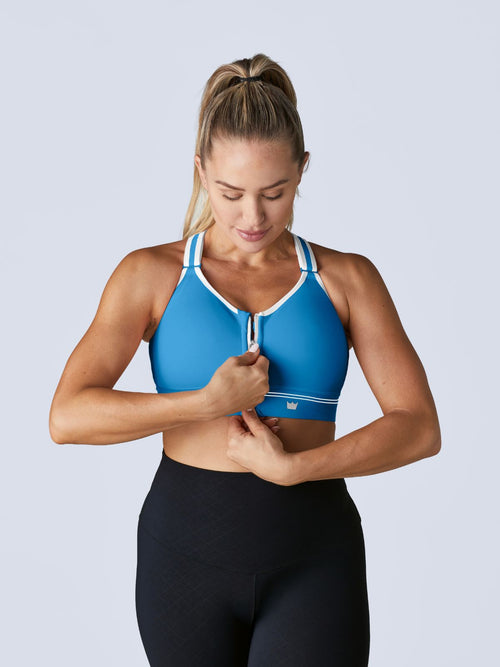
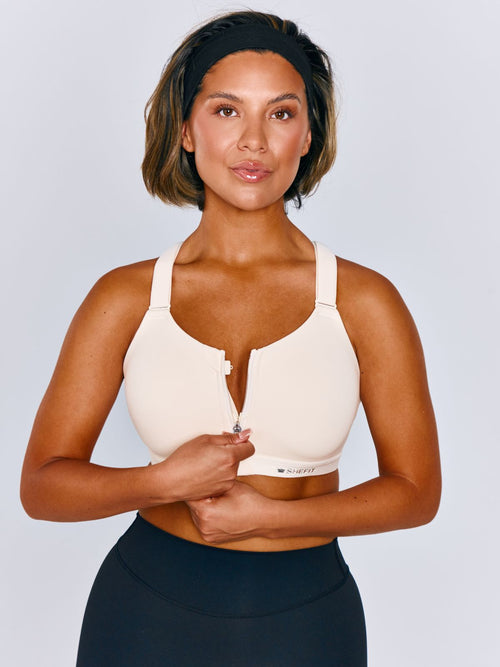
Our patented Zip. Cinch. Lift.® system is how we build that in. Both the Ultimate Sports Bra and Flex Sports Bra carry it, and it has three parts:
- Zip: a front zipper that gets the bra on and off easily. It opens and closes; the adjusting happens at the band and straps.
- Cinch: a cinchable rib band that sets your compression and support.
- Lift: non-stretch adjustable shoulder straps that set your lift.
When the elastic in a fixed bra relaxes, its support goes with it. When our rib band starts to feel looser, you cinch it a little further. Because the straps are non-stretch, they hold the lift you set instead of giving way mid-run.
In our testing, our bras are wash-tested to 25 cycles before showing obvious wear, and with proper care they last 12-24+ months. Care makes a real difference to that number. We recommend laying your bra flat to air dry; it can handle a low-heat dryer cycle, but air drying keeps it in shape longest. Our guide to washing sports bras without losing support covers the rest of the routine.
Where SHEFIT Fits: Which Sports Bra for Which Workout
Run our three core bras through the same five checks and the choice comes down to how much movement you are asking each one to control. All three are $69.
| Sports bra | Support level | Best for | Price |
|---|---|---|---|
| Ultimate Sports Bra | High impact | Running, HIIT, CrossFit, horseback riding, maximum bounce control | $69 |
| Flex Sports Bra | Medium impact for C+ cups, high impact for A-B cups | Yoga, cycling, strength training, pickleball, varied-intensity workouts | $69 |
| Emerge Sports Bra | Medium impact for C+ cups, high impact for A-B cups | Yoga, walking, everyday and all-day wear | $69 |
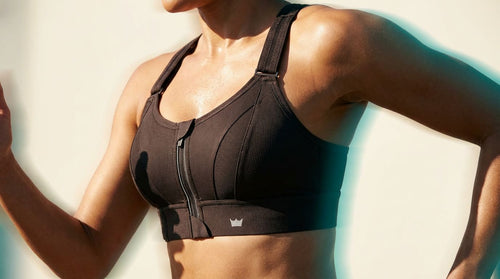
The Ultimate Sports Bra is the one we built for maximum bounce control. It pairs encapsulation and compression with patented adjustable shoulder straps and rib band, plus removable modesty pads, and it is the bra from the University of Memphis study above. If your week includes running, jump-heavy classes, or time in the saddle, start here.
The Flex Sports Bra sits just below the Ultimate, and we describe it two-sidedly on purpose: it is more supportive than other brands' high-support bras, but not as strong as her sister bra, the Ultimate Sports Bra. Smooth cups give it a sculpted look, and the same adjustability lets it move between a strength session and a pickleball match.
The Emerge Sports Bra is our pick for low-movement days and all-day wear. It has wire-free, seam-free smooth cups with a light integrated pad, so it works under everyday clothes as easily as it does in a yoga class.
The Ultimate and Flex Sports Bras run XS-6Luxe in AA-I cups, and the Emerge Sports Bra runs XS-6Luxe and fits A-I cups.
Sports Bra Brand Questions, Answered
What are the top sports bra brands?
Tester picks differ because each test uses different bodies, activities, and methods: Runner's World tested for high-impact running, while the Telegraph used a panel of netball players. The right brand for you depends on your band size, cup size, and workout. Judge any brand on five things: support construction, adjustability, size range, evidence for bounce control, and durability through washing.
What is the most comfortable sports bra for everyday wear?
For all-day wear, we recommend our Emerge Sports Bra. Its wire-free, seam-free smooth cups and light integrated pad skip the pressure points that make a workout bra hard to wear all day. And if you like living in one from morning to night, Prof. Wakefield-Scurr says in the Telegraph's guide that there is no evidence all-day wear has any negative effects.
How do I know a brand's "high support" bra will hold me?
Check how much the fabric and underband stretch, and confirm that both the band and the shoulder straps adjust. Then test it with the tags on: do a few minutes of your own activity in front of a mirror. SMA's test sets the bar at zero discomfort and movement no greater than 3 to 4 out of 10. Read the return policy before you buy, so a bra that fails can go back.
How often do I need to replace a sports bra?
Often sooner than you would expect. As the washing research above shows, support fades with use, so replace a bra once the band has stretched, it rides up, or it no longer controls bounce. With proper care, our bras last 12-24+ months, and the adjustable rib band and straps let you take up slack along the way.
Choosing the Brand That Holds Up for You
The best sports bra brand for you is the one whose bras pass all five checks on your body: a support design that matches your activity, adjustment at the band and shoulders, a size range built in real band and cup sizes, evidence for bounce control beyond a label, and support that survives the wash. Hold every brand, ours included, to that standard.
When you are ready to find your fit, book a free virtual fitting with our team. We can help you measure, choose your size, and set up your bra so it holds you from the very first workout.
References
[1] Rizzone KH, Edison B, Coleman N, Carter C, Ichesco I, Cassidy P, Chung J, Jones CMC. "Sports Bra Preferences by Age and Impact of Breast Size on Physical Activity among American Females." International Journal of Environmental Research and Public Health, 2021. https://hsrc.himmelfarb.gwu.edu/cgi/viewcontent.cgi?article=7380&context=smhs_peds_facpubs
[2] Bowen C. "We Tested 45+ Sports Bras to Find the 12 Best for High-Impact Running Support." Runner's World, 2026. https://www.runnersworld.com/gear/a21731269/best-sports-bras/
[3] Sports Medicine Australia. "Exercise and Breast Support." Sports Medicine Australia, 2025. https://sma.org.au/resources/injury-fact-sheets/exercise-and-breast-support/
[4] Jessica O'Donnell. "The best sports bras of 2026, tested by international netball players." The Telegraph, 2026. https://www.telegraph.co.uk/recommended/leisure/fitness/best-sports-bras/
[5] Fong HB, Nelson AK, McGhee D, Ford K, Powell DW. "Increasing breast support is associated with a distal-to-proximal redistribution of joint negative work during a double-limb landing task." Journal of Applied Biomechanics, 2022. https://www.memphis.edu/healthsciences/pdfs/jab-biomech-2023.pdf
[6] McGhee DE, Steele JR. "Optimising breast support in female patients through correct bra fit. A cross-sectional study." Journal of Science and Medicine in Sport, 2010. https://pubmed.ncbi.nlm.nih.gov/20451452/
[7] Wakefield-Scurr J, Hamilton C, Reeves K, Jones M, Jones B. "The effect of washing and wearing on sports bra function." Sports Biomechanics, 2022. https://www.tandfonline.com/doi/full/10.1080/14763141.2022.2046147