Which Bra Is Right for You? Learn More


Every sports bra promises support. Pull one off the rack, check the tag for your size, and hope for the best. For a lot of women, that is the entire shopping strategy. The result is predictable: bounce during burpees, band riding up during deadlifts, and straps that lose tension after a handful of washes. The problem usually comes down to a mismatch between how the bra controls movement and what your body actually needs during exercise.
An estimated 85% of women are wearing the wrong bra size [1]. That statistic alone explains why so many women assume sports bras just do not work for them. At SHEFIT, we hear from women every day who had given up on finding real support until they understood one thing: not all sports bras manage breast movement the same way. These design categories each take a fundamentally different approach, and the right choice depends on your breast size, your activity, and how the bra is constructed.
This guide breaks down how compression sports bras actually work, what the research says about their benefits, and how to find one that fits your body and your training.
What Is a Compression Sports Bra?
A compression sports bra works by pressing both breasts against the chest wall as a single unit. Rather than separating and individually supporting each breast, the bra uses firm, stretchy fabric to hold everything close to the body, reducing the distance breast tissue can travel during movement.
This is the most common sports bra design on the market. Most pullover-style bras without individual cups fall into this category. They are practical and effective for many women, particularly those with smaller bust sizes doing low-to-medium impact activities.
The confusion starts when you compare compression to the other two design approaches:
|
Design Type |
How It Works |
Best For |
Typical Features |
|---|---|---|---|
|
Compression |
Presses both breasts against chest wall as one unit |
A-C cups; low-to-medium impact (yoga and walking) |
Pullover style, no individual cups, S/M/L sizing |
|
Encapsulation |
Surrounds each breast in its own cup for individual support |
D+ cups; activities requiring natural shape retention |
Structured cups, often underwire, band/cup sizing |
|
Hybrid (compression + encapsulation) |
Combines chest wall compression with individual cup support |
All sizes; medium-to-high impact (running and HIIT) |
Adjustable straps, adjustable band, individual cups with overall compression |
The hybrid category is where things get interesting. Research published in Medicine & Science in Sports & Exercise found that bras incorporating both breast elevation and compression provided significantly greater comfort compared to standard encapsulation sports bras during physical activity for women with large breasts [2]. That finding suggests the either/or framing of compression vs. encapsulation misses the point: combining both delivers the strongest results.
How Compression Sports Bras Reduce Breast Movement
Understanding why compression works starts with basic anatomy. Breasts contain Cooper's ligaments, connective tissue that provides structural support and shape. During exercise, unsupported breast tissue moves in three dimensions: up and down, forward and back, and side to side. Repeated stretching of these ligaments during high-impact movement can lead to discomfort and long-term tissue changes.
A compression sports bra counteracts this by reducing the space available for breast tissue to move. The fabric presses the breasts against the ribcage, limiting vertical displacement (the primary source of bounce) and reducing the overall range of motion across all three planes.
The downstream effects extend beyond the chest. Research from the University of Memphis demonstrated that greater breast support is associated with reduced peak knee valgus angles and greater trunk flexion during landing movements, biomechanical profiles linked to lower ACL injury risk [3]. Separate research found that greater breast support is associated with reduced oxygen consumption and improved running economy during treadmill running. In practical terms, your body works less hard when your bra does its job.
Research also confirms that without sufficient breast support, women experience increased embarrassment, decreased willingness to exercise, and increased breast discomfort or pain [4]. The barrier to exercise is not always motivation. Sometimes it is a bra that fails under load.
Benefits of Wearing a Compression Sports Bra
Bounce reduction and ligament protection. The primary benefit is controlling breast movement during activity. By restricting the range of motion, compression bras reduce the repetitive stress on breast connective tissue that leads to discomfort during exercise and structural changes over time.
Reduced upper body strain. Unsupported breast weight pulls the upper body forward, forcing compensatory adjustments through the spine and shoulders. Compression distributes that load across the ribcage, reducing the concentrated strain that builds during long workouts. This is especially relevant for running, where the repetitive impact compounds with every stride.
Chafing happens when a bra shifts against your skin during repetitive movement. A compression bra that stays in place eliminates the friction at the underband and strap lines where most irritation occurs. What matters most is a fit tight enough to prevent the bra from moving independently of your body, not seamless construction.
Performance focus. When your bra works, you stop thinking about it. That mental freedom matters during training. If you have ever paused mid-set to readjust or cut a run short because of discomfort, you know the cost of inadequate support. Compression bras remove that distraction.
Exercise accessibility. For women who avoid certain activities because of breast discomfort, a properly fitted compression bra can open up options that previously felt off-limits. If understanding how impact levels work is new to you, matching your bra to your activity changes the equation.
Compression vs Encapsulation vs Hybrid: Which Design Is Right for You?
The conventional advice is straightforward: compression for small busts, encapsulation for large busts. That framing is incomplete.
Your ideal design depends on the intersection of two factors: your breast size and your activity level. A woman with a C cup doing yoga has different structural needs than a woman with a C cup running intervals. Breast size sets the baseline; activity level determines the ceiling.
|
Factor |
Compression |
Encapsulation |
Hybrid |
|---|---|---|---|
|
How it controls movement |
Flattens against ribcage |
Supports each breast individually |
Compresses against torso + individual cup support |
|
Best bust size range |
A-C cups |
D+ cups |
All sizes (A through I+) |
|
Low-impact activities |
Strong option |
Works well |
More support than needed, but comfortable |
|
High-impact activities |
Adequate for smaller busts only |
Good for larger busts |
Best option across all sizes |
|
Typical fit system |
S/M/L pullover |
Band + cup sizing |
Adjustable band + adjustable straps |
|
Shape during wear |
Flattened, compressed silhouette |
Natural, separated shape |
Supported with individual shape retention |
|
Adjustability |
Minimal (fixed elastic) |
Moderate (hook closures) |
Maximum (continuous adjustment) |
For women with larger cup sizes, compression alone often falls short during high-impact activities. Compression still works at larger sizes, but without individual breast control, bounce escapes in directions that flat compression alone cannot manage. Encapsulation addresses that gap, but it sacrifices the chest-wall anchoring that compression provides. Hybrid designs solve both problems simultaneously.
How to Choose the Right Compression Sports Bra
The band is where your search should start. It provides roughly 80% of total support, which means a loose band undermines everything else the bra tries to do. Straps handle the remaining lift and positioning.
Here is what to evaluate:
-
Band fit provides roughly 80% of support and controls ride-up. Look for a band that sits snug and level across your back, where two fingers fit under it comfortably.
-
Strap construction determines whether lift holds throughout your workout. Non-stretch straps hold tension longer than elastic straps.
-
Cup structure controls how movement is managed. Individual cup space for each breast (hybrid or encapsulation) handles bounce differently than uniform compression.
-
Adjustability lets you personalize tension. Continuously adjustable bands and straps outperform fixed S/M/L sizing because you can dial in the fit for your body.
-
Fabric affects both comfort and longevity. Breathable, moisture-wicking materials reduce friction and hold up better over time.
-
Size range matters more than most women realize. Check the manufacturer's chart rather than defaulting to your everyday bra size.
Fit Checklist
Before committing, check these five points:
-
Band sits level across your back without riding up
-
Each breast sits in its own space with no spillage over the top or sides
-
Straps provide lift without digging into your shoulders
-
Coverage does not extend too far under your armpits
-
Two fingers fit under the band comfortably
One thing that surprises many women: a bra with proper lift raises breast tissue higher on your chest, which can reveal skin near the armpit that was previously hidden. This is normal anatomy, not spillage or excess tissue. If you see armpit skin, that is your bra doing its job, lifting you up. Spillage is different: it means tissue pushing over the top or sides of the cup.
Once the bra passes the standing checklist, do 30 seconds of jumping jacks and high knees. If anything shifts, tighten. If anything digs, loosen. For a detailed walkthrough of the measurement process, finding your perfect SHEFIT size covers every step.
Common Myths About Compression Sports Bras
"Compression bras are only for women with small breasts." This is the most persistent misconception. Compression as a principle works for all sizes. The limitation shows up when compression works alone, without individual breast support. Hybrid designs that combine compression with encapsulation provide effective support across the full size spectrum, from AA through I cups and beyond.
"Tighter is always better." More compression does not automatically mean more support. A bra that is too tight restricts breathing, digs into the ribcage, and can actually impair performance. Research has linked excessive underband tightness to restricted breathing mechanics during activity. The goal is firm, consistent contact with your ribcage, not maximum constriction.
"One bra works for every activity." Your breast support needs change with activity intensity. A bra that handles yoga comfortably may not control bounce during sprints. Your breast size compounds this: larger sizes need higher support for virtually every activity level. Matching your bra to both your body and your workout prevents the compromises that lead to discomfort.
"Compression bras cause sagging." This myth persists without evidence. Compression bras do not weaken breast connective tissue. Reducing excessive movement during exercise actually protects the supportive structures from the repetitive stretching that contributes to tissue changes over time.
"You should double up for more support." Layering two bras creates uneven pressure, restricts breathing, and usually results in worse support than a single well-fitted bra. Inadequate support calls for a better bra with the right design, fit, and adjustability, not a second layer.
SHEFIT Sports Bras: Compression and Encapsulation Combined
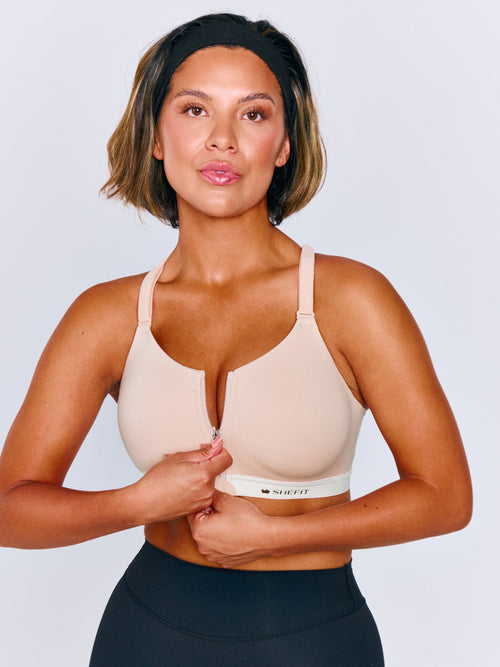
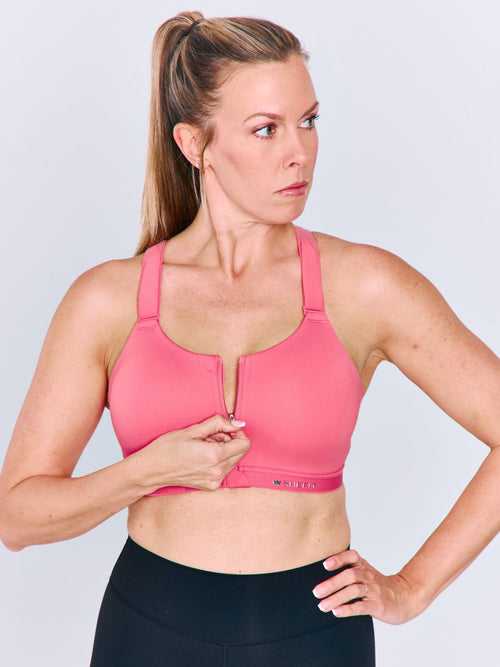
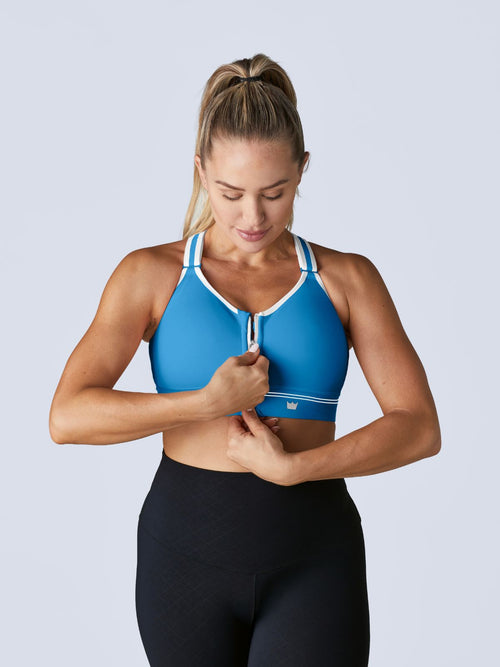
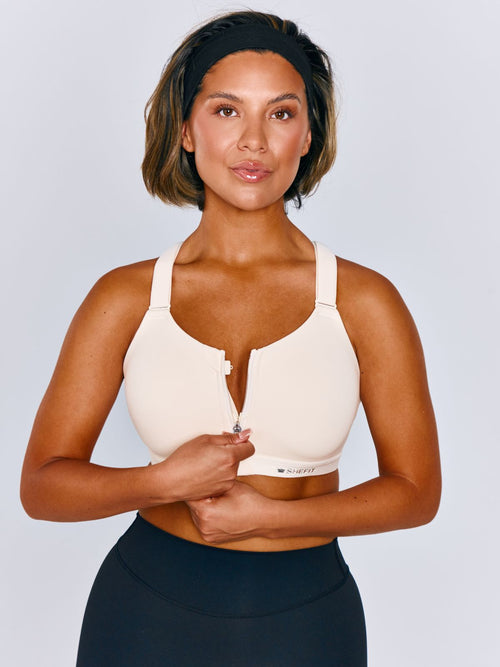
We built our sports bras around the hybrid principle: combine compression and encapsulation in one design so you get the chest-wall anchoring that prevents bounce and the individual cup support that controls movement in every direction.
Ultimate Sports Bra
The Ultimate Sports Bra ($69) delivers our maximum support for high-impact training.
Key features:
-
Patented adjustable shoulder straps and rib band for custom fit
-
Encapsulation and compression design for complete motion control
-
Non-stretch straps that maintain lift wash after wash
-
Removable modesty pads for customizable coverage
-
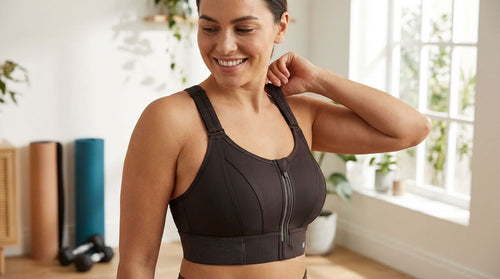
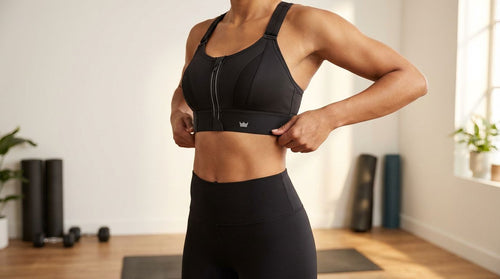
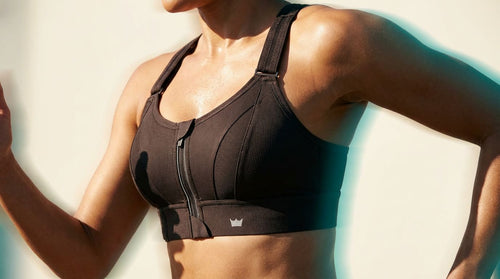
Front zipper for easy on and off
-
Sizes XS-6XL, AA-I cups
University of Memphis research confirmed that increasing breast support significantly reduces vertical breast displacement and alters lower-body biomechanics in ways linked to reduced injury risk. For high-impact activities like running and HIIT, plus horseback riding, that level of control translates directly to less back strain and a more comfortable training experience.
Flex Sports Bra
The Flex Sports Bra ($65) offers patented adjustable features with smooth cups for a sculpted look. It provides high-impact support for smaller bust sizes (32C and under) and medium-impact for larger sizes. Our medium-impact rating delivers support that rivals what other brands call high-impact.
Best for: cycling and strength training, pickleball, or varied-intensity sessions.
How They Compare
Both use the same hybrid design, but they are built for different training styles and support needs.
|
Feature |
SHEFIT Ultimate |
SHEFIT Flex |
|---|---|---|
|
Support level |
Maximum (all sizes) |
High (32C and under) / Medium (larger sizes) |
|
Adjustable band |
Yes (patented) |
Yes (patented) |
|
Adjustable straps |
Yes (patented, non-stretch) |
Yes (patented) |
|
Design type |
Encapsulation + compression |
Encapsulation + compression |
|
Cup style |
Removable modesty pads |
Smooth cups, sculpted look |
|
Size range |
XS-6XL, AA-I cups |
XS-6XL, AA-I cups |
|
Best activities |
Running and HIIT, plus horseback riding |
Cycling and strength, plus pickleball |
|
Durability testing |
25 wash cycles |
25 wash cycles |
|
Price |
$69 |
$65 |
Both bras are designed for all breast types, from small to large, enhanced or natural. They are wash-tested to 25 cycles before showing obvious wear, compared to an industry standard of roughly 5 washes. With 75,000+ 5-star reviews across our product line, the adjustability works across every body type and activity level.
How to Care for Your Compression Sports Bra
A compression sports bra will last longer with a few basic habits that protect the elastic and structural components.
-
Wash in cold water on a gentle cycle, ideally inside a mesh lingerie bag. Skip the fabric softener; it breaks down elastic fibers.
-
Dry by laying flat or hanging. Never machine dry. High heat degrades the materials that provide compression.
-
Store flat or folded gently. Avoid stuffing cups, which can warp their shape.
-
Rotate between two or more bras if you train daily. This gives elastic time to recover between wears.
Adjustability extends a bra's useful life even further. As elastic naturally relaxes over time, you tighten the band and straps rather than replacing the bra. That is one of the practical advantages of a continuously adjustable design over fixed S/M/L sizing.
FAQs About Compression Sports Bras
What does a compression sports bra do?
A compression sports bra holds both breasts against the chest wall to reduce movement during physical activity. By limiting how far breast tissue can travel during exercise, it reduces bounce, prevents discomfort, and protects the connective tissue (Cooper's ligaments) that maintains breast structure.
Are compression bras good for you?
Yes, when properly fitted. Compression bras reduce breast movement during exercise, which protects against ligament strain and reduces back and shoulder discomfort. The key is getting the right fit: firm enough to control movement, not so tight that it restricts breathing.
What is the difference between a compression bra and a regular sports bra?
"Compression" describes how the bra controls movement: pressing breasts flat against your torso. "Regular sports bra" is a general term that could mean compression, encapsulation, or hybrid. The distinction that matters is whether the bra compresses, encapsulates each breast individually, or does both.
Can you wear a compression sports bra all day?
A well-fitted compression bra is comfortable for extended wear. Avoid bras that are excessively tight, as prolonged over-compression can restrict breathing and ribcage mobility. An adjustable bra lets you loosen the fit for all-day comfort and tighten it for training.
Do compression sports bras flatten your chest?
Compression bras reduce the profile of your bust during wear. They do not permanently change breast shape or size. Hybrid designs that combine compression with individual cups maintain more natural shaping while still controlling movement.
How often should you replace a compression sports bra?
Most sports bras last 6 to 12 months with regular use. Signs it is time to replace: the band rides up, straps lose tension, or you notice increased bounce during activities that the bra used to handle. Bras with adjustable features last longer because you can compensate for natural elastic relaxation by tightening.
Can a tight sports bra cause acid reflux?
An excessively tight band can increase intra-abdominal pressure, which may aggravate acid reflux symptoms in women who are already prone to the condition. The solution is proper fit, not avoiding compression. A well-fitted compression bra should feel snug without creating pressure on the abdomen.
The right compression sports bra changes how your body moves under load, how long you can train without distraction, and whether exercise feels like something you look forward to or something you endure. When support works with your body instead of against it, you stop negotiating with discomfort and start focusing on what you came to do.
References
[1] McGhee, D.E. & Steele, J.R. "Optimising breast support in female patients through correct bra fit." Journal of Science and Medicine in Sport, 2010. https://pubmed.ncbi.nlm.nih.gov/20451452/
[2] McGhee, D.E. & Steele, J.R. "Breast elevation and compression decrease exercise-induced breast discomfort." Medicine & Science in Sports & Exercise, 2010. https://pubmed.ncbi.nlm.nih.gov/20019639/
[3] Fong, H.B., Nelson, A.K., Storey, J.E., et al. "Greater Breast Support Alters Trunk and Knee Joint Biomechanics Commonly Associated With Anterior Cruciate Ligament Injury." Frontiers in Sports and Active Living, 2022. https://doi.org/10.3389/fspor.2022.861553
[4] Risius, D., Milligan, A., Berns, J., Brown, N., & Scurr, J. "Understanding key performance indicators for breast support." Journal of Sports Sciences, 2017. https://pubmed.ncbi.nlm.nih.gov/27291899/