Which Bra Is Right for You? Learn More


Researchers at the University of Portsmouth put 98 sports bras through a biomechanics lab to measure how much each one actually reduced breast movement, spanning bras marketed at every support level. Across the full sample, movement reduction ranged from 36% to 74%, averaging 58%. But narrow that down to just the bras marketed specifically as "high support," and the picture gets more interesting: when the team set an objective bar for what counts as genuine high support, roughly three in ten of those labeled bras did not clear it [1].
That gap is the whole problem with shopping for a high support sports bra. "High support" is a phrase a brand prints on a hangtag. It is not a certified rating, it is not audited by anyone, and as the Portsmouth data shows, it is not always true. Two bras can carry the identical label and deliver measurably different results on your body.
At SHEFIT, we build adjustable, high-impact bras for exactly this reason: the only support that matters is the support you can verify on yourself, in the size you actually wear, doing the activity you actually do. So the useful question is not whether a bra is labeled high support. It is whether the construction, the fit, and the condition of that bra add up to real support for your body and your workout.
This guide covers what the research defines as high support, who genuinely needs it, which construction types deliver it, how to check the fit yourself, and how to tell when a bra has quietly stopped performing.
What "High Support" Actually Means (and Why the Label Alone Isn't Proof)
The Portsmouth study gave the category something it had never had: a number. By measuring breast-movement reduction across all 98 bras, the researchers sorted performance into three tiers. Bras reducing movement by less than 54% fell into the low tier. Between 54% and 63% was medium. Anything above 63% qualified as genuinely high support [1].
Set against that scale, the marketing label starts to look unreliable. Of the bras in the sample that brands specifically marketed as high support, only about 69% actually landed in the high tier. The rest were medium or low performers wearing a high-support description. And the spread within the sample was wide enough that the best bra tested reduced movement roughly twice as much as the worst one, even though a shopper reading hangtags would have seen no difference between them.
None of this means labels are worthless. It means they describe intent rather than outcome. A brand designing toward high support will build differently from one designing a low-impact everyday style, and that intent shows up in the cups and the band. But intent is where the claim stops. The research community has been direct about the gap: reviewing the state of breast biomechanics, McGhee and Steele argued that more systematic research and better translation of findings into design are still needed to build better sports bras and to address exercise-induced breast pain [2]. The science is ahead of the shelf, and the shopper is left to close the distance.
That is what the rest of this guide is for. If the label cannot be trusted on its own, you need to be able to read the construction and test the fit yourself.
Who Actually Needs a High-Support Sports Bra
Support level is a match between your activity and your body, not a universal upgrade. High-impact activity is the clearest trigger. During running, breasts do not simply bounce up and down: they trace a figure-eight pattern, which means a bra has to control motion in every direction at once rather than just resisting vertical drop [3].
Activities that typically call for a high-support bra include:
Running, from easy miles to sprint intervals
HIIT and circuit training with jumping intervals
Jump rope and plyometrics
Court and field sports with sudden direction changes
Horseback riding
The part most buying guides skip is that impact ratings are calibrated relative to bust size. Fleet Feet makes this point plainly: support ratings are generally set against larger cup sizes, so an A or B cup may find a bra labeled low-impact perfectly adequate for a high-impact workout [3]. Two women can run the same 5K and need different support tiers, and neither of them is doing it wrong.
This is why we talk about impact levels as a spectrum rather than a hierarchy, and why our impact level breakdown walks through which activities sit where. Start with your activity, adjust for your cup size, and let those two answers pick the tier. Buying more support than your combination calls for is not safer, it is just less comfortable.
Compression, Encapsulation, or Both: What Construction Actually Delivers Support
Underneath every support claim sits one of three construction approaches, and they work on entirely different mechanics.
Construction |
How it controls movement |
Best suited for |
|---|---|---|
Compression |
Presses the breasts toward the chest wall as a single unit; usually a pull-on style with no closures |
Medium-impact activity, smaller cup sizes |
Encapsulation |
Surrounds each breast in its own cup, containing motion directionally rather than flattening it |
Multi-directional movement, larger cup sizes |
Compression plus encapsulation |
Combines both mechanisms, so each breast is individually contained and the whole structure is held close to the body |
High-impact activity, and the combination generally recommended when support demands are highest |
Fleet Feet's classification is the practical version of this: compression-only designs land in medium-impact territory, while compression combined with encapsulation is what works for high-impact activity. The Portsmouth data supports the same conclusion from the measurement side, where bra style, specifically a move away from compression-only construction toward encapsulation or a combination of both, was the single characteristic most strongly associated with greater breast-movement reduction across the tested sample.
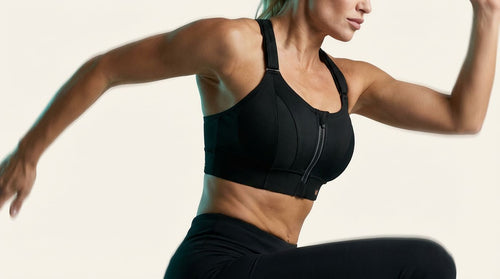
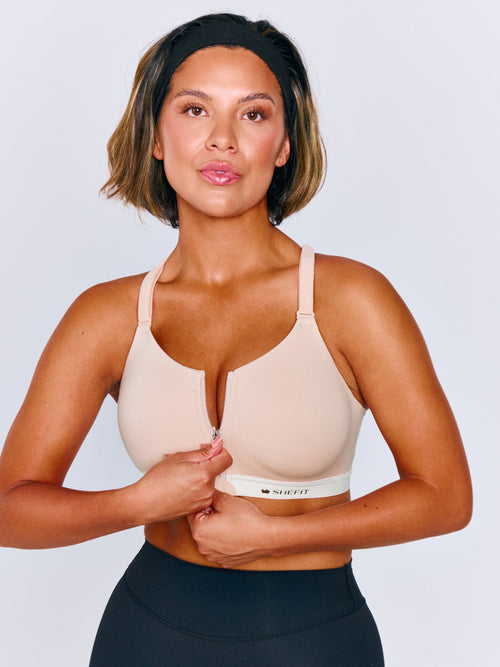
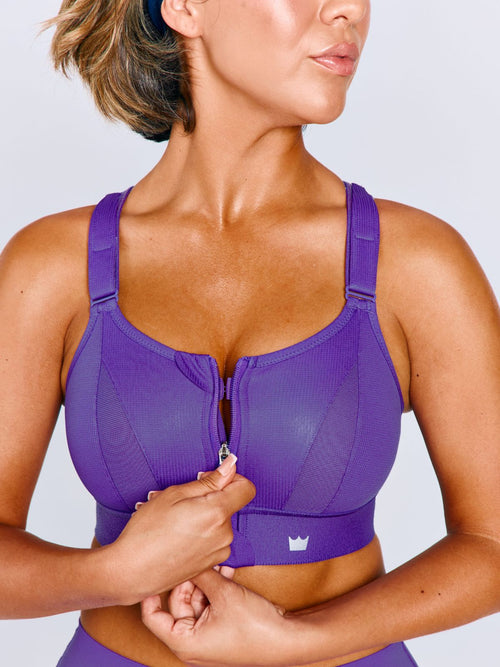
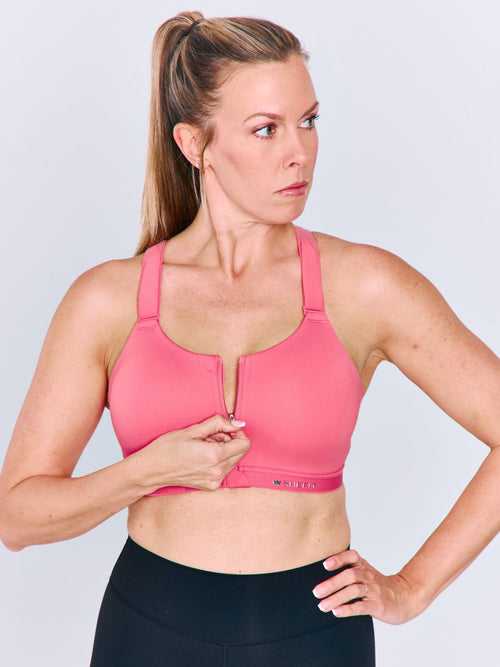
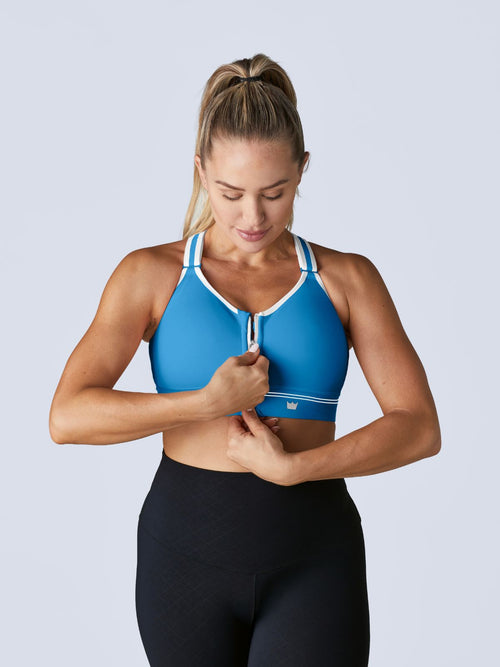
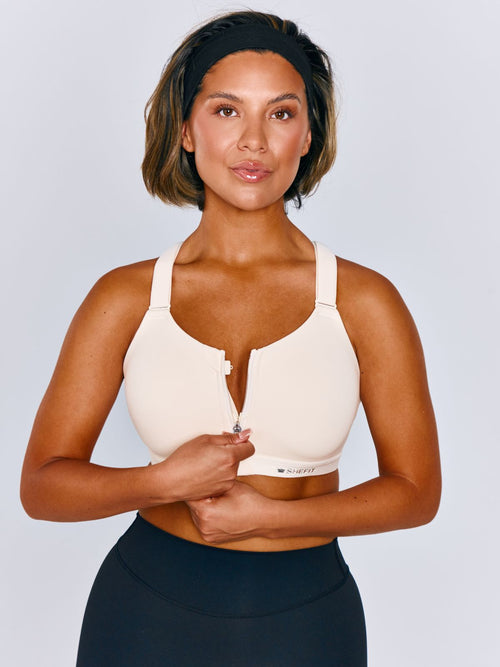
Our Ultimate Sports Bra® ($69) is built on that combination principle, with the added variable that the compression is yours to set. The patented Zip. Cinch. Lift.® system lets you zip the front closed, cinch the rib band to the tension you want, and adjust the shoulder straps independently, so encapsulating cups sit inside a compression level you control rather than one the factory picked for an average body. That distinction matters more than it sounds: a fixed-compression bra is calibrated to a hypothetical wearer, and you are not one.
How to Check That the Underband, the Straps, and the Cups Are Working
Construction gets you a candidate. Fit is what makes it work, and fit is testable in about ninety seconds in front of a mirror.
The underband carries most of the load, so start there. Prof. Joanna Wakefield-Scurr of the University of Portsmouth's Breast Health Research Group describes two checks: the band should not shift when you raise your arms or twist your upper body, and you should not be able to pull it more than about five centimeters away from your ribcage [4]. If the band rides up your back or lifts when you reach overhead, the support structure is failing before you have taken a single stride.
Then work upward:
Straps should adjust independently and hold their setting through a full workout, without digging into your shoulders or sliding toward your arms
Cups should contain each breast fully, with no compression of tissue over the top edge or out the sides
The front neckline should stay put when you jump, rather than shifting down with each landing
The whole bra should feel secure at rest and stay secure through movement, which are two separate tests
One check deserves its own explanation, because it causes more unnecessary worry than any other. When a bra lifts you properly, skin near the armpit that used to sit lower becomes visible. That is normal anatomy rearranged by real lift, and it is not spillage. Actual spillage is breast tissue escaping over or beside the cup, creating a bulge where the fabric edge cuts in. Visible armpit skin means the bra is doing its job. Tissue pushed out of the cup means the size is wrong. Learning to tell them apart saves a lot of women from returning a perfectly good bra.
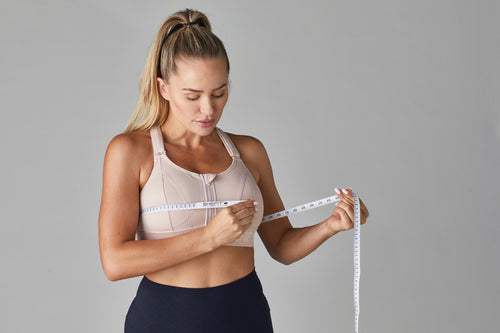
If any of these checks come back unclear, sizing is usually the culprit rather than the design. Bra sizing is not regulated between brands, so the size you wear elsewhere predicts very little about the size you need here. Our Fit Central tools cover all three routes, a quick Fit Advisor questionnaire, a free virtual fitting with a professional fitter, or self-measurement against our inches-based chart, and every SHEFIT bra runs XS through 6Luxe. For readers whose main complaint is a band that will not stay put, our fit guide walks through the checks in more detail.
Sports Bra Longevity: When a "High Support" Bra Stops Being High Support
A bra that passed every check above will not pass them forever. Elastic fatigues. The band that once refused to move away from your ribs gradually gives, the straps stop holding their setting, and the cups lose the shape that made encapsulation work. None of this is dramatic enough to notice on any single day, which is precisely why it goes unnoticed for months.
The rate of that decline is measurable. Wakefield-Scurr's research found that a sports bra's support can drop by roughly one-third after around 25 washes [4]. A bra you wear and wash twice a week reaches that point faster than most people expect, and it does so without looking worn out. The fabric can still be intact and the color still good while the support has quietly moved down a tier.
Rather than counting months, watch for the signals: a band you can now pull further from your body than you could when the bra was new, straps that loosen mid-workout, or a sudden need for a tighter setting to feel the way it used to feel on a looser one. On an adjustable bra, that last signal is the clearest one you get, because you can feel yourself compensating. When adjustment no longer restores the original feel, the elastic has done what elastic does, and the bra has stopped being a high-support bra regardless of what its tag still says.
What to Look for When Shopping for a High Support Sports Bra
Pull the previous sections together and the shopping criteria come into focus. The point is not to find a bra that says high support. It is to find one whose construction lines up with what the research associates with the high-support tier, in a size that lets that construction work.
What to check |
What good looks like |
Why it matters |
|---|---|---|
Construction type |
Compression combined with encapsulation |
The combination recommended for high-impact activity |
Underband |
Firm, non-stretch, ideally adjustable; moves less than about 5cm from the body |
Carries the majority of the support load |
Straps |
Independently adjustable and stable through movement |
Lets you tune fit rather than accept an average |
Cup coverage |
Full containment with no tissue escaping the cup edge |
Encapsulation only works when the cup actually encapsulates |
Neckline |
Higher front coverage |
Associated with greater movement reduction in the Portsmouth testing |
Fabric |
Moisture-wicking, with nylon-content options worth a look |
Comfort over long sessions, and nylon showed a measurable association with support in the same testing |
Sizing route |
Brand offers measurement-based sizing rather than S/M/L guesswork |
Over 80% of women are wearing the wrong bra size [5] |
That last row is worth sitting with. Women's Running UK reports that more than 80% of women wear the wrong bra size [5], which means the most common reason a high-support bra underperforms has nothing to do with how it was built. A genuinely high-support bra in the wrong size will test as a medium-support bra on your body.
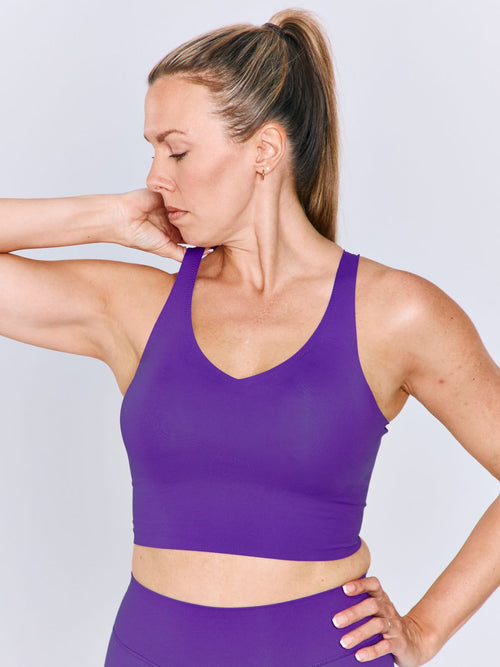
Two of our bras sit on either side of the high-support line, which makes the choice fairly clean. The Ultimate Sports Bra® ($69) is our high-impact option, with the full Zip. Cinch. Lift.® adjustability for running, for HIIT, and for anything with sustained bounce. The Flex™ Sports Bra ($65) is medium-impact and adjustable, which suits lifting and cycling and cross-training, or high-impact work for smaller cup sizes where the relative-support principle applies. Both run XS through 6Luxe, and both are worth sizing properly before you judge either one.
Frequently Asked Questions
What's the difference between high-impact and high support?
High-impact describes the activity a bra is designed for. High support describes how much breast movement it actually reduces. Most brands use the terms interchangeably, but the Portsmouth research showed the connection is not automatic: bras marketed for high-impact use did not all reach the high-support tier when measured in a lab.
Can a smaller cup size need high support too?
Sometimes, though less often than you might expect. Support ratings are generally calibrated to larger cup sizes, so an A or B cup may get sufficient control from a lower-rated bra even during high-impact activity. Comfort is the deciding factor: if a medium-impact bra keeps you steady and pain-free through your workout, there is no benefit to buying up a tier.
Is high support the same as high compression?
No. Compression is one mechanism for achieving support, and by itself it generally lands in medium-impact territory. High support at the top of the range usually comes from compression combined with encapsulation, where each breast is individually contained rather than flattened as a unit. A very tight compression-only bra is not a substitute for that structure.
How do I know if my sports bra has lost its support?
Test the band. If you can pull it further from your body than you could when it was new, or if it rides up during a workout, the elastic has fatigued. On an adjustable bra, the tell is needing a tighter setting to get the feel you used to get on a looser one. Research puts the drop at roughly one-third of original support after around 25 washes.
How often should I replace a high-support sports bra?
Go by wash count and behavior rather than the calendar, since a bra worn daily fatigues far faster than one in rotation. The 25-wash finding above gives a rough benchmark, but the honest answer is to replace it when it stops passing the band test, no matter how new it looks.
The Bottom Line
The phrase on the tag is a claim, not a measurement. What actually determines whether a bra delivers high support is the construction underneath it, the fit against your specific body, and how much life the elastic has left. Those three things are all checkable, and once you know how to check them, the label becomes almost beside the point.
That is the thinking behind Zip. Cinch. Lift.®: instead of asking you to trust a support rating set for an average body, we built adjustability into the band, the straps, and the closure so you can set the support yourself and reset it as the bra ages. If you want to see how the tiers compare across the range, our full sports bra collection lays out every impact level in one place.
References
[1] Norris, M., Hurley, E., Brooke-Wavell, K., Scurr, J. "How the characteristics of sports bras affect their performance." Ergonomics (University of Portsmouth repository, author accepted manuscript), 2020. https://pure.port.ac.uk/ws/portalfiles/portal/23048531/Norris_et_al_2020_AAM.pdf
[2] McGhee, D.E., Steele, J.R. "Biomechanics of Breast Support for Active Women." Exercise and Sport Sciences Reviews (ACSM journal), July 2020. https://journals.lww.com/acsm-essr/fulltext/2020/07000/biomechanics_of_breast_support_for_active_women.1.aspx
[3] Fleet Feet. "What is a High-Impact Sports Bra?" Fleet Feet, 2026. https://www.fleetfeet.com/blog/what-is-a-high-impact-sports-bra
[4] Telegraph Recommended (with expert input from Prof. Joanna Wakefield-Scurr, University of Portsmouth Breast Health Research Group). "The best sports bras of 2026, tested by international netball players." The Telegraph, 2026. https://www.telegraph.co.uk/recommended/leisure/fitness/best-sports-bras/
[5] Women's Running UK. "The best running bras 2026." Women's Running UK, 2026. https://www.womensrunning.co.uk/gear/sports-bras/