Which Bra Is Right for You? Learn More


The push-up sports bra category makes a promise most designs cannot keep. It tells you that you can have a lifted, flattering silhouette and real workout support in the same bra. Walk into any store or scroll any product page, and the messaging is the same: lift plus support, style plus performance. But pick up the average push-up design and read the fine print, and you will find a qualifier that changes everything: "best for low to medium impact."
That qualifier is the design reality the category does not want to explain. Traditional push-up sports bras cap out at medium impact because the mechanism that creates lift, padded or molded cups, does not control breast movement at high intensity. The padding holds shape when you are standing still. Once you start running, jumping, or doing burpees, that same padding becomes part of the problem.
At SHEFIT, we took a different approach to lift. Instead of fixed padding, we designed an adjustable strap-and-band system that lets you dial in exactly how much elevation you want without giving up high-impact support. This guide explains what the push-up category actually is, why most versions max out at moderate activity, who they work well for, and how an adjustable design solves the lift-support trade-off that the rest of the market has not figured out.
What Is a Push Up Sports Bra?
A push-up sports bra is a sports bra that combines bounce control with aesthetic lift. The core mechanism in most push-up designs is a structured cup with padding that elevates breast tissue upward and toward the center of the chest, creating a fuller, more defined silhouette than a standard sports bra.
The padding comes in several forms. Some bras use fixed foam inserts sewn directly into the cup. Others use removable pads that let you adjust the amount of lift or take the pads out entirely. A smaller number of lower-support designs use underwire or contoured cup shaping to enhance the visual effect.
What this style shares with every other sports bra: moisture-wicking fabric, a supportive band, and some degree of bounce control. What it adds: that visible lift component, the upward shaping that standard sports bras either skip or actively work against in favor of compression.
The distinction matters because lift and support are not the same thing. Lift changes how your chest looks. Support changes how your chest moves. A bra can do one, both, or (in the case of many push-up designs) prioritize one at the expense of the other.
Push Up vs Standard Sports Bra: What's Actually Different?
Two things separate push-up designs from standard or adjustable sports bras: aesthetic lift and cup padding density. Everything else, band support, moisture management, strap function, is shared territory.
The trade-off lives in the cup. Push-up designs use thicker, structured padding to create shape. That padding takes up space inside the cup, which limits how tightly the bra can compress or encapsulate breast tissue during high-impact movement. Standard sports bras and adjustable sports bras skip the heavy padding in favor of construction that prioritizes bounce control over visual shaping.
Here is how the two categories compare across the features that matter most:
| Feature | Push-Up Sports Bra | Standard / Adjustable Sports Bra |
|---|---|---|
| Primary goal | Lifted, shaped silhouette during activity | Maximum breast movement control |
| Lift mechanism | Padded or molded cups | Strap tension + encapsulation + compression |
| Typical support level | Low to medium impact | Medium to high impact |
| Best impact range | Yoga / pilates / cycling / strength training | Running / HIIT / CrossFit / horseback riding |
| Silhouette effect | Fuller, more defined bust | Natural or compressed shape |
| Cup design | Thick padding, fixed or removable | Thin lining, smooth cups, or no padding |
| Adjustability | Limited (padding is fixed shape) | Varies (some offer strap + band adjustment) |
Neither category is objectively better. The right choice depends on what you are doing and what you need from your bra while doing it.
Who Needs a Push Up Sports Bra?
The honest answer: anyone who wants a flattering silhouette during lower-impact training and is willing to accept that most push-up designs will not hold up under high-intensity work.
The Right Fit
- Women who want visible lift and shape during yoga, pilates, or barre sessions and light strength training
- Smaller cup sizes (A through C) looking for a more defined silhouette during moderate activity
- Group fitness settings where confidence in your look matters alongside comfort
- Cycling, walking, or elliptical sessions where vertical breast displacement stays low
The Wrong Fit
- Running at any pace: the figure-eight breast movement pattern during running overwhelms fixed padding
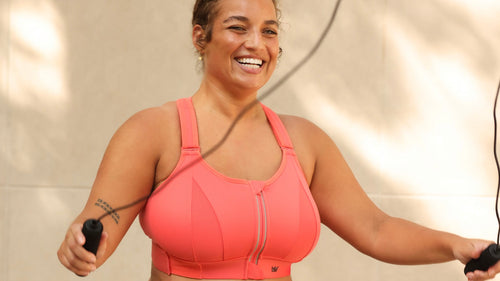
- HIIT, CrossFit, box jumps, jump rope: repeated vertical impact requires dynamic support, not static cups
- Horseback riding: the vertical bounce and forward lean combination demands maximum support from both cup structure and band compression
- Any activity where you find yourself holding or adjusting your bra mid-workout
This is not a knock on push-up sports bras. It is a design limitation that comes from prioritizing shape. The padding that creates lift at rest cannot dynamically adapt when forces increase. If you want both lift and high-impact support, you need a different mechanism, which we will get to.
The Lift-Support Trade-Off: Why Most Push Up Sports Bras Max Out at Medium Impact
Understanding this trade-off requires knowing how breasts actually move during exercise. Breast tissue is not fixed to the chest wall by muscle. It sits on top of the pectoral muscles, suspended by Cooper's ligaments, and moves independently of the torso during physical activity.
During running, breasts move in a figure-eight pattern across three planes of motion: up and down, side to side, and front to back. A single stride can produce several centimeters of displacement in each direction simultaneously. That multi-directional movement is what makes high-impact support so difficult to engineer.
Fixed padded cups address one plane effectively. They push tissue upward, creating lift and controlling some vertical movement at low speeds. But padding is rigid. It cannot respond to the lateral and anterior-posterior forces that increase dramatically during running, jumping, or plyometric training. The result: the cup holds shape, but breast tissue moves inside and around it, defeating the purpose of the support.
This is where encapsulation and compression come in. Encapsulation wraps each breast in its own structured cup space, controlling movement independently. Compression presses tissue against the chest wall to restrict overall displacement. Together, they cover all three planes of motion.
Research confirms why this matters. A 2017 study in the Journal of Sports Sciences found that without sufficient breast support, women experience increased embarrassment and decreased willingness to exercise [1]. The effects go beyond comfort: a 2022 study from the University of Memphis Breast Biomechanics Research Center found that greater breast support was associated with reduced peak knee valgus angles during landing, a biomechanical profile linked to lower ACL injury risk [2].
The trade-off is not a flaw. Push-up bras were designed for style at moderate impact levels. For higher intensity, a different mechanism is needed.
How SHEFIT Delivers Lift AND High-Impact Support
The reason most push-up designs force a choice between lift and support is the mechanism. Fixed padding creates shape but not dynamic control. We built a system that does both.
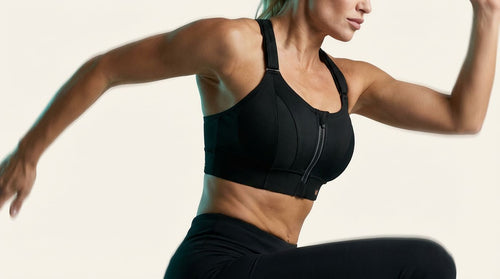
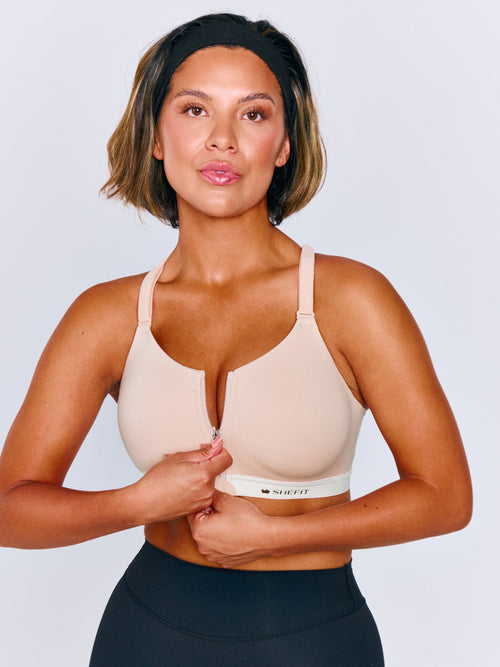
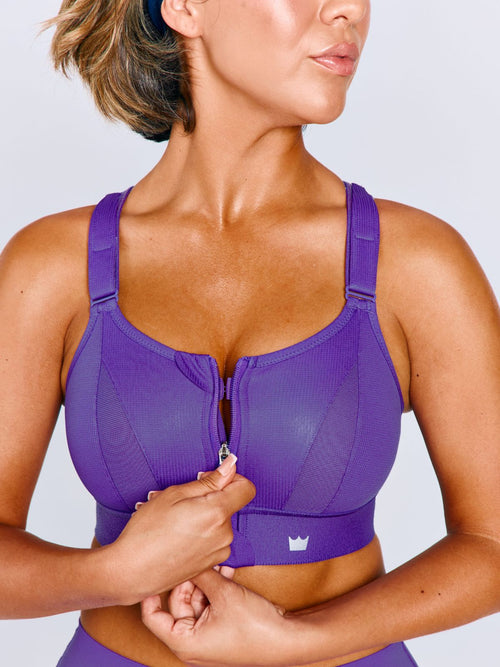
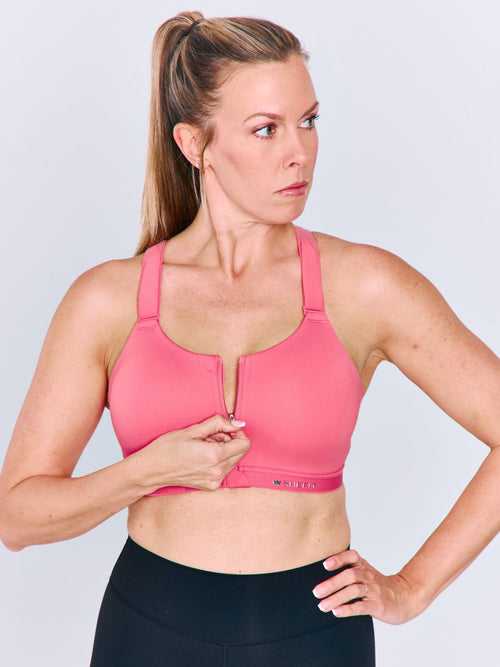
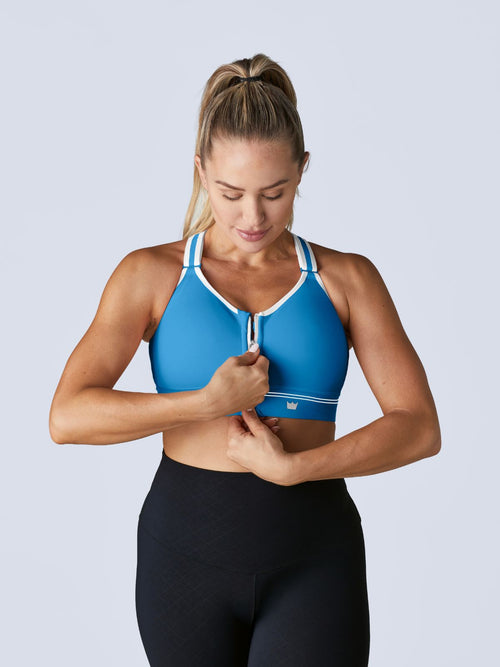
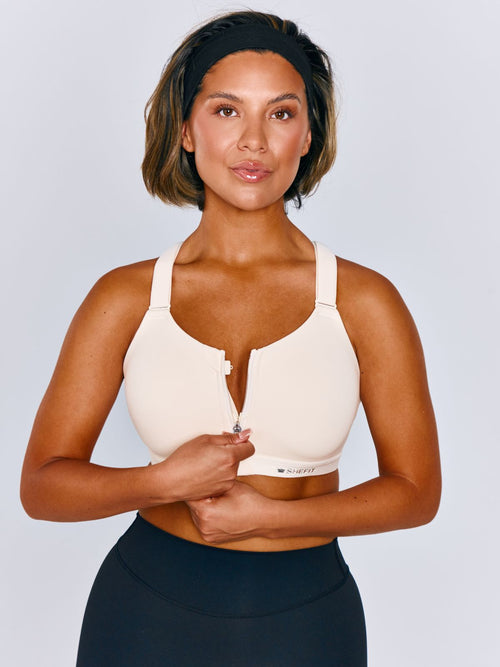
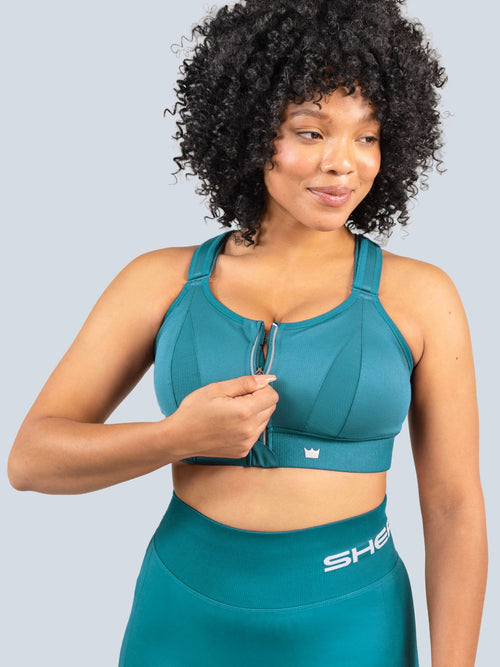
Our patented adjustable shoulder straps and rib band work together to lift and compress breast tissue from above and below. The non-stretch shoulder straps on the Ultimate Sports Bra let you tighten from above, elevating breast tissue to exactly where you want it. The rib band customizes compression at the base. Together, they create a push-up effect through proper tissue positioning, not foam inserts.
The Ultimate Sports Bra's removable modesty pads are the closest analog to traditional push-up padding in our lineup. But the lift comes from the strap-and-band system, not the pads. You can remove the pads entirely and still get full support and visible elevation, something no traditional push-up design can offer.
University of Memphis research confirmed what we built. A separate study found that bras incorporating both breast elevation and compression provided significantly greater comfort than standard encapsulation alone for women with large breasts during physical activity [3].
Both the Ultimate and the Flex Sports Bra use our patented adjustable design with encapsulation and compression. Here is how they compare:
| Feature | Ultimate Sports Bra | Flex Sports Bra |
|---|---|---|
| Price | $69 | $65 |
| Impact level | High impact | High impact (32C and under), medium impact (larger sizes) |
| Cup design | Encapsulation + compression, removable modesty pads | Encapsulation + compression, smooth cups |
| Straps | Non-stretch, adjustable | Adjustable |
| Size range | XS-6Luxe, AA-I cups | XS-6Luxe, AA-I cups |
| Best activities | Running / HIIT / CrossFit / horseback riding | Yoga / cycling / strength training / pickleball |
| Durability | Tested to 25 wash cycles | Tested to 25 wash cycles |
With 75,000+ five-star reviews, Try Before You Buy (order up to five bras, try for seven days, pay only for what you keep), and our Game Changer Promise (30-day returns, free shipping), the risk of finding your fit is minimal. We also donate through the Sports Bra Project, with more than $1.2 million contributed to provide sports bras to women and girls in need.
Browse the full lineup in our sports bra collection.
How to Find the Right Fit for a Push Up Sports Bra
Fit is where the push-up category gets tricky. Padded cups change the sizing equation: the padding adds volume inside the cup, which means the fit you expect from your usual size may not translate when a push-up bra adds an extra layer between your body and the cup wall.
Research estimates that 85% of women are wearing the wrong bra size [4], and push-up designs compound the problem. Women often buy based on how the bra looks on a mannequin or a model, not how it fits their body in motion.
Start with Measurements, Not Cup Letters
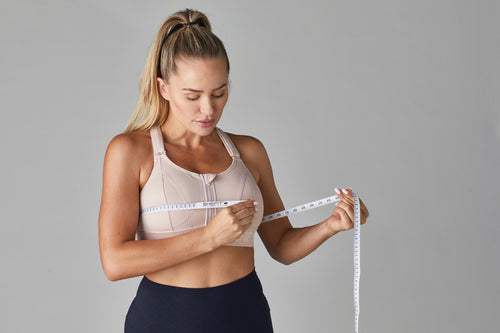
Bra sizing is not regulated from brand to brand. A cup letter at one company does not mean the same thing at another. Measure your underbust (for band size) and your bust at its fullest point (for cup size) in inches, then cross-reference against the brand's size chart. Our sports bra size chart walks through the full measurement process.
The Quick Fit Checklist
- Band: Sits level across your back. Allows two fingers underneath without gaping. Stays put when you raise both arms. The band carries roughly 90% of your support.
- Cups: Fully contain breast tissue on all sides. No wrinkles (too large), no tissue pushing over the rim (too small).
- Straps: Provide lift without digging. One finger should slide under each strap comfortably.
- Coverage: Check the armpit area. If you see armpit skin, that is your bra doing its job, lifting you up. That is normal anatomy being exposed by proper lift, not spillage. Spillage is different: it means tissue pushing over the top or sides of the cup, past the underarm seam.
- Bounce test: Jump in place ten times. If you reach for your chest on any of those jumps, the bra is not controlling movement well enough.
For a deeper walkthrough of each checkpoint, our complete fit guide covers the full five-point check with visual cues for too big, too small, and just right.
Between Two Sizes?
If you fall between sizes: larger size for more coverage, smaller size for more control. With push-up designs specifically, sizing up gives you more room for the padding without compressing your tissue uncomfortably. Sizing down gives a tighter, more locked-in feel.
FAQs
What is a push up sports bra?
It is a sports bra that pairs bounce control with aesthetic lift. Structured or padded cups elevate breast tissue upward and inward, creating a fuller silhouette during exercise. Most designs are built for low to medium impact activity.
Is a push up sports bra good for running?
Traditional push-up designs are not ideal for running. Fixed padded cups cannot control the three-directional movement pattern that running produces. For running, you need a bra built around individual cup support and compressive force. An adjustable design like SHEFIT's patented strap-and-band system delivers lift without giving up high-impact support.
What's the difference between a push up sports bra and a regular sports bra?
The main difference is the cup: push-up sports bras use thicker padding to create visible lift, while standard sports bras prioritize movement control with thinner cups or compression construction. Push-up designs typically max out at medium impact. Standard and adjustable sports bras are built for the full impact range.
Can you get both lift and support from the same sports bra?
Yes, but not from fixed padding. SHEFIT's patented adjustable shoulder straps and rib band create lift through tissue positioning rather than foam inserts. You tighten from above for elevation and adjust the band for compression. The result is push-up-level lift that holds through running and HIIT sessions.
What size push up sports bra should I get?
Start by measuring your underbust and bust in inches rather than relying on a cup letter from another brand. Bra sizing varies across brands, so measurements are the most reliable path. If you fall between two sizes, go larger for more coverage or smaller for more control.
Does SHEFIT make a push up sports bra?
SHEFIT does not market a traditional push-up bra because those designs cap at medium impact. Instead, our patented adjustable design delivers push-up-level lift without the impact limitation. The Ultimate Sports Bra and Flex Sports Bra both provide visible elevation through strap-and-band adjustment, with support that holds through high-intensity training.
References
[1] Risius, D., Milligan, A., Berns, J., Brown, N., & Scurr, J. "Understanding key performance indicators for breast support: an analysis of breast support effects on biomechanical, physiological and subjective measures during running." Journal of Sports Sciences, 35(9), 842-851, 2017. https://pubmed.ncbi.nlm.nih.gov/27291899/
[2] Fong, H.B., Nelson, A.K., Storey, J.E., Hinton, J., Puppa, M., McGhee, D., Greenwood, D., & Powell, D.W. "Greater Breast Support Alters Trunk and Knee Joint Biomechanics Commonly Associated With Anterior Cruciate Ligament Injury." Frontiers in Sports and Active Living, 2022. https://doi.org/10.3389/fspor.2022.861553
[3] McGhee, D.E. & Steele, J.R. "Breast elevation and compression decrease exercise-induced breast discomfort." Medicine & Science in Sports & Exercise, 2010. https://pubmed.ncbi.nlm.nih.gov/20019639/
[4] McGhee, D.E. & Steele, J.R. "Optimising breast support in female patients through correct bra fit: a cross-sectional study." Journal of Science and Medicine in Sport, 2010. https://pubmed.ncbi.nlm.nih.gov/20451452/