Which Bra Is Right for You? Learn More


Three miles into a run, a strap slides off your shoulder. You tuck it back. It slides again. You shorten your stride to keep it in place, then catch yourself hunching forward, arms pinched in, trying to keep everything from shifting. The run is still happening, but your focus left the pavement two minutes ago. That strap is now the entire workout.
Strap design sounds like a detail, but it dictates how free your upper body actually feels once you start moving. The racerback, where straps converge toward the center of your upper back instead of running straight down from each shoulder, is not a fashion trend. It is the most common architecture in sports bras for a reason that goes back to the very first purpose-built sports bra ever made. At SHEFIT, we have spent years engineering what happens after those straps converge, because strap placement is only the starting point of support.
This guide breaks down what the racerback actually is, how its design affects the way support reaches your body, what separates one version from another, and how to find the right match for your activity, your cup size, and your preference for coverage.
What Is a Racerback Sports Bra?
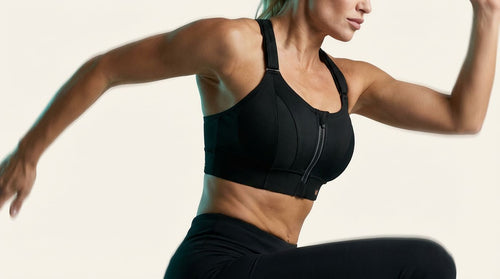
A racerback sports bra is any sports bra whose straps angle inward from the shoulders and meet between the shoulder blades, forming a Y or T shape across the upper back. The defining feature is that center-back convergence point. Where a standard bra runs two parallel straps straight down from each shoulder, a racerback routes them toward the spine.
The design dates back to 1977, when Lisa Lindahl, Hinda Miller, and Polly Smith invented the Jogbra, the first sports bra made specifically for exercise. Their original design used a cross-back strap construction, and the racerback has been the dominant sports bra architecture ever since. Before the Jogbra, women taped themselves down, doubled up regular bras, or simply avoided running altogether. The racerback solved a fundamental geometry problem: how to keep straps anchored on a body in motion.
One important distinction to clear up early: "racerback" describes the back strap configuration only. It does not indicate a support level, an impact rating, or a cup construction. A racerback can be a low-support pullover for yoga or a full-coverage, high-impact bra built for HIIT. The back design tells you where the straps sit. Everything else, the support, the bounce control, the fit across different cup sizes, comes from the construction underneath.
How the Racerback Design Affects Support
The racerback works because of where it places load on your body and how it stays put during movement.
The angled strap geometry spreads strap load across a broader area of the upper back and shoulders, which many wearers experience as reduced localized shoulder pressure compared to vertical straps. Instead of two narrow lines of tension pulling straight down on the tops of your shoulders, the straps fan out across a wider zone. For women who carry more breast tissue, that pressure distribution can be the difference between a workout that feels sustainable and one that ends with red grooves on each shoulder.
Strap stability is the second structural advantage. During exercises with a wide range of motion, vertical straps tend to slide toward the outer edge of the shoulder, especially during lateral raises, swimming strokes, or overhead presses. A racerback clears the top of the shoulder blade entirely. The straps sit in a natural channel between the shoulder blades, where there is less surface for them to slip from. Your shoulders and arms move freely because the straps are no longer in the path of that movement.
Then there is what happens at the breast level. Research from the University of Portsmouth shows that breasts move in three dimensions during exercise: vertically, forward-and-back, and side-to-side, tracing a figure-eight pattern [1]. This is not a simple up-and-down bounce. The converging strap path helps address lateral and forward-back motion components by anchoring the bra closer to the body's center of mass, which reduces the leverage that movement has on the cups and band.
Racerback vs. Other Strap Styles
Every strap style makes trade-offs. The racerback is the most versatile for active use, but understanding what each option does well helps you match the right bra to the right situation.
| Strap Style | Back Exposure | Movement Security | Upper Back Load Distribution | Best For |
|---|---|---|---|---|
| Racerback (Y or T shape) | Moderate; center back covered | High; straps locked between shoulder blades | Spread across upper back | Most workouts, layering under tanks |
| Straight parallel straps | Low; straps cover both shoulders | Moderate; can slip during overhead movement | Concentrated on shoulder tops | Everyday wear, low-impact activity |
| Criss-cross | Moderate to high | High; X pattern holds well | Spread across back, but narrower contact | Dance, barre, open-back tops |
| Halter neck | High; back fully open | Low to moderate; single anchor point at neck | Concentrated at base of neck | Swimming, fashion-forward styling |
The racerback stands out for one reason that the table makes visible: it combines high movement security with distributed load across the upper back. Criss-cross styles come close on security but often use thinner straps, which concentrate pressure. Halter styles give you the most back exposure but route all tension through a single point at the neck, which limits how much weight they can comfortably support.
Our Ultimate Sports Bra and Flex Sports Bra both use a racerback construction paired with non-stretch straps. That non-stretch element matters: stretchy straps lose tension over time, and stretch means bounce. Non-stretch straps maintain lift wash after wash, so the support you feel on day one is the support you still feel after 25 wash cycles.
Support Level Inside a Racerback Sports Bra
The racerback determines where the straps sit. The support level comes from what is happening in the cups and band, and that construction falls into three categories.
Compression bras flatten breast tissue against the chest wall using tight, stretchy fabric. They work by pressing everything down. For smaller cup sizes doing moderate activity, compression alone can be enough. For larger busts or high-impact movement, compression on its own tends to create a uniboob effect and does not control three-dimensional breast motion well.
Encapsulation bras give each breast its own individual cup space. Instead of pressing tissue flat, they surround and contain it. Encapsulation controls directional movement better than compression because each breast is held independently.
Combination (encapsulation + compression) bras do both. They give each breast individual cup space and add compression around and between the cups for maximum control. The Portsmouth researchers identify the combination design as the highest support tier. Both our Ultimate Sports Bra and our Flex Sports Bra use encapsulation and compression design.
That same research group identified five construction characteristics linked to reduced breast movement in high-support bras:
- Encapsulation-style cup design
- Padded cups
- Nylon-based material
- An adjustable underband
- A higher neckline (for every 1cm higher the neckline, breast bounce is reduced by 1%)
That neckline finding is worth pausing on. It means support is partly a function of how much coverage the bra provides across the upper chest, something most shoppers never think about when comparing two bras that look similar from the front.
The Performance Impact of Breast Support
The conversation around sports bras tends to center on comfort: does this feel good, does that pinch, is there chafing. Comfort matters. But the research on breast support and athletic performance goes much further than whether a bra feels pleasant to wear.
Researchers estimate that during one hour of running at a pace of 10 minutes per mile, breasts undergo an estimated 10,000 oscillations [1]. Along with the skin, Cooper's ligaments are the only natural supporting structures of the breast, and once overstretched, they cannot recover. That is permanent tissue damage from repeated unsupported movement.
In a survey of UK female athletes, 51% experienced breast pain and 29% said poorly fitting bras affected their performance [2]. The performance cost is measurable: an unsupportive bra shortens stride by an average of 4cm, adding up to one extra mile over a marathon distance, and a 36DD wearer would finish a marathon over 34 minutes behind a similarly fit 36A wearer with the same training experience.
The impact extends to injury risk. A peer-reviewed study at the University of Memphis Breast Biomechanics Research Center found that greater breast support alters trunk and knee joint biomechanics in ways associated with reduced ACL injury risk factors [3]. This matters especially for women, who face significantly higher ACL injury rates than men in the same sports.
When Team GB athletes received individual bra prescriptions before the Tokyo Olympics, 97% reported benefits in comfort, fit, and support, and 17% said the change had significantly improved their performance [2]. A 2026 study in the Journal of Sports Sciences reinforced these findings, showing that breast health education and proper bra prescription make a measurable difference for elite female match officials [4].
The takeaway is straightforward: breast support is a performance variable. Treating it as an afterthought costs you pace and efficiency over time, and may affect joint health as well.
What to Look for in a Racerback Sports Bra
Knowing the back strap configuration matters is the first step. Knowing what else to evaluate when you are actually shopping is where the fit gets dialed in.
1. Match Impact Level to Your Activity and Cup Size
Your activity and your breast size both factor into which impact level you need. Understanding impact levels helps you avoid under-supporting or over-engineering.
- Low-impact (yoga, walking, Pilates): compression-only or light encapsulation bras work for most sizes
- Medium-impact (cycling, hiking, pickleball, strength training): encapsulation + compression recommended, especially for larger cup sizes
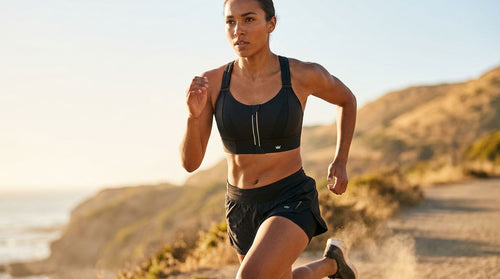
- High-impact (running, HIIT, CrossFit, horseback riding): encapsulation + compression with non-stretch straps is the standard for all cup sizes
Breast size changes the equation. Smaller busts can sometimes wear a medium-impact bra for moderate activities, but HIIT still requires encapsulation, compression, and non-stretch construction for proper control. Larger busts need maximum support features for anything above a walk.
2. Check the Cup Construction
Look for individual cup space with encapsulation and compression design. Smooth cups give a clean silhouette under tops and prevent nipple show-through. Avoid bras that rely on compression alone for anything above low-impact.
3. Prioritize the Band
The band provides 90% of the support. If the band is loose, the bra rides up. If it is too tight, it digs into the rib cage and restricts breathing. The fit should be snug, like a hug, firm enough that you cannot slide more than two fingers under the band, but not so tight that it leaves marks after a workout.
4. Evaluate Strap Adjustability
Not all racerback straps adjust. Look for non-stretch straps with a mechanism that lets you set the lift precisely. Stretchy straps lose tension over time and let bounce creep back in.
5. Consider Neckline Height
A higher neckline means more support. If you are a larger cup size or doing high-impact activity, a bra with a higher front neckline reduces bounce more effectively, as the Portsmouth research shows.
6. Verify the Size Range
A bra that only runs S through XL in a generic size system leaves a lot of women out. Look for brands that offer a true extended range and separate band and cup sizing.
Fit failure modes to watch for:
- Too big: bra rides up into the armpits, straps slide off shoulders, cups gap away from the chest
- Too small: breast tissue bulges over the top or sides of cups, straps dig into shoulders, band feels restrictive
One note on fit that trips people up: if you see armpit skin when wearing a properly fitted high-support bra, that is your bra doing its job, lifting you up. Armpit skin visibility is not spillage. Spillage is tissue pushing over the top or sides of the cup. The skin that appears under your arms when your breasts are properly lifted is normal anatomy.
SHEFIT's Racerback Sports Bras
We built our sports bras around one idea: adjustable support that fits your body, not a size chart approximation of your body. Both of our core bras use a converging-strap racerback, and both feature our patented adjustable shoulder straps and rib band for a custom fit.
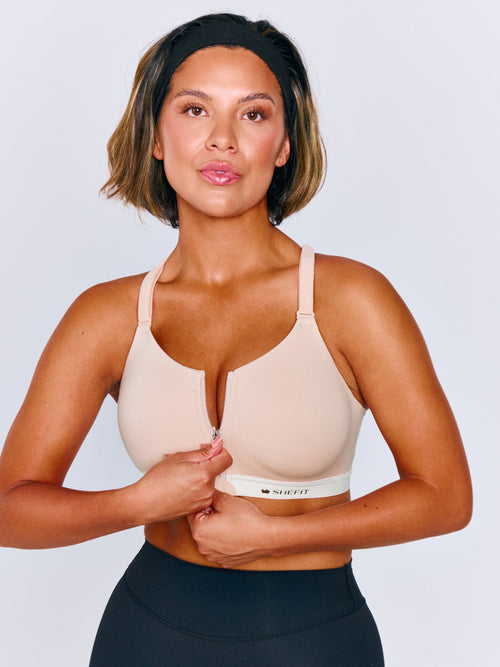
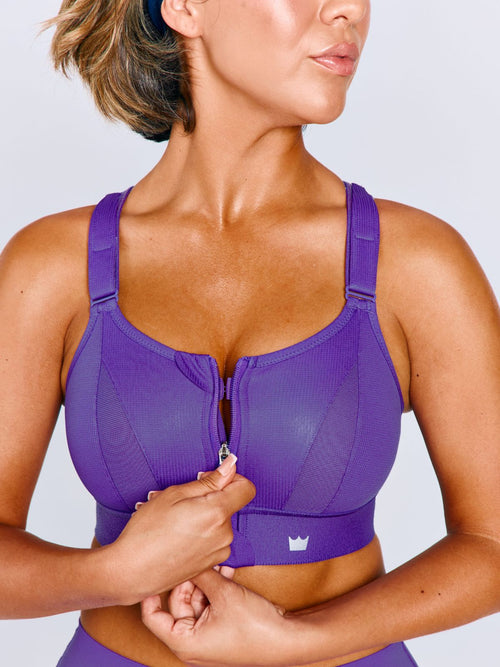
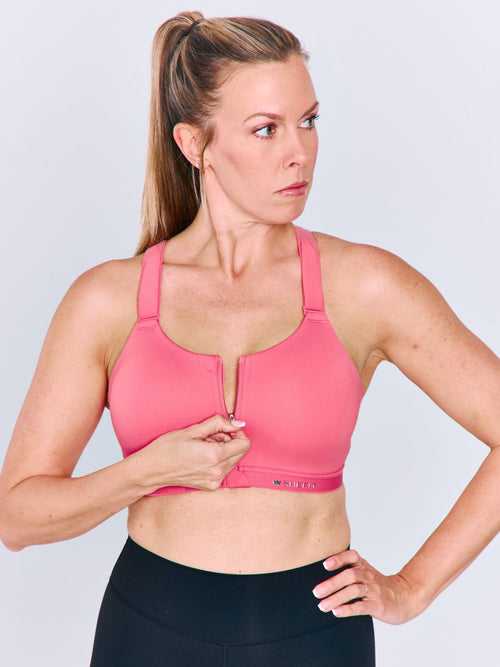
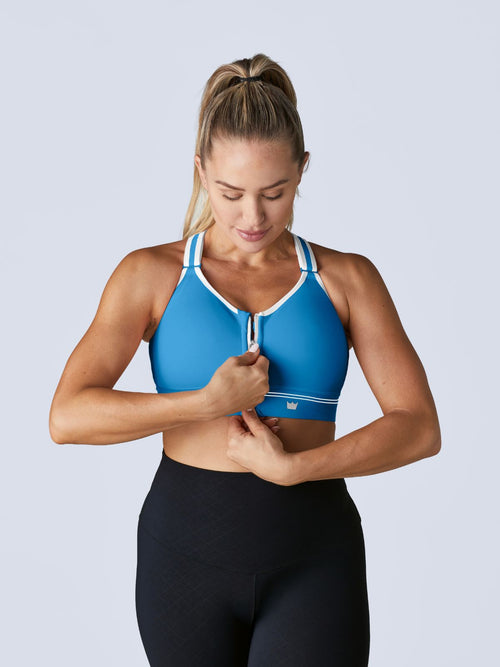
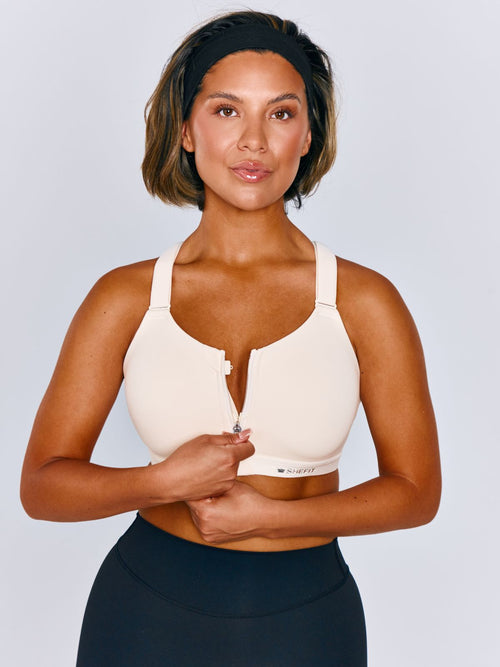
The Ultimate Sports Bra ($69) is our high-impact workhorse. It uses encapsulation and compression design with non-stretch straps, removable modesty pads, and a front zipper closure. The adjustable rib band lets you tighten or loosen the fit as your body changes throughout the day, week, or month. It covers running, HIIT, CrossFit, and horseback riding, and it is built for all breast types from AA through I cups, in sizes XS to 6Luxe. Independent research at the University of Memphis Musculoskeletal Analysis Laboratory found that our high-support bra reduces breast motion by more than 50% compared to previously reported values from other brands' high-support options [5]. The Ultimate is the bra that put us on the map, and across all our products, we have earned more than 75,000 five-star reviews.
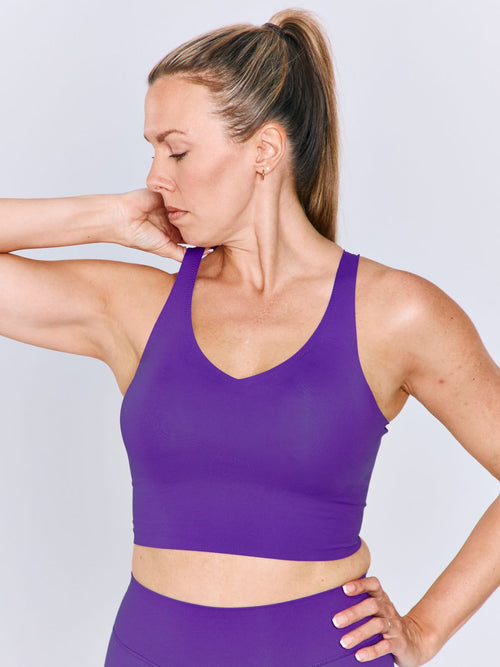
The Flex Sports Bra ($65) is our medium-impact option. It also uses encapsulation and compression design with smooth cups for a sculpted look, adjustable straps, and the same patented rib band. It provides high-impact support for smaller bust sizes (32C and under) and medium-impact for larger sizes, making it versatile for yoga, cycling, strength training, and pickleball. Same size range: XS to 6Luxe, AA to I cups.
Both bras are wash-tested to 25 cycles before showing obvious wear, so the support holds up long after the first few washes. And if the fit is not right, our Sure-Fit Promise gives you 30-day returns and free exchanges.
How to Find Your Fit in a Racerback Sports Bra
Studies estimate that 70-100% of women are not wearing the correct bra size. If that statistic feels abstract, consider this: most women size themselves using a method that consistently overestimates band size and underestimates cup size. The number on your current bra tag may not be the number you actually need.
Here is how to find the right fit:
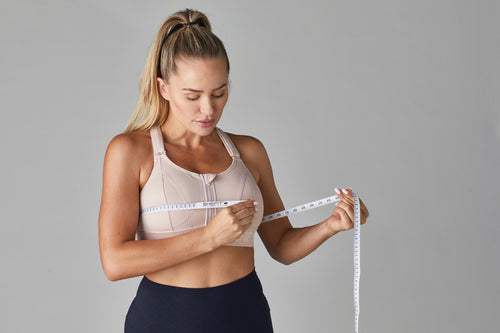
- Start with the band. The band provides 90% of the support, so it is the measurement that matters most. Measure your underbust with a fabric measuring tape while wearing a comfortable, non-compressive everyday bra. Round to the nearest whole number.
- Measure your bust. Wrap the tape around the fullest part of your bust, just above the nipple. Keep the tape flat and level. Round to the nearest whole number.
- Cross-reference against a size chart. Use your actual inch measurements, not a cup letter from another brand. Bra sizing is not regulated, so a cup size from one company does not translate directly to another.
- If you fall between sizes, go with the larger size for more coverage or the smaller size for more control.
If you want help, we offer two fitting tools:
- Fit Quiz: a quick questionnaire that gives you a personalized size recommendation
- Free Virtual Fitting: a 30-minute video call with a Fit Expert who walks you through measurements and product recommendations at no cost
Your measurements give you a traditional bra size (like 34D), which is a starting point for cross-referencing against a sports bra size chart. That traditional number gets you in the right range; the adjustable band and straps let you fine-tune from there.
FAQ
Is a racerback sports bra better for large busts?
The converging strap path is generally better for larger busts because it distributes load more broadly and stays in place during movement. However, the strap style alone does not determine support. Look for encapsulation and compression construction, a firm band, and non-stretch straps alongside the back configuration.
Can I wear a racerback sports bra for high-impact exercise?
Yes, as long as the bra pairs that strap configuration with high-impact construction: encapsulation and compression cups, an adjustable underband, and non-stretch straps. It is the most common strap style in high-impact sports bras for good reason.
What is the difference between a racerback and a regular sports bra?
The difference is in the back strap configuration. A racerback converges straps toward the center of the upper back. A standard sports bra runs parallel straps straight down from each shoulder. The racerback offers better strap security during movement and broader load distribution, while parallel straps may be easier to layer under certain tops.
How should a racerback sports bra fit?
The band should feel snug but not restrictive. You should be able to slide two fingers under the band, no more. Straps should sit firmly without digging into the shoulders. Cups should fully contain each breast with no gapping or tissue spilling over the top. If you see armpit skin when you lift your arms, that is normal with a bra that provides real lift.
Does SHEFIT make racerback sports bras?
Yes. Both the Ultimate Sports Bra and the Flex Sports Bra use racerback construction with patented adjustable shoulder straps and rib band. The Ultimate is designed for high-impact activity; the Flex covers medium-impact. Both are available in XS to 6Luxe and AA to I cups.
References
[1] Susan Lacke. "Supportive Science: The Quest to Build A Better Sports Bra." Triathlete, 2020-09-16. https://www.triathlete.com/culture/supportive-science-the-quest-to-build-a-better-sports-bra/
[2] Nichola Renwick. "Wearing a well-fitting sports bra can improve your performance - an expert advises how to find one." University of Portsmouth, 2023-08-25. https://www.port.ac.uk/news-events-and-blogs/blogs/improving-health-and-wellbeing/wearing-a-well-fitting-sports-bra-can-improve-your-performance-an-expert-advises-how-to-find-one
[3] Hailey B. Fong, Alexis K. Nelson, Julie E. Storey, Jay Hinton, Melissa Puppa, Deirdre McGhee, Daniel Greenwood, Douglas W. Powell. "Greater Breast Support Alters Trunk and Knee Joint Biomechanics Commonly Associated With Anterior Cruciate Ligament Injury." Frontiers in Sports and Active Living, 2022-05-19. https://doi.org/10.3389/fspor.2022.861553
[4] Jenny Burbage, Emily Paines, Chloe G. Errington, et al. "Impact of breast health education and individual sports bra prescription on elite female football match officials." Journal of Sports Sciences, 2026-04-03. https://www.tandfonline.com/doi/full/10.1080/02640414.2026.2623565
[5] Hailey B. Fong, Alexis K. Nelson, Deirdre McGhee, Kevin Ford, Douglas W. Powell. "Increasing breast support is associated with a distal-to-proximal redistribution of joint negative work during a double-limb landing task." Journal of Applied Biomechanics, 2023. https://www.memphis.edu/healthsciences/pdfs/jab-biomech-2023.pdf