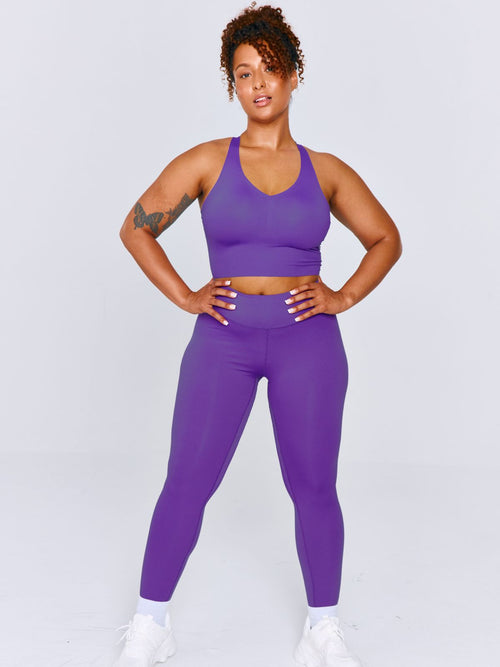
Which Bra Is Right for You? Learn More


Somewhere along the way, comfort and support got filed as opposites. Shopping advice treats them like a dial you slide in one direction or the other: pick the cushy pullover and accept the bounce, or strap into something rigid and accept the pinching. Every woman who has finished a workout with red marks across her shoulders has been told, in one way or another, that this is the price of being held in place.
That framing is wrong, and the research does not support it. Pinching, riding up, and restricted breathing are not the cost of support. They are symptoms of a bad fit, and a bad fit undermines comfort and support at once. The bras that test as the most comfortable in independent labs are frequently the same ones controlling movement best, because the mechanics that stop bounce are the mechanics that stop rubbing.
At SHEFIT, we built our whole product line around that overlap. Our founder, Sara Moylan, was a mom and collegiate athlete doubling up on bras and tying off the excess straps with a rubber band because nothing on the market did both jobs, and every design decision since has come from refusing to accept the tradeoff she was handed.
So here is what comfort actually means in a sports bra, what causes the discomfort you have been blaming on the wrong things, and how to tell in about ninety seconds whether the bra you own is working.
Why "Comfortable" and "Supportive" Aren't Opposites
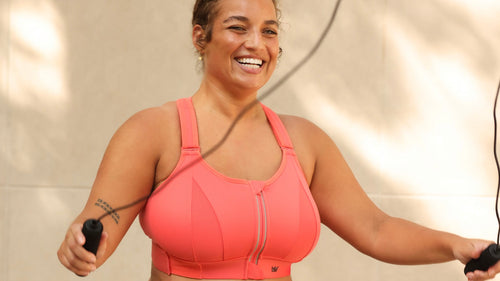
Comfort in a sports bra is not the presence of plushness. It is the absence of distraction.
Think about the last workout where you never once thought about your bra. Nothing pinched. Nothing crept up your back. Nothing bounced hard enough to break your stride, and nothing squeezed tight enough to shorten your breath. That absence is the standard. Bra designers who work in this space describe the goal the same way: a bra you forget you are wearing. Laura Tempesta, a bra designer and industry educator behind Bravolution, frames good design around exactly that distraction-free experience rather than around any single fabric or feature.
Once you define comfort as the absence of distraction, the supposed tradeoff falls apart. Bounce is a distraction. Chafing is a distraction. A band riding up your ribs mid-run is a distraction. The features that eliminate all three are the same features that get filed under "support."
Three myths keep the tradeoff alive:
- Tighter equals more supportive. Past a point, tighter just means restricted breathing and pressure marks. Support comes from where the tension sits, not how much of it there is.
- Straps do the heavy lifting. They do not. They set lift and stability, and when they are asked to carry the load, they dig into your shoulders and your neck complains by mile two.
- Comfort means minimal structure. Independent gear testers keep finding the opposite. Treeline Review's testing noted that the most comfortable bras in their lineup were often the simpler, well-built designs with wide straps that spread pressure rather than concentrating it [1]. Structure, placed correctly, is what makes a bra disappear.
The Band Does Most of the Work
If you take one mechanical fact from this article, make it this one: the band carries the support, and the straps mostly steer.
Our fitters put the band at roughly 90% of the support in any bra, which is why every fit conversation we have starts at the ribcage rather than the shoulders. Jené Luciani Sena, an author and style expert who has spent years on bra fit, puts it in a line our team quotes constantly: check your back, not your rack. The part of the bra you cannot see in a mirror is the part doing the work.
Here is how to check yours:
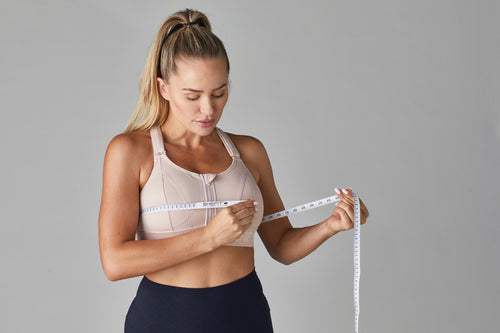
- Run two fingers under the band. They should slide beneath it with resistance, and the fit should read as snug like a hug. If your whole hand fits, the band cannot anchor anything during impact.
- Raise your arms overhead. The band should stay put. If it climbs your back, it is too loose, and a band that rides up drags coverage into your armpits, which is where chafing starts.
- Take a deep breath. Full expansion, no pinch. Restricted breathing is a sign the band is compensating for the wrong size, not a sign of serious support.
- Look at the back in a mirror. The band should sit level with the front and lie flat against your skin, without rolling or cutting a ridge into your back.
A too-loose band creates a chain reaction that ends at your shoulders. When the ribcage is not anchored, the weight transfers to the straps, the straps dig in, and the discomfort you feel at your collarbone actually originated six inches lower. Tightening the straps at that point makes it worse. Cinching the band fixes it.
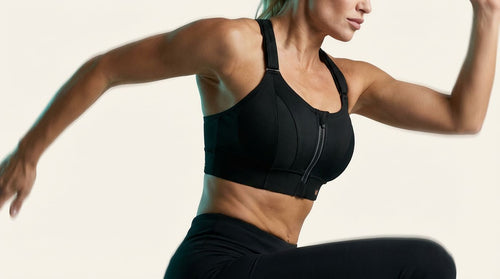
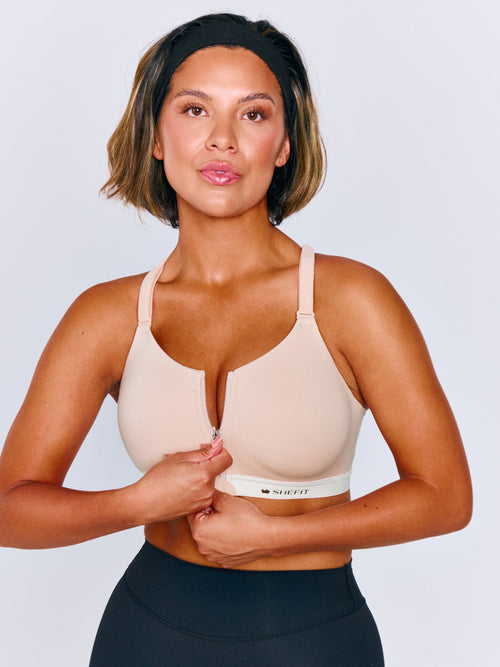
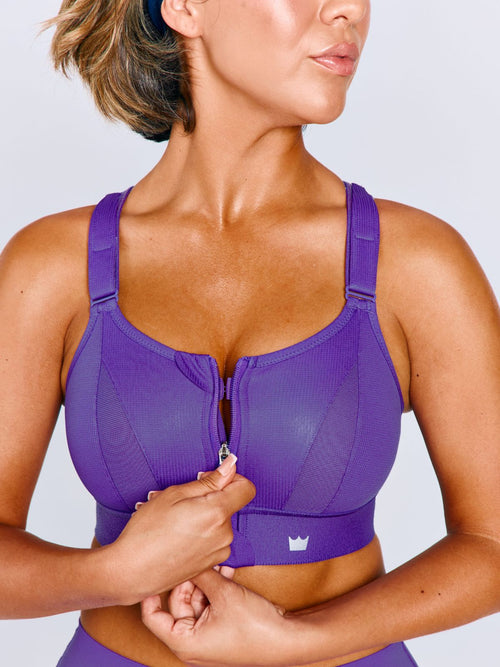
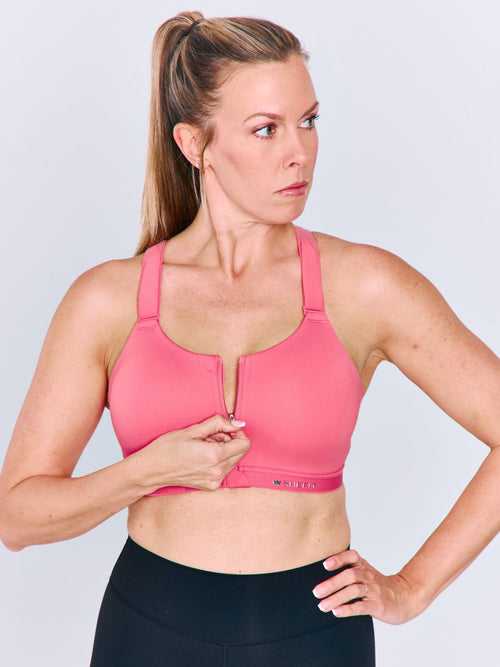
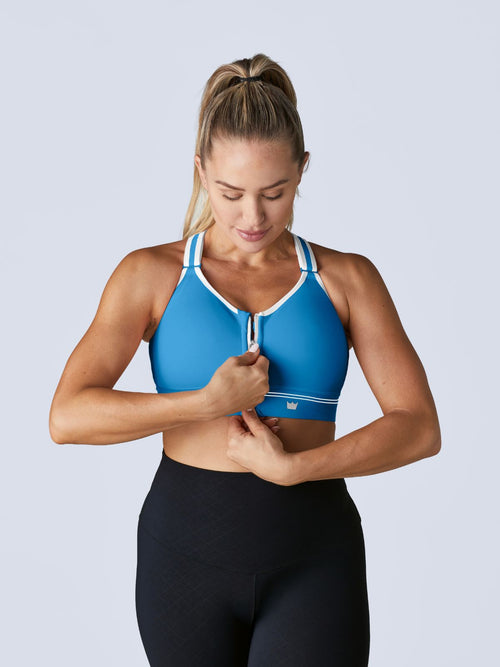
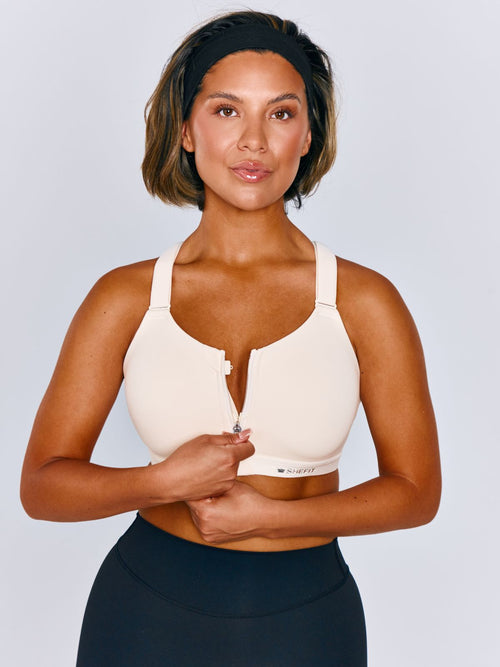
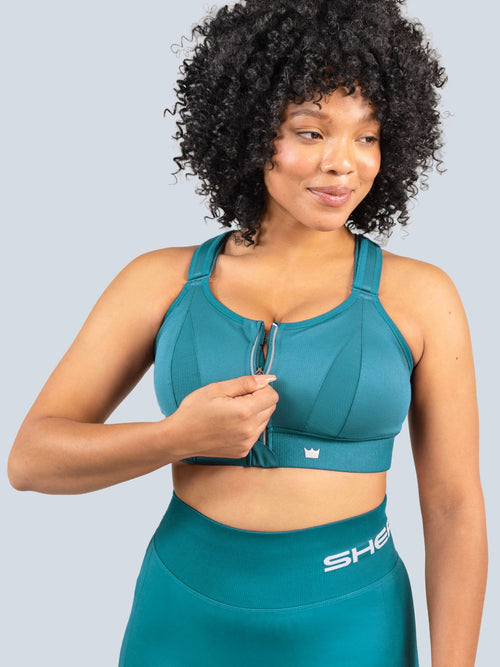
Our patented design exists because that adjustment cannot be a one-time factory decision. A front zipper gets the bra on and off, a cinchable rib band sets your compression, and non-stretch shoulder straps set your lift, all independently. Bodies change across a cycle, a season, and a decade, and non-stretch straps hold their tension instead of loosening into bounce over time. If you want help dialing in the starting point, our team walks through it at Fit Central.
Compression, Encapsulation, or Both: Which Actually Feels Better
Two mechanisms exist for controlling breast movement, and most bras pick one.
| Compression | Encapsulation | |
|---|---|---|
| How it works | Presses breast tissue toward the chest wall as a single unit | Surrounds each breast in its own supportive cup space |
| Typical construction | Pull-on style, wire-free, racerback | Separate cups, adjustable straps, sometimes underwired |
| Best suited for | Low-to-medium impact; smaller and medium busts | Medium-to-high impact; medium and larger busts |
| Comfort trade-off | Can feel restrictive if sized down to compensate | Can feel loose if the cups are not the right volume |
| Movement control | Limits vertical motion well, less effective side to side | Contains motion in every direction |
Compression alone works fine for a walk or a flow class. It starts failing when the movement gets multi-directional, because flattening tissue against the ribcage does nothing about lateral travel. Encapsulation alone can control direction beautifully and still let the whole assembly bounce if there is no compressive element holding it close.
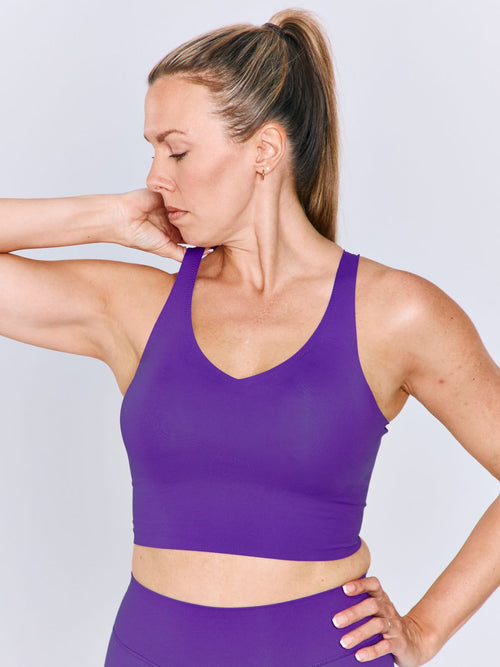
The version that solves both is the combination, which is why buying guides that map construction against impact level consistently put hybrid designs at the top of the high-impact column [2]. Both our Ultimate Sports Bra and our Flex Sports Bra use encapsulation and compression together in the same bra: individual cup space for each breast, plus a cinchable band that sets how firmly the whole structure sits against your body. The Flex adds smooth cups for a sculpted line under fitted tops, and Consumer Reports named it an Editor's Choice in its sports bra testing [3].
That combination is also why the comfort question stops being a category question. You are not picking between a comfortable bra and a supportive one. You are setting the compression yourself, on top of cups that already do the containment.
What Actually Causes Chafing (and What Stops It)
Chafing is the single most common complaint in bra testing, and most women misdiagnose the cause. The instinct is to blame tightness and size up. That usually makes it worse.
Friction causes chafing. Specifically, fabric moving repeatedly against skin that is damp with sweat, not pressure alone. Good Housekeeping's testing team has run more than 200 bras through lab and wear testing [4]. Which reframes the fix entirely: any bra shifting against your skin will chafe even if it feels loose and easy in the fitting room, while one that stays exactly where you put it will not chafe even under real compression.
That is the anti-chafing principle we design around: a custom fit that stays in place, without shifting or moving against your skin. When the band is anchored and the straps are set, there is no repeated travel across the same patch of skin, and no friction to accumulate over forty minutes.
Fabric does the second half of the job. Breathable, moisture-wicking fabrics that reduce friction pull sweat off the skin instead of holding it against you. There is a quick way to test what you already own: put a drop of water on the fabric. If it beads up and sits on the surface, the fabric is not wicking, and any workout longer than twenty minutes will keep that moisture right where you do not want it. If it spreads and disappears into the fabric, the material is moving moisture away from your skin.
Sizing errors cut both directions here, which is the part most advice misses:
- Too small concentrates pressure at the band and strap edges, and the resulting friction points rub with every stride.
- Too big lets the entire bra travel. The band creeps up, the cups shift, and the coverage migrates into your armpits, where the skin is thinnest and least forgiving.
Neither failure is fixed by fabric. Both are fixed by fit.
Matching Support to Your Actual Activity
Impact level is the standard framework for choosing a bra, and it works as long as you remember it has a second variable. Activity sets the baseline. Your breast size adjusts it.
| Impact level | Activities | What the bra needs |
|---|---|---|
| Low | Yoga, Pilates, walking, everyday wear | Light compression, comfortable band, freedom to move |
| Medium | Cycling, hiking, strength training, dancing, pickleball | Firm band, real cup structure, controlled vertical motion |
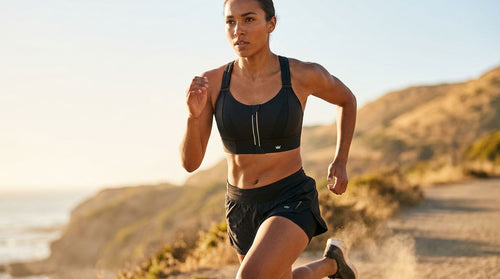
| High | Running, HIIT, aerobics, mountain biking, horseback riding | Encapsulation plus compression, non-stretch straps, locked-in band |
The nuance that most guides skip: breast size changes which row you actually belong in. Smaller busts have real flexibility and can often go a tier lighter than the activity suggests. But HIIT is the exception that holds across sizes. The stop-start landing loads in interval training call for encapsulation, compression, and non-stretch construction regardless of where you sit on the size range. Larger busts, meanwhile, need maximum support features earlier than the activity chart implies, and a "medium-impact" workout can require what the industry labels high-impact hardware.
This is exactly why we position our own bras by size as well as activity. The Flex Sports Bra delivers high-impact support at 32C and under, and medium-impact support in larger sizes, though our medium-impact rating delivers support that rivals what other brands call high-impact. It handles yoga, cycling, strength training, and pickleball comfortably. The Ultimate Sports Bra is the maximum-bounce-control option, built for running, HIIT, CrossFit, and horseback riding, with removable modesty pads and the widest adjustment range we make.
If you want the full breakdown of where each style lands, we mapped it out in our guide to understanding impact levels.
The Fit Check: How to Tell If a "Comfortable" Bra Actually Fits
A bra can feel fine standing still in a fitting room and fall apart the moment you move. Here is the ninety-second version of the check our fitters run.
Band. Snug like a hug, two fingers underneath with resistance, level around your whole torso. It should not move when you raise your arms.
Cups. Full coverage with no gapping at the top edge and no tissue escaping. Gapping means the cup volume is too large for you; the cup should contain the breast without extra space collapsing at the top.
Straps. They stabilize; they do not carry. If you can trace a groove in your shoulder after twenty minutes, the band underneath is too loose and the straps are picking up work that was never theirs.
Movement. Jump ten times. Reach overhead. Twist. Nothing should shift, ride up, or need a discreet adjustment afterward.
Two fit signals get confused constantly, and the difference matters:
- Armpit skin visibility is normal. If you see armpit skin, that is your bra doing its job, lifting you up. It is a sign the bra has separated and elevated tissue rather than letting it settle flat and wide.
- Spillage is a fit problem. Spillage means tissue pushing over the top or sides of the cup, and it points to a cup that is too small for your volume.
There is a third failure mode on the same axis, running the opposite direction: coverage that extends too far under your armpits. That is not lift and it is not spillage. It is excess material sitting in a high-friction area, and it will chafe. Too little coverage causes spillage; too much causes irritation under the arm. Correct fit lives between them.
Between sizes? Our rule is straightforward: larger size for more coverage, smaller size for more control. Pick the end of that trade you actually want, rather than defaulting to the bigger box.
One more thing worth knowing before you measure: the band-and-cup figure you get from a tape measure is a traditional bra size, not a sports bra size. Bra sizing is not regulated, so a cup letter does not travel reliably between brands. Use your actual underbust and bust measurements in inches against a specific brand's chart. Our full walkthrough of that process lives in our guide to the right sports bra fit.
The Research Behind Better-Fitting Support
Most sports bra advice runs on opinion. Ours runs on a lab, and the numbers are worth knowing because they explain why fit is a health question and not only a comfort one.
Start with the scale of the problem. Research by McGhee and Steele found that approximately 85% of women wear the wrong bra size [5]. And the consequences start young: a study of 2,089 British girls aged 11 to 18 found that 73% reported breast-specific issues affecting their sports participation or enjoyment, with 15% believing their breasts were too big to exercise at all [6]. That is not a comfort inconvenience. That is women opting out of movement because the equipment failed them.
Our bras have been tested at the University of Memphis Breast Biomechanics Research Center, and the findings have been published in peer-reviewed journals. Two results stand out.
On movement control, researchers measuring a double-limb landing task found vertical breast displacement in the high-support condition was 33% less than in the low-support condition, and more than 50% less than previously reported values for high-support sports bras from other sportswear companies [7]. The comparison point there is worth reading twice: not against no bra, but against other brands' high-support offerings.
On whole-body mechanics, a separate study found that greater breast support was associated with reduced peak knee valgus angles and moments, along with greater trunk flexion at initial contact [8]. Those are biomechanical profiles associated with lower ACL injury risk. The association is correlational rather than causal, and we are careful about that distinction, but the direction is consistent: how your chest is supported changes how you land.
Both studies used our Ultimate Sports Bra as the high-support condition. That is the bra we point women toward when the activity is genuinely high-impact, and it is the reason we keep investing in research rather than adjectives.
Durability is the last piece, and it is our own testing standard rather than a third-party finding: we wash-test our bras to 25 cycles before they show obvious wear, where most brands test to about 5. That is what supports the 12-to-24-month-plus lifespan we tell women to expect with proper care.
Frequently Asked Questions
What is the difference between compression and encapsulation sports bras?
Compression presses breast tissue toward your chest wall as one unit, which works well for lower-impact activity and smaller-to-medium busts. Encapsulation gives each breast its own supportive cup space, which controls movement in every direction and suits higher impact and larger busts. Bras that combine both, like ours, give you containment and adjustable compression in one garment.
How do I know if my sports bra fits correctly?
Run two fingers under the band with resistance, check that nothing gaps or spills at the cup edge, and confirm your straps stabilize without digging. Then jump ten times and raise your arms. If anything rides up or needs a quiet adjustment afterward, the fit is off, most often at the band.
How do I prevent chafing from a sports bra?
Stop the bra from moving. Chafing comes from fabric traveling across sweaty skin, so an anchored bra will not chafe even under firm compression. Pair that with breathable, moisture-wicking fabrics, and check your sizing in both directions, since sizing too large chafes just as readily as sizing too small.
How often should I replace a sports bra?
With proper care, expect 12 to 24 months or more, though heavy runners in daily rotation will hit the low end of that. Replace it when the band no longer holds tension at its tightest setting, since that is the support structure giving out.
Can a sports bra be both comfortable and high-support?
Yes, and the two usually arrive together. Bounce, pinching, and rubbing are all symptoms of a bra that does not fit, and fixing the fit resolves the discomfort and the movement at the same time. The bras that test best for comfort in independent labs are regularly the same ones controlling motion most effectively.
The Bottom Line
The comfort-versus-support tradeoff is a story we have all been sold, and it survives mostly because so many women have only ever worn bras that fit poorly in one direction or the other. Get the band right, get the construction matched to your activity and your size, and the choice disappears. What is left is a bra you stop noticing, which was the point all along.
If you are not sure where to start, measure yourself in inches, use the band checks above on what you already own, and see how much of what you have been calling discomfort was really just a fit problem. Our full range of sports bras is built to adjust to you rather than the other way around. Find your fit.
References
[1] Treeline Review. "Best Sports Bras." Treeline Review. https://www.treelinereview.com/gearreviews/best-sports-bras-aa-d
[2] Runners Need. "How to Find Your Perfect Sports Bra." Runners Need. https://www.runnersneed.com/expert-advice/gear-guides/sports-bra-buying-guide.html
[3] Lashbrook, Angela. "Best Sports Bras Review." Consumer Reports, 2022. https://www.consumerreports.org/apparel-accessories/activewear/best-sports-bras-a2298183941/
[4] Good Housekeeping Institute. "We Put 200+ Bras With AA-H Cup Sizes to the Test - These Were the Most Comfortable." Good Housekeeping, 2026. https://www.goodhousekeeping.com/clothing/bra-reviews/a71320491/best-bras/
[5] McGhee, D.E., & Steele, J.R. "Optimising breast support in female patients through correct bra fit: A cross-sectional study." Journal of Science and Medicine in Sport, 13(6), 568-572, 2010. https://doi.org/10.1016/j.jsams.2010.03.003
[6] Study on breast issues affecting sports participation among British girls aged 11-18. PubMed, 2016. https://pubmed.ncbi.nlm.nih.gov/26802991
[7] Fong, H.B., Nelson, A.K., McGhee, D., Ford, K., & Powell, D.W. "Increasing breast support is associated with a distal-to-proximal redistribution of joint negative work during a double-limb landing task." Journal of Applied Biomechanics, 2022. https://www.memphis.edu/healthsciences/pdfs/jab-biomech-2023.pdf
[8] Fong, H.B., Nelson, A.K., Storey, J.E., Hinton, J., Puppa, M., McGhee, D., Greenwood, D., & Powell, D.W. "Greater Breast Support Alters Trunk and Knee Joint Biomechanics Commonly Associated With Anterior Cruciate Ligament Injury." Frontiers in Sports and Active Living, May 20, 2022. https://doi.org/10.3389/fspor.2022.861553