Which Bra Is Right for You? Learn More


Walk into any studio and you will hear the same received wisdom, usually from someone who means well: yoga is gentle, so you barely need a bra. Grab a bralette, a thin strappy thing, whatever is soft. The class is slow. Your body will thank you.
Then you get into a class that is not slow. A heated Vinyasa flow with jump-backs, or a session that spends fifteen minutes on arm balances and inversions, and suddenly the "barely need a bra" advice feels like a setup. The bralette that was fine in a restorative session is not fine when you are upside down in a headstand or sweating through a 90-minute hot class.
And if you are doing yoga with a larger bust, the advice falls even shorter. The body mechanics of a D cup in a jumping Vinyasa sequence are not the same as a B cup in a slow stretch class, and treating them the same is how you end up uncomfortable, distracted, or cutting the session short.
The problem is not yoga. It is treating yoga as one thing. Nike's own technical designer, Tara Sweeney, puts it plainly: "Don't feel boxed in by how the bras are classified. If you feel most comfortable doing yoga in a high-support bra rather than a low-support one, then do it." At SHEFIT, we make bras across every support level for every body, which means we have had to answer this question for the smaller-busted Yin practitioner and the larger-busted power yogi in the same breath. The real question was never "how much support does yoga need?" It is "how much support does your yoga need?"
What Makes a Sports Bra Work for Yoga (Specifically)
Yoga asks more of a bra than most sports do, just not in the way people expect. Running is mostly vertical bounce. Yoga is reaching overhead in Warrior I, folding forward, twisting through the spine, and inverting, all while you breathe deeply. A design built only to control up-and-down movement can still ride up, gap, or dig when your arms go over your head or your torso rotates.
What makes it more complicated is that a typical yoga class moves through all of those positions in 60 to 90 minutes. Your bra has to hold through standing postures, floor work, and possibly inversions, without bunching, gapping, or cutting into your ribs when you fold forward. That is a different ask than any single-sport bra is usually designed for.
The design features that consistently matter for yoga cross every credible guide on the subject:
- Moisture-wicking fabric (nylon-spandex or polyamide-elastane blends) that moves sweat off the skin, which matters most in heated classes
- Seamless or flat-seam construction to reduce friction where the bra contacts skin or the mat during floor postures
- A wide, non-roll underband that stays put through folds and twists
- A racerback or criss-cross back that frees the shoulders for overhead reaches and backbends
- A wire-free design so nothing digs when you compress or rotate your ribcage
Then there is the breathing question, which comes up in almost every yoga bra conversation: will a snug bra choke your pranayama? The peer-reviewed answer is reassuring. A correctly fitted sports bra does not significantly affect respiratory function during submaximal exercise [1]. What restricts breathing is not support level, it is fit. A band or cup that is genuinely too tight, or an over-compressive style forced onto the wrong body, will feel like a squeeze in any class with deep breath work. The fix is proper fit, not less support.
Match Your Bra to Your Yoga Style
Every serious yoga bra guide lands on the same organizing idea: support should track the intensity of what you actually do on the mat. A restorative Yin class and a heated power flow are not the same workout, and they do not call for the same bra. The table below synthesizes the guidance from the sources that cover this well.
One thing the table cannot capture: most women practice across more than one yoga style. If you take Yin on Tuesdays and power Vinyasa on Saturdays, you are not a low-intensity practitioner. Size your bra for your most demanding class and you will be covered for everything easier.
| Yoga Style | Intensity | Recommended Support | Why |
|---|---|---|---|
| Yin / Restorative / Gentle | Low | Light | Minimal movement; comfort and breathability come first |
| Hatha / Flow | Low to Medium | Light to Medium | Some transitions; the right level depends on bust size |
| Vinyasa / Power Yoga | Medium | Medium | Dynamic sequences with more transitions and holds |
| Hot Yoga / Bikram | Medium | Medium, with moisture-wicking essential | Heat adds heavy sweat, so fabric performance matters |
| Arm Balances / Inversions | Medium to High | Medium to High | Sudden load shifts the body is not braced for |
There is a caveat the table cannot capture, and it is the one that trips women up most: bust size shifts the whole equation. A woman with a larger bust doing gentle Hatha often needs medium support where a smaller-busted woman is genuinely comfortable in light. Bjorn Borg's yoga guide frames the light end well: "A sports bra for yoga should provide light but stable support, feel soft against the skin and follow your breathing without tightening" [2]. That is excellent advice, for smaller busts in lower-intensity sessions. Treat it as a starting point, not a rule that applies to every body.
If your practice leans dynamic or heated, medium support is the honest floor, and the Flex Sports Bra is built for exactly that range. If you carry more up top or push into intense, sweaty sessions, the Ultimate Sports Bra gives you room to dial the fit higher.
The practical rule: if you practice multiple styles and only want to buy one bra, buy for your highest-intensity class. A medium-support bra is fine in a gentle class. A light-support bra is not fine in a dynamic one.
What Adjustability Changes for Yoga Practitioners
Here is the yoga-specific advantage almost no bra guide talks about. Yoga is a sequence of posture changes, and your body does not hold one shape. One that fits perfectly in Mountain Pose behaves differently when you are folded in half, inverted, or 45 minutes into a hot class where every deep breath expands your ribcage. A fixed-size bra makes one guess about your body and hopes it holds across all of that. An adjustable bra lets you correct as you go.
This matters more for yoga than for almost any other activity because the posture range is so wide. A runner moves in one plane. A yogi folds forward 90 degrees, rotates the spine, reaches both arms overhead, and possibly balances on one foot. Each of those shapes puts different pressure on the bra's band and cups. The ability to fine-tune the fit before a class, instead of hoping a fixed size works across all of that, is a real advantage.
That flexibility solves a few problems fixed bras cannot:
- Dial the band tighter before a heated flow, then loosen it for a slower restorative session, all in the same bra
- Non-stretch shoulder straps that adjust hold their place through overhead reaches instead of creeping down mid-pose
- Removable modesty pads let you set your coverage for the studio you are actually in
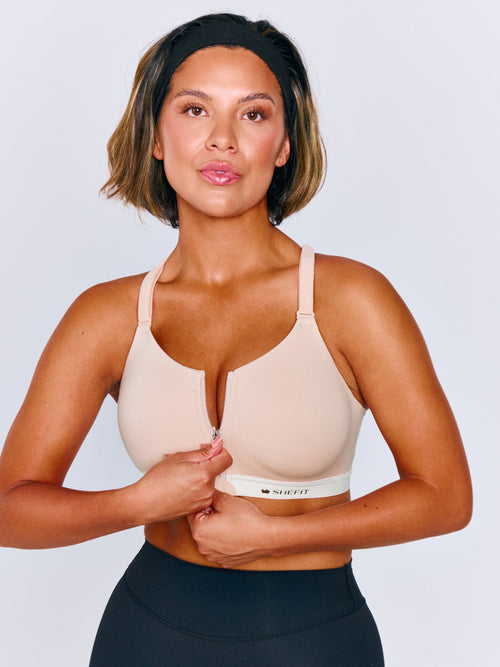
- Front closures mean you can get in and out without straining your shoulders after a long class
This is where third-party reviewers keep landing on SHEFIT. The Thewearify 2026 yoga bra roundup ranked the Flex first overall, calling out that it "offers a level of adjustability that is rare in the yoga bra category. Its front hook-and-loop closure and adjustable shoulder straps let you dial in the fit precisely." Runna's 2026 guide named the Ultimate best for large breasts and best for adjustability, noting it "allows you to fine-tune the fit in a way fixed-size bras can't." For a practice that never holds still, a bra you can adjust mid-week to match the class is a genuine edge.
SHEFIT's Yoga Sports Bras
Two bras cover most of what yoga throws at you, and which one fits you depends on your bust size and how hard your classes run. Both close in the front, which matters at the end of a sweaty class when your arms are tired and the last thing you want is to reach behind your back to find a hook.
| Bra | Price | Impact | Closure | Best For |
|---|---|---|---|---|
| Flex Sports Bra | $65 | Medium (high for 32C and under) | Front zipper | Vinyasa, power yoga, hot yoga |
| Ultimate Sports Bra | $69 | High | Front zipper | Larger busts, or anyone wanting maximum control |
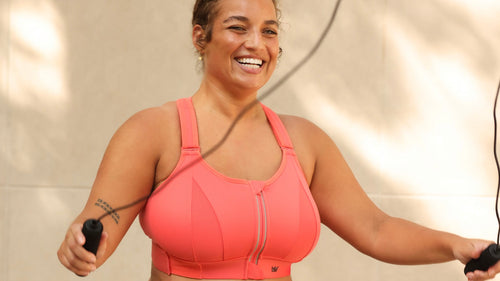
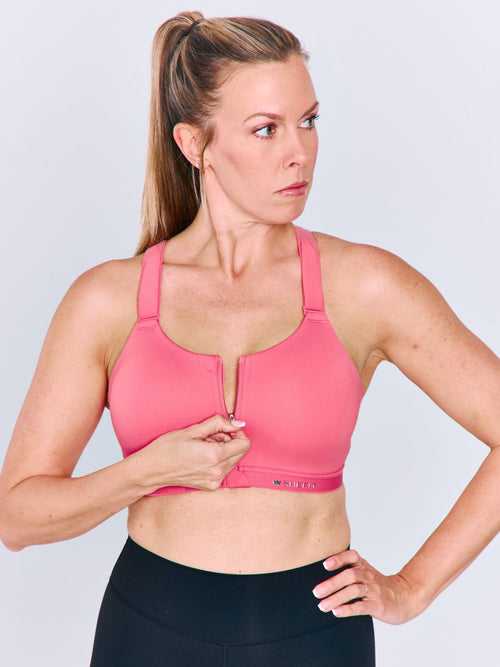
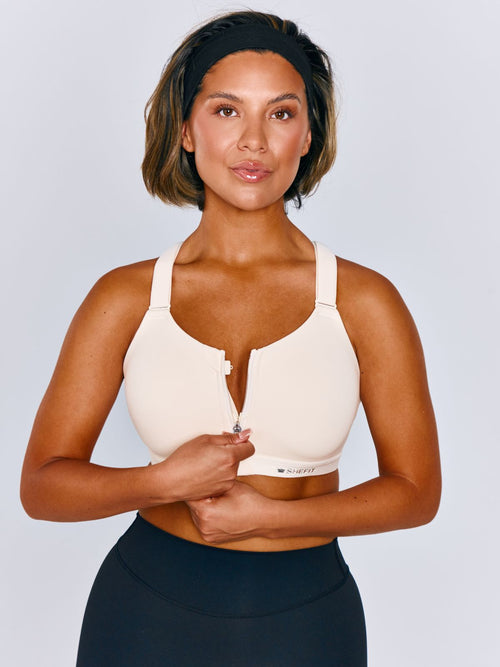
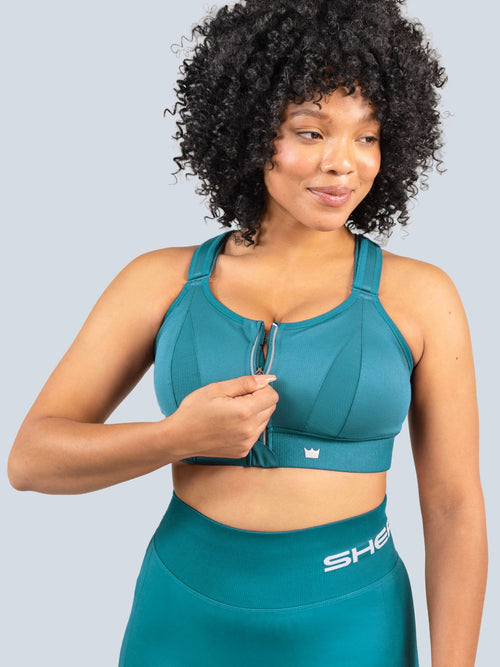
The Flex Sports Bra pairs patented adjustable features with wire-free seamless cups for a medium to high-impact, sculpted fit. Adjustable shoulder straps that secure personalized lift keep it in place through overhead work, the cinch rib band lets you dial the fit in without wrestling anything behind your back, and the front zipper closure makes getting it on and off easy. It runs high-impact for smaller bust sizes (32C and under) and medium-impact for larger sizes, which makes it the natural pick for dynamic and heated classes.
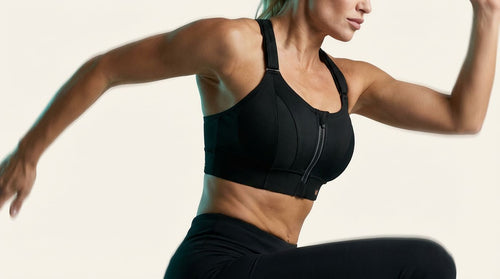
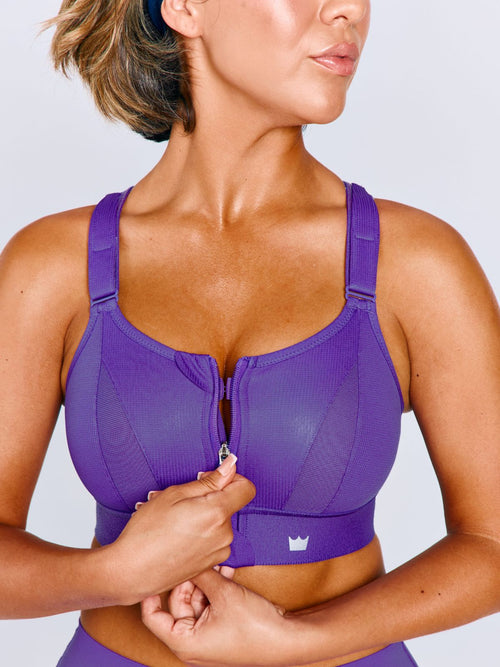
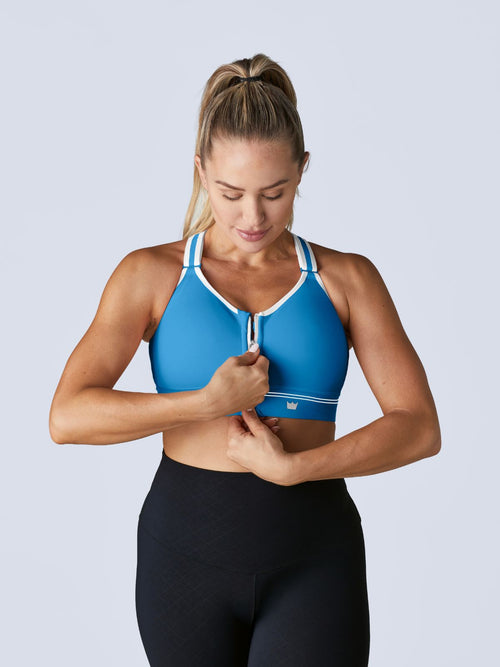
The Ultimate Sports Bra is the high-impact option, with patented adjustable shoulder straps and rib band for a custom fit, removable modesty pads, and a front zipper closure. Independent testing confirms it significantly reduces breast movement during high-impact activity, which is why it earns its place for larger busts and for anyone whose yoga looks more like a workout than a wind-down. Both bras run XS through 6Luxe and cover AA to I cups.
One thing worth knowing before you try either on: SHEFIT bras lift higher than conventional bras, so you may see some armpit skin that used to stay hidden. That is not spillage. Spillage is breast tissue overflowing the cup. What you are seeing is normal tissue lifted into view by proper support, which is exactly what a bra doing its job looks like.
Both bras adjust from the front. For a yoga practice, that is more practical than it sounds. You are not stopping mid-warrior to reach behind your back and shift a strap. You adjust at the start, and the bra holds through the whole session. When you come out of a 90-minute hot class with tired shoulders, a front zipper is a meaningful quality-of-life feature.
How to Check Your Yoga Bra Fits
A bra that feels right standing at the mirror can still fail you in a fold or a twist, so test it the way you will use it. The common mistake is evaluating fit in a single position. Reach overhead and then fold forward before you commit to a bra for practice. Run through these checks:
- Band: it should sit firm and level without riding up. Roughly 80% of a bra's support comes from the band, which is why bra expert Jené Luciani Sena tells women to check the back for support, not the cups.
- Cups: no gaping at the top, no compression spillage over the edges
- Straps: supportive without digging into your shoulders
- Movement: reach overhead, twist side to side, and fold forward; the bra should stay put through all three
Then add two yoga-specific tests that matter more here than a jumping jack would. Do a slow forward fold and check that the band stays anchored instead of creeping up your back. Move into Warrior I with both arms overhead and watch whether the shoulder straps shift or hold. Those two movements catch the fit problems yoga actually creates.
If you practice hot yoga, add one more check: after 20 minutes in a warm room, does the band feel tighter or start to roll? Deep, sustained breathing expands your ribcage with every inhale, and a band that felt fine at rest can start to feel restrictive as the class wears on. Adjustability solves this in a way a fixed-size bra cannot.
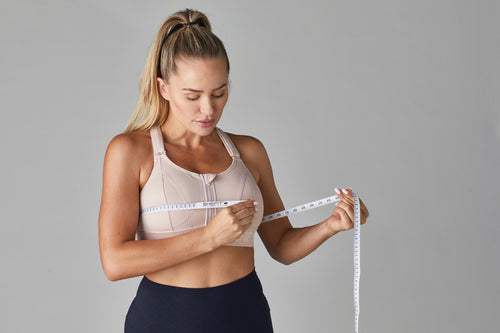
If you are between sizes or unsure where to start, SHEFIT sizes by measurements in inches rather than cup-letter guesswork, and the sports bra size chart walks you through measuring at home. Two measurements give you a more accurate starting point than any traditional cup letter can.
Fabric and Care: What to Look For in a Yoga Bra
Fabric quietly decides whether a bra survives a hot class or turns into a wet, clingy problem halfway through. The look of a bra and the performance of its fabric are often completely unrelated, and what works in a temperate studio can fail in a heated one. Keep a short checklist in mind when you are comparing options:
- Moisture-wicking fabric (nylon, polyester, or polyamide blends with elastane) is essential for hot yoga; mesh panels add ventilation where you need it
- Seamless or flat-seam construction cuts friction during floor postures and twists where the bra edges press into skin
- Padded or structured cups hold their shape and keep you modest when the fabric is soaked, and removable padding lets you choose
Care is simpler than most tags suggest. A sports bra lasts roughly 30 to 40 washes before the elastic starts to fade [3]. Wash cold, skip the fabric softener, and air dry flat to protect the stretch that does the actual work.
Fabric softener coats the fibers and blocks the moisture-wicking channels. Once those channels are clogged, the bra stops moving sweat away from your skin even when the fabric looks fine. Skip it for every wash, the second and thirtieth included.
Frequently Asked Questions
Can I wear a high-impact running bra for yoga?
Yes, though it may be more compressive than a restorative class needs. A correctly fitted bra does not restrict breathing during submaximal exercise, so the issue is never support level on its own, it is excess compression from poor fit. If a high-impact bra fits you well, it will serve you fine across most yoga styles.
The one area to watch is deep pranayama work or breath-focused classes. A band that is snug at rest can feel tighter during extended breath retention. The solution is not to switch bras, it is to make sure the band is not too tight in the first place.
Do I need a different bra for hot yoga?
For heated classes, moisture-wicking fabric and a stable underband move from nice-to-have to essential. Padded cups also help maintain modesty once the fabric is soaked through, which happens fast in a hot room.
You do not necessarily need a separate hot yoga bra, but you do need one built for heat. Something that performs beautifully in a 70-degree studio can become uncomfortable and clingy in a 95-degree room. Fabric choice is what separates the two.
How do I know what support level I need for my yoga practice?
Match support to two things at once: the intensity of your class and your bust size. Larger busts benefit from at least medium support even in gentler classes, while smaller busts can often stay comfortable in light support until the practice turns dynamic.
If you are unsure, use the support table earlier in this guide and default to the higher support level when a style falls in a middle range. It is easier to practice in slightly more support than you need than to spend class managing a bra that was not built for what you are doing.
What size SHEFIT bra should I get for yoga?
SHEFIT sizes by measurements in inches rather than cup-letter guessing, so start with the sizing guide and measure at home. If you land between sizes, size up for more coverage and size down for more control.
Measure around the fullest part of your bust and again around your ribcage just below the bust line. Those two numbers are what drive the fit, not a letter assigned differently by every brand. The sizing guide walks you through the process at home in about two minutes.
How often should I replace my yoga sports bra?
Plan on every 30 to 40 washes, or sooner if the elastic degrades and the band no longer holds firm. Once the band stops doing its job, the bra stops supporting you no matter how good it looks.
Two signs to watch for: the band rides up during class (instead of staying level across your back), and the bra no longer snaps back to shape after a wash. If either of those shows up, the elastic has stretched beyond where it can recover, and it is time to replace rather than adjust.
If you practice hot yoga multiple times a week, expect to rotate two bras and replace each one more often. The combination of heat and heavy sweat accelerates elastic degradation faster than occasional use in a temperate studio, even with careful washing.
The Bottom Line
Yoga is not one intensity, so there is no single yoga bra. The honest answer is to match your support to the class you actually take and the body you actually have, then let a bra you can adjust absorb the difference between a slow Yin session and a sweaty power flow. For most practitioners that means medium support with the ability to fine-tune, which is precisely the gap the Flex and Ultimate were built to fill.
If you are not sure where to start: find your class on the support table in this guide, factor in your bust size, and choose the bra that fits the higher end of what you practice. It is easier to wear a medium-support bra through a gentle class than to power through a hot flow in a bra that was not made for it.
And once you have the right support level, make sure the fit is right. A bra with the perfect support rating and a band that rides up is still a distraction. Adjust it to your body, test it through a few movements before you commit to an hour on the mat, and if you need to fine-tune mid-week as your classes change, let the adjustability do its job.
A bra that fits the way you move is the one you forget you are wearing, which is the whole point of getting on the mat in the first place.
References
[1] McGhee & Steele. "Biomechanics of Breast Support for Active Women." Exercise and Sport Sciences Reviews (ACSM journal), 2020. https://journals.lww.com/acsm-essr/fulltext/2020/07000/biomechanics_of_breast_support_for_active_women.1.aspx
[2] "Sports Bras for Yoga and Everyday Wear." Bjorn Borg. https://www.bjornborg.com/us/stories/guides/sports-bras-for-yoga-and-everyday-wear/
[3] "How to Find Your Perfect Sports Bra." Runners Need. https://www.runnersneed.com/expert-advice/gear-guides/sports-bra-buying-guide.html