Which Bra Is Right for You? Learn More


Cold water. No fabric softener. Never the dryer. If you have read one sports bra care guide, you have read that list, and there is nothing wrong with it. Every one of those rules holds up.
What the list does not tell you is why the bra in your drawer stopped holding you the way it did in March. All three rules are aimed at fabric, and fabric is rarely the part that fails first. The band elastic goes. The straps lose their tension. The closures loosen. Those are the parts doing the work of support, and a routine judged only by whether the fabric survived the wash is not actually being judged on the thing you care about.
At SHEFIT, we think about laundry the way we think about the bras themselves: in parts. So this is less a checklist than a way of looking at one. Which components you are protecting when you wash, how to pick a method you will realistically keep doing, and how to tell whether the routine is working by how the bra fits rather than by how it smells.
None of that means throwing out the three rules you already know. It means understanding what they are actually protecting, so you can apply the same thinking to the parts they were never designed to cover.
By the end, the goal is not a stricter routine. It is a way of judging the one you already have.
The Three Parts That Actually Decide Whether Your Bra Still Fits
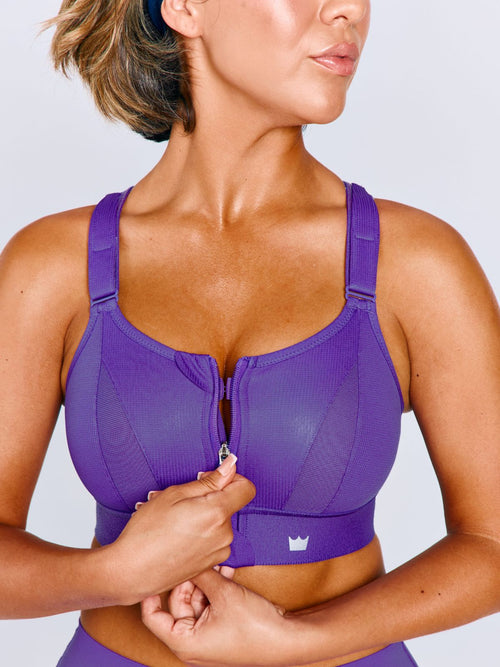
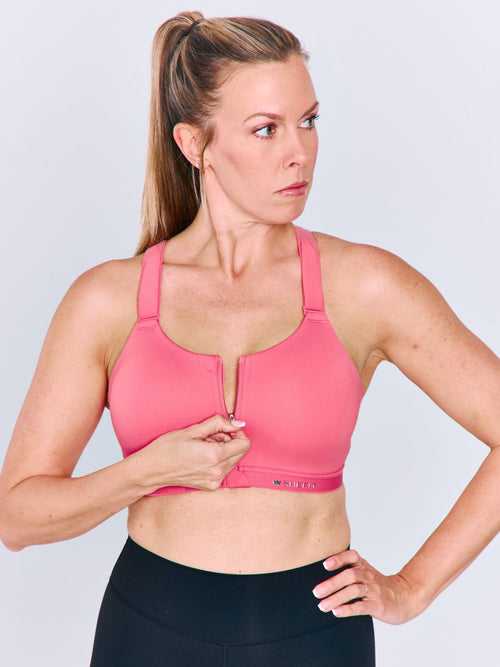
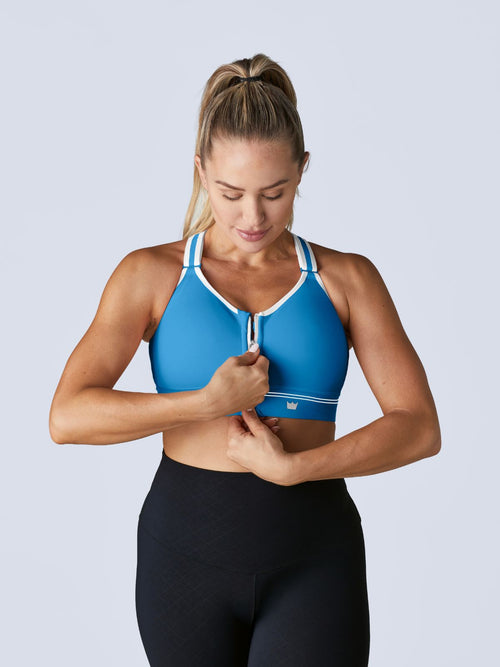
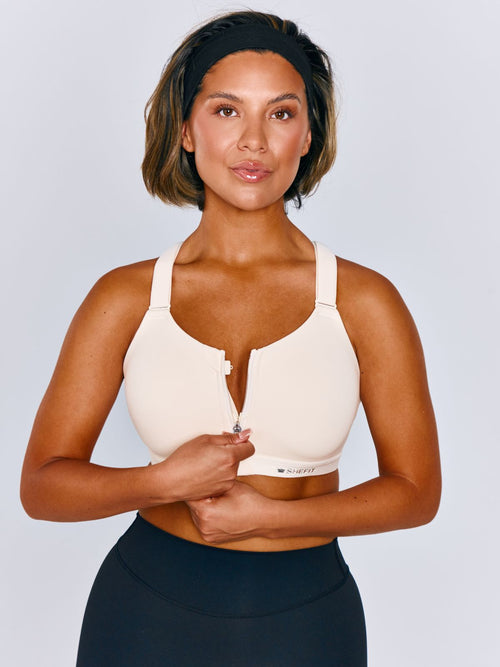
A sports bra reads as one object in the laundry basket, which is exactly why generic care advice treats it as one material. It is not. On an adjustable bra like our Ultimate or Flex, the adjustment system has three distinct parts, and each one has its own relationship to the wash:
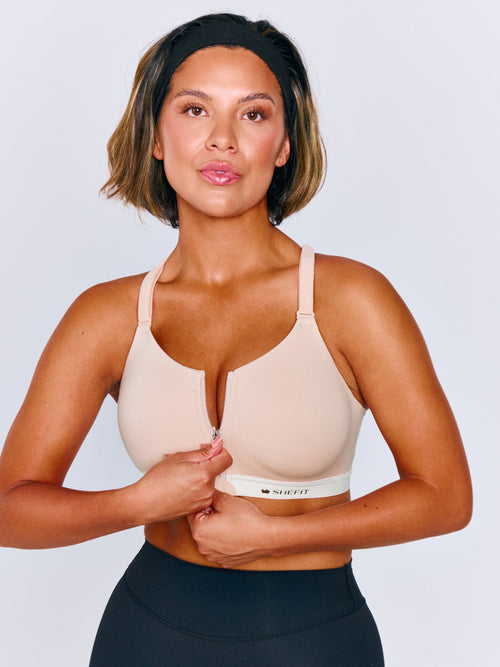
- The front zipper opens and closes for access. That is its whole job. It never sets compression, and it is not something you tighten or loosen to change the fit.
- The Velcro rib band around your torso is what sets compression and support. This is the piece you cinch, and the piece whose grip you notice first when it is gone.
- The adjustable shoulder straps set lift. Ours do not stretch, which is the point: non-stretch straps maintain lift wash after wash, where a stretchy strap gives up tension gradually enough that you may not notice until the lift is gone.
The practical consequence is small and specific. Fasten every closure before a bra goes into a machine. A hook or a strip of exposed Velcro that stays open will find another garment, and it will find the drum. Both REI and Marathon Sports build that same instruction into their machine-wash steps [1] [2], and it protects the bra and everything washing alongside it.
Skip that one step and the risk extends past the bra itself. An open Velcro hook can snag a delicate top or pull a thread loose on whatever else is in the load, which is part of why a mesh bag earns its place even on a load where the bra is the least of your worries.
The other consequence is that these parts age on different clocks, which is why a bra can feel wrong in a way that is hard to name. Band elastic degrades from heat and from being held at tension. Strap tension is mostly a construction question, which is why non-stretch straps behave differently over a year than stretchy ones. Velcro is a mechanical part that collects lint and fabric fuzz in its hooks and grips less firmly when it is loaded up, which is worth knowing because it looks exactly like elastic failure and is not. Run a fingernail or an old toothbrush across the hook side occasionally and you may get grip back that you thought was gone.
Cup fabric, meanwhile, is the part you see and the part that tends to outlive everything else. It fades, it pills at the seams, and none of that has much to do with whether the bra is still holding you. Judging a bra by how the fabric looks is how women end up throwing out a bra that still works and keeping one that stopped working months ago.
Component-level thinking also changes the diagnosis later. When a bra stops supporting you, one of these three things is usually the reason, and only one of them, the band, tends to announce itself.
That is also why a single washing rule can be right for one part and beside the point for another. Cold water protects fabric color and prevents the fading you notice on the cup, but a band's grip is a function of elastic memory and Velcro cleanliness, not water temperature, so the fabric-safe wash does nothing to save a band that is failing for mechanical reasons. Treating the bra as one material means every fix gets aimed at the part that is easiest to see rather than the part that is actually wearing out.
Hand Wash or Machine? Choosing by How You Actually Live
Here is the honest version: both work. Every care guide we scraped treats machine washing as legitimate when it is done carefully, and none of them treats hand washing as the only acceptable method. The question is not which one is correct. It is which one you will still be doing in November after five workouts a week and a school pickup schedule.
The machine route
Fasten the zipper, the band closure, and any hooks. Put the bra in a mesh or lingerie bag so it cannot wrap around anything. Run a cold or delicate cycle. Skip the fabric softener entirely. Done that way, the machine holds up as well as any basin.
The mesh bag is doing more work than it looks like it is doing. A drum full of jeans is a rough environment, and an unbagged bra tangles, gets pulled at the straps, and takes the brunt of every zipper and hook in the load. The bag turns the machine into something closer to a controlled soak with agitation. Load the bra with soft items rather than towels and denim if you have the choice, and if your machine has a spin-speed setting, take it down.
A high spin speed is where a lot of the strain happens that people blame on the wash cycle itself. Spin is what wrings the water out at the end, and it does that by force, which is the same kind of stress a hand wringing motion applies, just distributed across the whole load instead of concentrated in your hands. A lower spin setting takes a little longer to leave the bra reasonably dry, but it is a small trade against a component that is expensive to replace.
Detergent matters more than most guides admit. Use less than the cap suggests, since the caps are sized for cotton loads and excess detergent has nowhere to go in a tight synthetic knit. A formula made for performance fabric is worth it if you own one, mainly because it is built to lift oils out of synthetics rather than to soften and coat them.
The hand route
Fill a basin with cool-to-lukewarm water and a mild detergent. Let it soak long enough for the detergent to actually work, then massage gently, paying attention to the band and the seams where the straps meet the cups, since that is where sweat concentrates. Rinse until the water runs clear, and press the bra between two towels rather than wringing it [3]. Wringing is the step that does damage: it stretches elastic and distorts the shape of the cups.
Hand washing buys you two things a machine cannot. You control how long the detergent sits on the fabric, which is the variable that actually clears odor out of synthetics. And you can work the specific places sweat concentrates rather than trusting a cycle to reach them. For anyone who hand washes occasionally rather than always, the bras that have started to hold a smell are the ones worth the basin.
It does not have to be all or nothing. A lot of women land on a hybrid: machine wash on ordinary weeks, and pull a bra aside for a hand wash when it has had a particularly hard workout or has started to hold odor between washes. That is not a compromise so much as matching the method to what the bra actually needs that week, which is the same component logic the rest of this routine is built on.
On water temperature, guidance genuinely splits. Cold-to-lukewarm is the default across care guidance and the safest choice for fabric. Adidas takes a more permissive line and treats warm or hot water as acceptable, and helpful for breaking down bacteria [4]. Both positions are about wash water, which is a separate question from dryer heat, and the gap between those two is where most of the confusion about heat actually lives.
How often
Frequency is its own debate, and the honest answer is that it depends on how much you sweat and how warm your climate is more than on any number. Sweat sits in synthetic fibers in a way it does not in cotton, and textile research supports the general point that polyester and nylon hold odor more stubbornly than natural fibers, and that clearing it takes real detergent contact time, which a quick rinse does not provide. Practically, that means a heavy sweat session earns a wash, and a gentle one may not.
What does not work is leaving a damp bra balled up in a gym bag until laundry day. The odor that develops there is the kind that survives a wash, and it develops in hours. Hang the bra to dry as soon as you take it off, even if it is not going in the machine that day, and store bras flat or loosely rather than folded cup-into-cup, which creases the shape you are trying to protect.
The gym bag scenario is worth dwelling on because it is the most common way a genuinely good wash routine gets undone between washes. You can do everything right on wash day, cold cycle, no softener, careful drying, and still end up with a bra that smells because it spent six hours damp in a closed bag before it ever reached the machine. The fix costs nothing: pull it out and hang it the moment you are done, even if you are heading straight into the next thing. That single habit does more for odor control than switching detergents ever will.
A French environmental agency guideline that circulated recently suggested around three wears for sportswear, but that recommendation was made on resource-conservation grounds rather than hygiene ones, so it is a poor basis for deciding when your own bra needs washing.
What Removable Pads Need That the Rest of the Bra Doesn't
Removable modesty pads are the fourth part, and the only one that benefits from being separated out.
Take them out before the bra goes in the water. Left in place, they fold, migrate to the edge of the cup, and come out of the wash with a crease that does not fully recover. Wash them by hand, or in the garment bag alongside the bra, and reshape them with your fingers while they are still damp so they dry in the curve they are meant to hold [5]. Then let them air dry flat, separately from the bra, since a pad sandwiched inside a damp cup takes twice as long to dry and holds moisture against the fabric the whole time.
The reshaping step is the one people skip, and it is the one that matters. Foam holds whatever shape it dries in, so a pad that dries folded stays folded, and a pad that dries flat when it was meant to be curved will sit oddly in the cup forever after. Thirty seconds of smoothing it back into shape while damp saves the pad. Keeping pads in pairs also helps, since a pad from a different bra is rarely the same size and the mismatch shows.
Not every bra has this step. Our Ultimate comes with removable modesty pads, so it does. The Flex has smooth non-padded cups, which means nothing to remove, nothing to reshape, and one less part to lose in the laundry. Never putting the pads back in the bras that have them is a preference rather than a mistake.
Skip the Dryer and the Fabric Softener: Here's the Mechanism
Most women arrive at a care guide half-convinced that washing is what wears a bra out, and that more washing means a shorter life. That gets the mechanism backwards. Washing is maintenance. Two specific steps are what cause the damage, and both are avoidable.
Dryer heat breaks down the elastic and the fabric, and over time the bra loses support [1]. This is the mechanism, and it is worth being precise about it, because it is dryer heat rather than wash-water temperature that does the work. Fifteen minutes of tumbling on warm undoes more than a season of cold cycles. Our bras are built to withstand a low-heat dryer cycle, so one trip through the dryer on low will not undo yours. Treat that as the margin for error, though, not the routine, because laying flat is still better. Air dry instead: flat on a rack or a towel, or draped over a bar. Avoid hanging a bra by its straps, which can stretch ordinary elastic straps over time [4]. Our non-stretch straps are built to resist exactly that kind of gradual give, but flat drying is good practice for any bra, and it keeps the weight of the water off the shoulder seams.
Fabric softener clogs the fibers of performance fabric, so sweat and dirt stay trapped instead of washing out, and the fabric loses the breathability and wicking it was engineered for, so sweat has nowhere to go [2]. The bra comes out smelling like softener rather than clean, a different outcome entirely. Dryer sheets do the same work by a different route.
Skip those two steps and washing becomes the thing that extends the bra rather than the thing that degrades it. In our own wash testing, the Ultimate and Flex held up through 25 wash cycles before showing obvious wear, and that number assumes the bra is being washed regularly, not spared.
That last point is the one worth sitting with, because it runs against instinct. The instinct is to wash less to make a bra last longer. The testing says the opposite: a bra washed on a normal schedule with heat kept out of the picture outlasts one that gets worn repeatedly between washes and then hit with a hot dryer to catch up. Heat is the variable that matters, not wash count, and once that is separated out, skipping washes to protect the bra stops making sense.
How to Tell If It's the Wash Routine or the Bra Is Just Done
This is the part no care guide gives you. Every ranking article on this topic offers a static list of replacement signs, and none of them offers a way to tell, mid-routine, whether the way you are washing is protecting the support or quietly eroding it. The test is fit, not smell. A bra can come out of the wash smelling perfect and be structurally finished, and it can smell faintly of last Tuesday and still hold you exactly as designed.
Run through the specifics rather than asking yourself the vague question of whether it still fits right:
| What you notice | What it usually means | What to do |
|---|---|---|
| Band still grips at a middle setting; you have room to cinch tighter | The elastic has life in it | Nothing. The routine is working |
| Band feels loose even at its tightest setting | The band can no longer anchor the bra during impact | Replace it. This one is not recoverable |
| Straps slide off your shoulders or need constant readjustment mid-workout | Strap tension is gone | Replace it |
| Bra rides up into your armpits or chafes where it never did | The bra is moving against your skin instead of staying put | Replace it, or recheck the size |
| Odor persists after a full wash but the band still grips | Detergent contact time, not structural failure | Longer soak, thorough rinse, no softener |
| Cups look creased or misshapen after drying | The pads or cups dried folded | Reshape damp, dry flat |
Two of those deserve unpacking. Chafing is worth naming precisely, because the instinct is to blame seams. Our Ultimate is not seamless, and chafing does not come from seams. It comes from the bra moving against your skin, which means the fix is a fit that stays in place, not a smoother construction. If a bra that never chafed suddenly does, something in the fit has shifted, and the band is the usual culprit.
The other is armpit skin, which gets misread constantly. Visible skin at your underarm when a bra lifts properly is normal anatomy, not a fit failure, and it is not a sign you have washed something wrong. Spillage is the actual thing to watch, meaning tissue that pushes out past the cup edge. That distinction matters here because a fit-based check only works if you are checking the right things.
If the band is the one carrying the majority of the support, which it is, roughly 80 to 90 percent of it depending on whose figure you use, then band grip is the single most informative signal in that whole table. Check it first, and treat the strap and zipper checks as confirmation rather than as three equally weighted questions.
That ordering also explains why a bra can pass every other check in the table and still be done. Straps sliding and cups creasing are real signals, but they are secondary ones. A band that has lost its anchor will let a bra move during impact even if the straps are perfectly tensioned and the cups look brand new, because the band is what keeps the whole structure from traveling in the first place. Start there, and only look further down the table if the band still grips the way it should.
The check itself
The reason this works as a verification rather than just a diagnosis is that you can repeat it and watch the trend. Pick one bra you wear regularly and do this three or four times a year:
- Put it on and set the band where it feels right, then note roughly where that setting sits. Somewhere in the middle is what you want, because it means you have room left.
- Move. Not a full workout, just enough impact to see whether the band stays put or starts to travel upward.
- Check the straps at the end. Adjusting them once and then forgetting about them means the tension is intact.
If the band setting you need creeps steadily tighter across those checks, the elastic is aging, which is normal and expected. If it jumps tighter over a single season, something in the routine is accelerating it, and the dryer is the first place to look. That is the difference between a bra wearing out on schedule and a bra being worn out by how it is being cared for, and it is a distinction you cannot make from a single snapshot.
Writing the setting down matters more than it seems like it should. Memory is unreliable for something this gradual, and a band that has crept two notches tighter over four months feels normal in the moment because you adjust to it a little each time you put the bra on. A note on your phone, even a rough one, is what turns this from a feeling into something you can actually track.
Building a Routine That Holds Up
The rotation does more work than any single wash step. Owning two or three bras and cycling through them, one being worn, one in the wash, one ready, cuts how often each individual bra gets laundered and gives the elastic time to recover between wears. It also removes the pressure that leads to shortcuts, since nobody hand washes carefully at 10pm when it is the only clean bra for tomorrow.
How many you need comes down to how often you train. Two covers someone working out two or three times a week with a regular laundry cycle. Three is the comfortable number at five or six sessions, and it is where the one-worn, one-washed, one-ready pattern actually holds without a gap. Past that you are buying convenience rather than longevity, though a bra kept for high-impact days and another for lower-impact ones does spread the wear sensibly, since the high-impact bra is the one whose band works hardest.
Rotation also protects the specific parts this whole approach is built around. A band that gets a day or two of rest between wears has time for the elastic to relax back toward its resting shape before it is asked to stretch again, which is a different situation than a single band being cinched and washed on a two-day loop indefinitely, with no real recovery time in between. The zipper and the Velcro see less total wear per bra too, simply because each one is spending more of the week off duty. None of that shows up immediately. It shows up as a bra that is still on its original band setting a year later, instead of one that needed re-cinching every few months.
Beyond that, the goal is a routine you will actually keep rather than a perfect one. A mesh bag and a cold cycle done every time beats a hand wash done twice and then abandoned. And if you are shopping for a bra where this kind of component maintenance genuinely pays off, the Ultimate and the Flex are built around an adjustable rib band and non-stretch straps you can keep dialing in as the seasons and your body change. That is a different proposition from wearing a bra until it gives out.
Sports Bra Washing Questions, Answered
Can a sports bra go in the washing machine?
Yes. Fasten every closure, use a mesh or lingerie bag, and run a cold or delicate cycle without fabric softener. For most people that routine is the one that actually gets followed week after week, which counts for more than the theoretically gentlest method.
How do I wash a sports bra that leaves my skin itchy?
Two likely causes, and neither is the seams. Detergent residue left in synthetic fibers is the first, so use less detergent than feels right and rinse until the water runs completely clear. Movement is the second: a bra shifting against your skin during a workout irritates it, and that points to fit rather than fabric.
What is the three bra rule?
It is a rotation heuristic more than a rule: one bra being worn, one in the wash, one ready to go. The same rotation pattern shows up in care guidance across the board. Three is convenient, not required, and two works if your laundry cycle is quick.
Why does my bra still smell after washing?
Synthetic fibers hold odor compounds more tightly than cotton does, and a short cold cycle may not give the detergent enough contact time to release them. Try a longer soak before the wash, use a detergent formulated for performance fabric, and make sure the rinse is thorough. If the smell survives all of that and the band has also lost its grip, the bra is finished rather than dirty.
References
[1] Paige Frederick-Pape. "How to Care for Your Sports Bra." REI Co-op. https://www.rei.com/learn/expert-advice/how-to-care-for-your-sports-bra.html
[2] "How to Wash your Sports Bras." Marathon Sports. https://www.marathonsports.com/blog/how-to-wash-your-sports-bras
[3] "How to Wash Workout Clothes." Martha Stewart. https://www.marthastewart.com/how-to-wash-workout-clothes-11972225
[4] "Stay Supported: How To Care For Your Sports Bra." Adidas. https://www.adidas.com/us/blog/827894-stay-supported-how-to-care-for-your-sports-bra
[5] "How to Wash a Sports Bra." Runner's World. https://www.runnersworld.com/gear/a68855411/how-to-wash-sports-bra/