2X REWARDS POINTS · OCT. 6–7 ONLY Sign In


Every activewear brand publishes a sports bra size chart. Almost none of them explain what the numbers actually mean, why your everyday bra size might not translate, or how to tell when a bra that looks right on paper is wrong on your body. The result is a cycle most women know well: order a size, try it on, feel the band ride up during a run, return it, try again.
An estimated 85% of women are wearing the wrong bra size [1]. That number becomes even more frustrating when you realize that sports bras require a tighter, more precise fit than everyday bras to actually control breast movement. At SHEFIT, we designed our entire product line around solving this problem, because a size chart is only useful if you understand how to read it, how to measure yourself accurately, and what a correct fit actually feels like.
This guide walks through the full process: how sports bra sizing works, how to take your measurements, what the numbers in a size chart mean, and how to verify that the bra you chose is doing its job.
Why Sports Bra Sizing Is Not the Same as Regular Bra Sizing
Your everyday bra and your sports bra serve fundamentally different purposes. A regular bra provides shape and light support. A sports bra needs to control breast movement across three planes of motion during physical activity. That difference in function means the fit requirements are stricter.
Sports bras need a tighter band. The band is responsible for the majority of support (bra fitting expert Jene Luciani Sena puts it at roughly 90%), which means a band that feels fine in an everyday bra may be too loose during a run. If your band rides up when you raise your arms overhead, it cannot anchor the bra against your ribcage during impact.
The other complication is sizing systems. Some brands use traditional band and cup sizing (32C, 36DD). Others use alpha sizing (S, M, L, XL), which collapses a wide range of bust sizes into a single letter. A "Medium" at one brand might cover 34A through 36C. At another brand, it covers 34D through 36B. Some brands go a step further and use their own proprietary size language: at SHEFIT, for example, "Large" is called Luxe, and our size range runs from XS to 6Luxe. Without a universal standard, the same woman can be three different sizes across three different brands.
Because bra sizing is not regulated, SHEFIT recommends using your actual measurements in inches rather than relying on traditional cup sizes. Measurements are the one piece of information that travels reliably across brands, which is why the rest of this guide starts with how to measure yourself accurately.
How to Measure Your Sports Bra Size
Accurate measurements are the foundation of a good fit. Before you start, make sure you have the right tools and you are wearing the right bra.
What you will need:
- Paper and something to write with
- A fabric measuring tape (preferred, easiest and most accurate). If you do not have one, a piece of string or a thin strip of fabric works as a substitute, which you then compare against a ruler or a carpenter's tape
- A full-body or vanity mirror
What to wear while you measure:
Wear a comfortable everyday or t-shirt bra (non-padded, unlined is ideal). Do not wear a minimizing or compressive workout bra while you measure. A compression bra flattens breast tissue and will skew your bust number too small, which can send you to a SHEFIT size that is smaller than what you actually need.
If you would rather not measure yourself alone, you have two other options. Our Fit Advisor is a 30-second questionnaire that generates a personalized size recommendation that appears on product pages as you browse. And if you want hands-on help, you can schedule a free 15-minute virtual fitting with one of our professional fitters, who will walk you through the measurement process over a secure video call and answer any questions. Both are free.
For readers who prefer to do it themselves, here is the process.
Step 1: Measure Your Bust
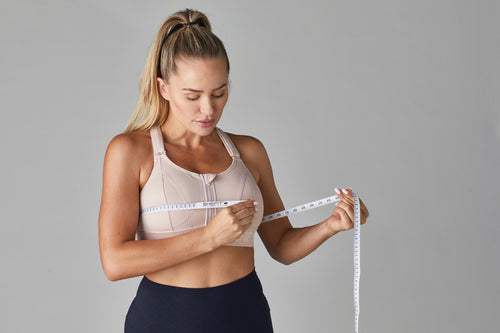
Wrap the measuring tape around your back and slide it up to the fullest part of your bust, just above the nipple. Pinch the beginning and end of the tape together in the center of your chest so the ends line up.
Keep the tape flat against your body and parallel to the floor. Use your mirror to check your back: if the tape is drooping, it is too loose; if it is digging into your skin, it is too tight. Round up or down to the nearest whole number and write it down. This is your bust measurement.
If you are using a piece of string or fabric, pinch the start and end points firmly, then lay the string flat alongside a ruler to read the measurement.
Step 2: Measure Your Band (Ribcage)
Use the same method, but this time slide the tape up directly under your bust. Pinch the ends together in the center of your chest, keep it flat, mirror-check the back, and round to the nearest whole number. This is your underbust measurement, and it corresponds to your band size. The band carries roughly 90% of a bra's support, so the tape should feel snug but not restricting.
Write this measurement down next to your bust measurement.
Match your underbust measurement to your band size using the chart below:
| Underbust Measurement (inches) | Band Size |
|---|---|
| 25-27 | 30 |
| 27-29 | 32 |
| 29-31 | 34 |
| 31-33 | 36 |
| 33-35 | 38 |
| 35-37 | 40 |
| 37-39 | 42 |
| 39-41 | 44 |
Step 3: Find Your Cup Size
Subtract your band size from your bust measurement. The difference in inches determines your cup size.
| Bust Minus Band (inches) | Cup Size |
|---|---|
| Less than 1 | AA |
| 1 | A |
| 2 | B |
| 3 | C |
| 4 | D |
| 5 | DD/E |
| 6 | F |
| 7 | G |
| 8 | H |
| 9 | I |
Example: Your underbust measures 33 inches (band size 34). Your bust measures 38 inches. The difference is 4 inches, which corresponds to a D cup. Your traditional bra size is 34D. Use that number as the starting point when you cross-reference a specific sports bra brand's size chart, because the translation from traditional sizing to a sports bra size is rarely one-to-one.
When to Re-Measure
Your measurements are not permanent. Your body changes through pregnancy and breastfeeding, weight fluctuations, hormonal shifts, and aging. Re-measure every six to twelve months, or whenever a bra that used to fit starts feeling off. If you have gone through a significant body change, measure before your next purchase rather than assuming your old size still applies.
Sports Bra Size Chart (Band, Cup, and Alpha Sizing)
Most sports bra brands sell their products in alpha sizes rather than traditional numeric sizing. The reference chart below shows how traditional band and cup measurements typically map to alpha sizing across the industry. This is a general guide, not a SHEFIT-specific chart; every brand sets its own ranges.
| Band Size | AA-A Cup | B Cup | C Cup | D Cup | DD/E Cup | F-G Cup | H-I Cup |
|---|---|---|---|---|---|---|---|
| 30 | XS | XS | XS | S | S | M | M |
| 32 | XS | S | S | S | M | M | L |
| 34 | S | S | M | M | L | L | XL |
| 36 | M | M | M | L | L | XL | 2XL |
| 38 | L | L | L | XL | XL | 2XL | 3XL |
| 40 | XL | XL | XL | 2XL | 2XL | 3XL | 4XL |
| 42 | 2XL | 2XL | 2XL | 3XL | 3XL | 4XL | 5XL |
| 44+ | 3XL | 3XL | 3XL | 4XL | 4XL | 5XL | 6XL |
One more wrinkle: even alpha sizing is not standardized across brands. SHEFIT replaces "Large" with Luxe in our own size range, so what another brand calls an XL may map to our Luxe tier, a 2XL to 2Luxe, and so on up to 6Luxe.
Because cup letters and alpha labels both vary from brand to brand, we recommend using your actual underbust and bust measurements in inches (from Steps 2 and 3 above) when you cross-reference SHEFIT's sizing page, rather than leaning on a cup letter from another brand. Our sizing chart reads inches directly, which removes the guesswork that comes with translating a cup size across brands. If you fall between two sizes on our chart, we recommend sizing up for more coverage and sizing down for more control.
Understanding Sister Sizes
If you fall between two sizes, sister sizing can help. Sister sizes share the same cup volume but pair different bands with different cups. For example, 34C and 32D hold the same cup volume. If a 34C band feels loose, try 32D for a snugger band with the same cup capacity. Our dedicated sister size guide walks through how to use sister sizing to fine-tune your fit.
How to Check if Your Sports Bra Fits
Numbers get you to the right starting point. The real test happens when the bra is on your body. Run through these five checks before committing to a purchase:
- Band: The band should sit level across your back without riding up. You should be able to fit two fingers between the band and your ribcage, but no more. If the band creeps up when you lift your arms, it is too loose.
- Straps: Straps should feel secure on your shoulders without digging into your skin. They should not slip when you move. Non-stretch straps hold their tension longer than elastic ones, which matters over the life of the bra.
- Cups: Your breasts should be fully contained in the cups with no wrinkles, gaps, or overflow. Each breast should sit in its own space.
- Coverage: Check that the bra does not sit too far under your armpits. A bra that rides up into the armpit is too big and will cause chafing during movement.
- Bounce test: Do 30 seconds of jumping jacks or high knees. Your breasts should feel secure with minimal movement. If you notice significant bounce, the support level or size is wrong.
One thing that surprises many women: a bra that provides proper lift raises breast tissue higher on your chest, which can reveal skin near the armpit that was previously hidden. If you see armpit skin, that is your bra doing its job, lifting you up. Spillage is different: it means tissue pushing over the top or sides of the cup.
Choosing the Right Support Level for Your Activity and Size
A perfectly sized bra in the wrong support level will still let you down. Your breast size and your activity level both determine what you need.
| Activity Level | AA-B Cups | C Cup | D+ Cups |
|---|---|---|---|
| Low impact (yoga and walking) | Low support | Low-medium support | Medium-high support |
| Medium impact (cycling and hiking) | Medium support | Medium support | High support |
| High impact (running and HIIT) | Medium-high support | High support | High support |
Women with larger cup sizes need higher support levels even for activities that seem low impact. Research from the University of Memphis found that greater breast support is associated with reduced peak knee valgus angles and greater trunk flexion during landing movements, biomechanical profiles linked to lower injury risk [2]. The effects extend beyond comfort. Breast support is a key performance indicator during exercise, and insufficient support is linked to discomfort that reduces willingness to exercise [3].
If understanding how impact levels work is new to you, matching your bra to both your body and your activity changes the equation entirely.
Sports Bra Construction Types and How They Affect Sizing
The way a sports bra is built affects how it is sized and who it works best for. There are three main construction types.
| Construction Type | How It Works | Best For | Typical Sizing |
|---|---|---|---|
| Compression | Presses both breasts against the chest wall as one unit | AA-C cups; low-to-medium impact | Alpha sizing (S/M/L) |
| Encapsulation | Surrounds each breast in its own cup for individual support | D+ cups; all impact levels | Band + cup sizing |
| Hybrid | Combines chest wall compression with individual cup support | All sizes; medium-to-high impact | Band + cup or adjustable |
Compression bras dominate the alpha-sized, pullover-style market. They work well for smaller busts during lighter activities, but they lack individual breast control for larger cup sizes during high-impact movement.
Encapsulation bras offer individual support through structured cups, which is critical for D+ cups. They use numeric sizing (34C, 38DD) for a more precise fit.
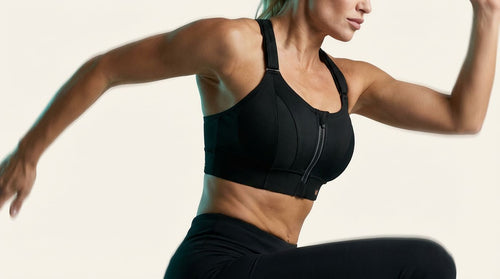
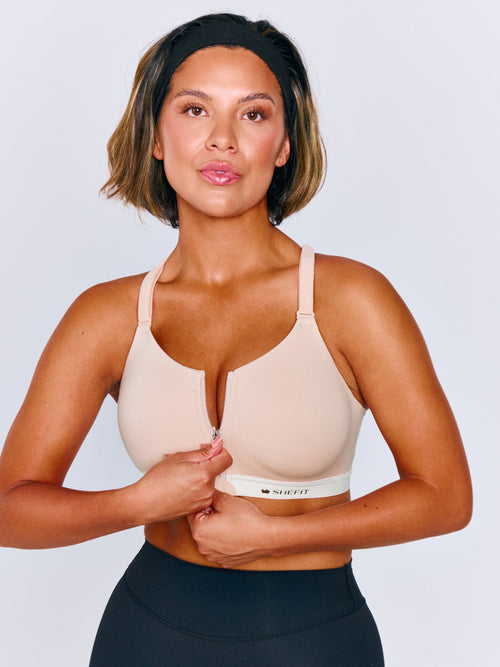
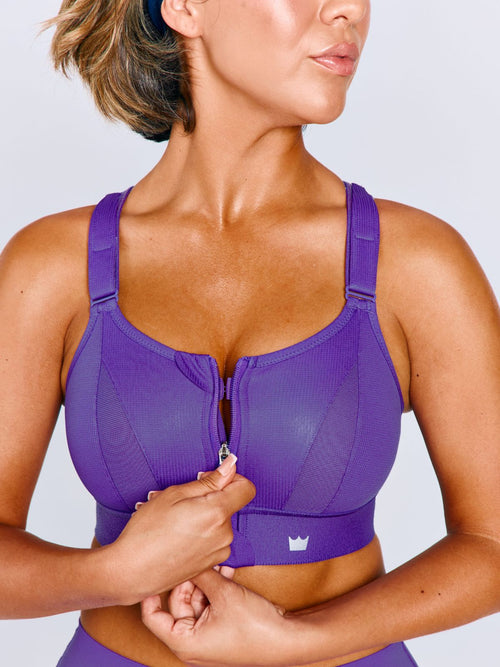
Hybrid designs combine both approaches. They compress against the torso while also providing individual cup support, which delivers the strongest results across all sizes. Both our Ultimate Sports Bra and Flex Sports Bra use this encapsulation and compression design, paired with non-stretch straps that maintain lift wash after wash. For a deeper look at how compression sports bras compare to other construction types, we have covered the full breakdown.
Common Sizing Mistakes and How to Avoid Them
The 85% wrong-size statistic exists for a reason. These are the mistakes we see most often:
Using your everyday bra size without re-measuring. Your regular size is a starting point, not a guarantee. Sports bras fit differently, and your body changes over time. Measure before every purchase.
Ignoring the band. Most women focus on cup size and overlook the band entirely. Since the band carries the majority of support, a loose band undermines everything else the bra tries to do.
Choosing alpha size without checking the underlying measurements. A "Medium" covers a different range at every brand. Always check the specific size chart rather than assuming your usual alpha size transfers.
Not accounting for breast size when picking support level. A C cup doing yoga and a C cup running intervals need different levels of support. Breast size sets the baseline; activity level sets the ceiling.
Wearing a bra past its useful life. Elastic relaxes over time. If the band rides up, straps lose tension, or you notice more bounce than you used to, the bra needs replacing. Most sports bras hold up for about a year with regular use. Bras with adjustable straps and bands last longer because you can tighten them as elastic naturally relaxes.
Women with larger cup sizes face these problems at a higher rate because most brands offer limited options above a D cup. Adjustable designs help close that gap by letting you fine-tune fit rather than relying on a fixed size.
SHEFIT Sports Bra Sizing Guide
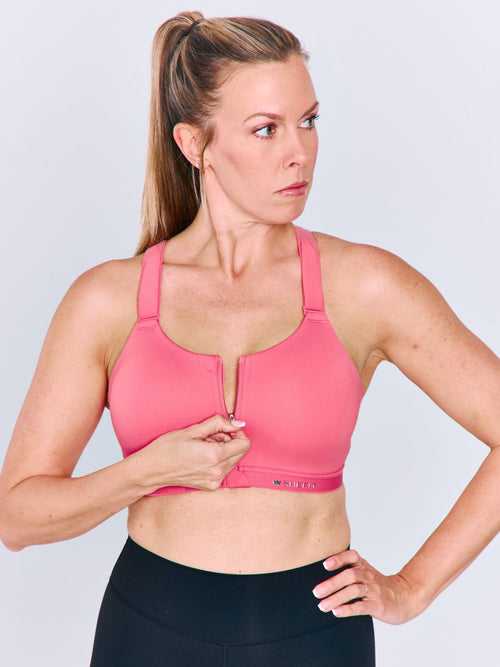
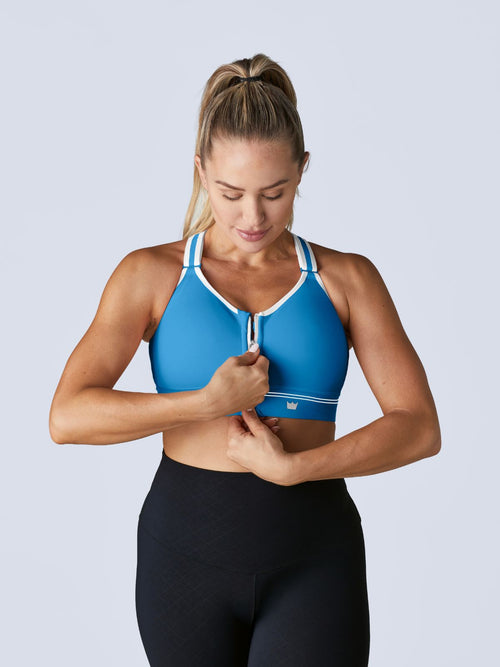
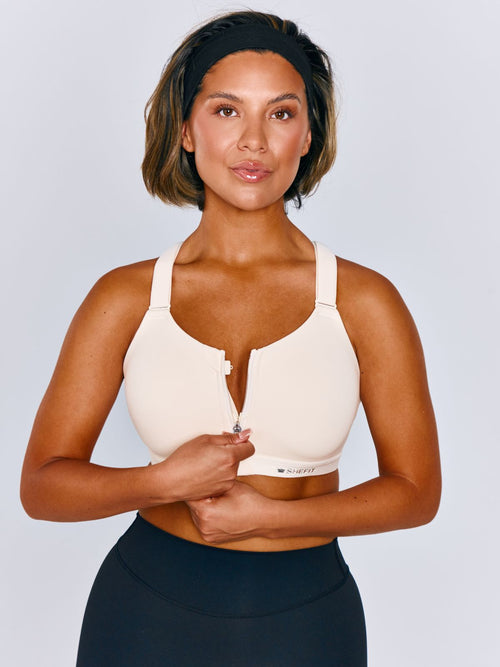
We built our sports bras to solve the exact problems this article describes. Our patented adjustable shoulder straps and rib band let you customize fit continuously rather than choosing from fixed size steps. If your measurements fall between sizes, or if your size changes over time, you adjust the bra to match.
Both our core products use a hybrid encapsulation and compression design, meaning each breast gets individual support while the overall bra compresses against the torso for maximum motion control. Here is how they compare:
| Feature | Ultimate Sports Bra | Flex Sports Bra |
|---|---|---|
| Price | $69 | $65 |
| Support level | Maximum (all sizes) | High (32C and under) / Medium (larger sizes) |
| Design | Encapsulation + compression | Encapsulation + compression |
| Straps | Non-stretch, patented adjustable | Patented adjustable |
| Band | Patented adjustable rib band | Patented adjustable |
| Cup style | Removable modesty pads | Smooth cups, sculpted look |
| Size range | XS-6Luxe, AA-I cups | XS-6Luxe, AA-I cups |
| Best activities | Running and HIIT | Cycling and strength training |
| Durability | Wash-tested to 25 cycles | Wash-tested to 25 cycles |
University of Memphis research found that the Ultimate Sports Bra reduces vertical breast displacement by more than 50% compared to an unsupported baseline during a landing task [4]. Both products are designed for all breast types, from small to large, enhanced or natural.
The Flex Sports Bra is worth noting for women who want a sculpted look with strong support. Our medium-impact rating for the Flex delivers support that rivals what other brands call high-impact.
FAQs About Sports Bra Sizing
How do I know what size sports bra to get?
Start by measuring your underbust (band size) and your full bust. Subtract the band measurement from the bust measurement to find your cup size. Use the brand's specific size chart to match your band and cup to their sizing system. If you are between sizes, size up for more coverage or size down for more control.
What size is a 32 in sports bras?
A 32 band typically corresponds to XS or S in alpha sizing, depending on your cup size. A 32B is usually an S, while a 32DD might be an M. Check the brand's chart because alpha sizing is not standardized.
Can sports bras cause back pain?
A poorly fitted sports bra can contribute to back pain. If the band is too loose, straps compensate by pulling harder on your shoulders, which strains the upper back. A band that sits snug and level distributes the load properly and reduces that strain.
How often should I get re-measured for a sports bra?
Every six to twelve months, or after any significant body change such as weight loss or gain, pregnancy, or hormonal shifts. Your measurements can change without you noticing, and wearing the wrong size affects both comfort and support.
Do sports bras stretch over time?
Yes. Elastic fibers in the band and straps gradually relax with repeated wear and washing. This is why adjustable bras last longer; you can tighten the fit as the material naturally relaxes. Most fixed-size sports bras need replacing within a year.
What if I am between two sizes?
Try both. If one band feels too snug and the next feels too loose, consider sister sizing (going down a band size and up a cup size, or vice versa). Adjustable bras handle this situation well because you can dial the fit rather than choosing between two fixed options.
Does breast size affect which support level I need?
Yes. Larger breast sizes need higher support for virtually every activity level. A woman with D+ cups needs high support even for medium-impact activities like cycling, while an A cup may be comfortable in low support for the same workout.
The right sports bra size is where accurate measurements meet the right construction and support level for your body. A size chart gets you started, but the fit check confirms whether the numbers translate to real support. When adjustability is part of the equation, the margin for error shrinks because the bra adapts to you rather than the other way around.
References
[1] McGhee, D.E. & Steele, J.R. "Optimising breast support in female patients through correct bra fit." Journal of Science and Medicine in Sport, 2010. https://pubmed.ncbi.nlm.nih.gov/20451452/
[2] Fong, H.B., Nelson, A.K., Storey, J.E., et al. "Greater Breast Support Alters Trunk and Knee Joint Biomechanics Commonly Associated With Anterior Cruciate Ligament Injury." Frontiers in Sports and Active Living, 2022. https://doi.org/10.3389/fspor.2022.861553
[3] Risius, D., Milligan, A., Berns, J., Brown, N., & Scurr, J. "Understanding key performance indicators for breast support." Journal of Sports Sciences, 2017. https://pubmed.ncbi.nlm.nih.gov/27291899/
[4] Fong, H.B., Nelson, A.K., McGhee, D., Ford, K., & Powell, D.W. "Increasing breast support is associated with a distal-to-proximal redistribution of joint negative work during a double-limb landing task." Journal of Applied Biomechanics, 2023. https://www.memphis.edu/healthsciences/pdfs/jab-biomech-2023.pdf