Which Bra Is Right for You? Learn More


Full Coverage Sports Bra: What It Means, Who It's For, and How to Find Your Fit
Search for "full coverage sports bra" and you get a shopping carousel, a handful of product pages that use the term as a filter label, and almost nothing that explains what full coverage actually is. Most activewear brands treat the term like a self-explanatory checkbox, blending it together with "high impact," "maximum support," and "longline" until none of them mean anything specific.
At SHEFIT, we have spent years engineering bras around the specific design problem that full coverage solves. The label points to a cup and neckline style that determines how much breast tissue the bra contains, where it contains it, and what kind of movement it can control during activity. Understanding that distinction is the difference between a bra that technically fits and one that actually works.
This guide defines full coverage as a design category, explains who benefits most from it, clears up the most common style confusions, and walks through how to check the fit so you know the bra is doing its job.
What Full Coverage Means in a Sports Bra
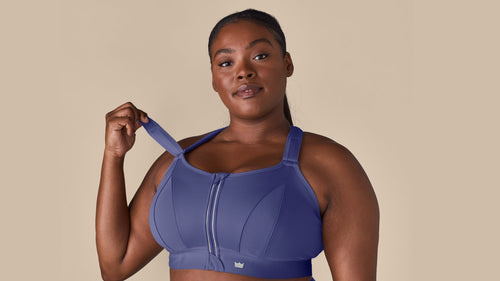
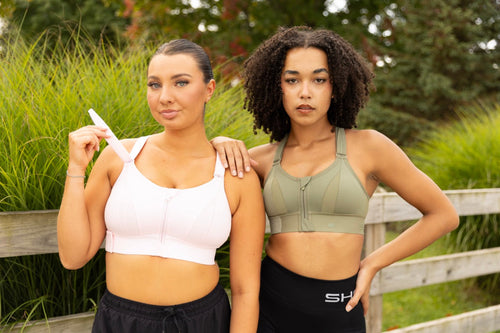
Full coverage describes the shape and coverage of the cup. It means three specific things: a high neckline that fully encloses breast tissue at the upper pole, full underarm enclosure that contains tissue extending laterally toward the armpit, and an encapsulation design that houses each breast in its own cup space rather than compressing them together as a single unit.
This is important to separate from impact rating. A bra can be full coverage AND low impact. It can also be full coverage AND high impact. These are two independent design dimensions.
|
Dimension |
Full Coverage |
Plunge / Scoop |
High Impact |
|---|---|---|---|
|
What it describes |
Cup shape, neckline height, and underarm enclosure |
A lower-cut cup with partial coverage |
An activity rating tied to bounce control |
|
Neckline |
High, fully enclosing upper breast tissue |
Low-cut, exposing the upper portion of breast tissue |
Not specified by the label |
|
Underarm coverage |
Full enclosure, contains lateral breast tissue |
Partial, side tissue may sit outside the cup |
Not specified by the label |
|
Breast containment |
Individual cup space for each breast (encapsulation) |
Often compression-style or partial encapsulation |
Not specified by the label |
|
Best for |
D+ cups, high-impact activity, wearing as a top |
Smaller cups, layering under v-neck tops |
Running, HIIT, and other high-bounce workouts |
|
Overlap with full coverage |
n/a (this is the baseline) |
Different design dimension |
Yes. Many full-coverage bras are also high impact |
When you search for a full coverage sports bra, you are looking for a specific cup design. Make sure the bra you choose also matches the impact level your workouts require.
Who Benefits Most from a Full Coverage Sports Bra
Full coverage is not exclusive to any single body type, but certain groups consistently find it solves problems that other bra styles leave unaddressed.
Women with D+ cup sizes get the most immediate benefit. At larger sizes, breast tissue extends further toward the underarm and higher across the chest wall. A plunge or scoop-neck bra leaves that tissue outside the cup, creating discomfort and movement during exercise. Full coverage contains the full envelope of breast tissue on all sides, including the lateral tissue that standard cups miss entirely. Research confirms that breast support directly affects a woman's willingness to exercise, with insufficient support listed among the key barriers to physical activity [1]. Full coverage directly addresses the coverage gap that creates those barriers. Women looking for sports bras built specifically for larger cup sizes will find full coverage a defining feature of the options that actually work.
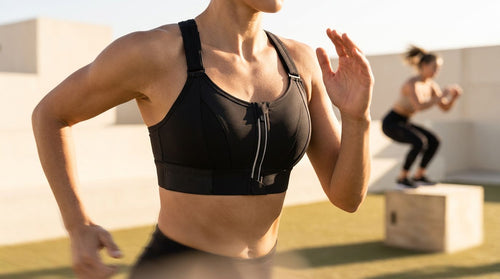
Women who wear the sports bra as a top also gravitate toward full coverage. A high neckline plus full underarm enclosure means no extra layer is needed during outdoor runs, gym sessions, or warm-weather training. The bra covers what needs covering without requiring a tank top on top.
Women returning to high-impact exercise after a break (postpartum recovery, injury rehab, or simply getting back to the gym after time away) want maximum coverage and support during a transition period when their body and confidence are still settling. Full coverage provides a secure, held-in feeling that makes the re-entry less daunting.
Full Coverage vs. Other Sports Bra Styles (Common Confusion Cleared Up)
Three style labels get tangled with full coverage constantly: high impact, longline, and racerback. They describe completely different design dimensions that can coexist in the same bra.
High impact is an activity rating for high-bounce workouts, not a cup shape. Plenty of high-impact bras happen to be full coverage, and plenty are not. Longline describes band length, the band extending down toward the ribcage rather than sitting under the bust. A longline bra can absolutely have full-coverage cups. Racerback is a strap configuration (H-back or X-back) that describes how the straps sit across your back, with no bearing on cup shape.
A full-coverage racerback longline sports bra is a valid combination. Each label addresses a separate piece of the design. When you shop, think of them as filters you can stack, not categories that cancel each other out.
Where the Confusion Starts
Most retailers display these labels as parallel product categories. You see tabs labeled "High Impact," "Full Coverage," "Longline," and "Racerback" as though they are mutually exclusive. That makes it easy to assume you have to pick one. In reality, you are picking across multiple dimensions at once. The first question is coverage (full or partial). The second is impact level (low, medium, or high). The third is strap style and band length. Knowing that these are independent choices simplifies the search.
The Science Behind Full Coverage and Encapsulation Support
Full coverage works because of what happens to breast tissue during movement. Breasts move in three dimensions during exercise: up and down, side to side, and in and out. Each direction creates a different stress on the connective tissue (Cooper's ligaments) that gives breasts their shape over time. Full coverage encapsulation reduces the range of motion that puts repeated stress on those ligaments by containing each breast individually and controlling movement across all three planes.
University of Memphis research links high-support sports bras to biomechanics associated with lower ACL injury risk. The study found that greater breast support was associated with reduced peak knee valgus angles and greater trunk flexion during landing [2]. That connection between breast support and lower-body injury risk is one that most shoppers never consider.
A second University of Memphis study (covered in detail later in this guide) found that the same high-support encapsulation design reduced vertical breast motion by more than 50% compared to wearing no bra at all. That gap matters. If you are comparing two bras that both say "high impact" on the label, the one with full-coverage encapsulation is controlling significantly more movement.
Research also shows that wearing a sports bra synchronizes breast movement with torso movement in over 90% of running strides, compared to roughly two-thirds of strides without a bra [4]. When breast motion stays in phase with the torso, the repetitive strain on connective tissue drops substantially.
Features to Look For in a Full Coverage Sports Bra
In the most-cited bra-fit study in the literature, 85% of participants were found to be wearing ill-fitting bras [5]. When the fit is already off, even a well-designed full-coverage bra will underperform. These are the features that separate a full-coverage bra that works from one that merely covers.
|
Feature |
Why It Matters |
What to Look For |
|---|---|---|
|
High neckline + full underarm coverage |
Defines full coverage. Contains breast tissue at the upper pole and sides |
No tissue visible above the neckline or extending past the underarm panel |
|
Individual cup space |
Each breast moves independently, reducing breast-to-breast friction |
Cups that separate rather than compress both breasts as one unit |
|
Non-stretch shoulder straps |
Stretch straps mean bounce. Non-stretch straps maintain consistent lift |
Pull the strap during the try-on. If it snaps back, it will lose tension over time |
|
Adjustable rib band |
The band carries roughly 80% of support. An adjustable band lets you dial in the fit as your body changes |
Look for micro-adjustments (hook-and-eye or cinch) rather than S/M/L elastic |
|
Wireless construction |
Full-coverage bras prioritize comfort and containment. Wires can dig into breast tissue during high-impact movement |
Most purpose-built full-coverage sports bras are wireless by design |
|
Size range that includes full-bust sizes |
Full coverage solves a large-bust problem. A bra that only goes up to DD misses the audience that needs it most |
Look for AA through I cups (our range runs XS-6Luxe, AA-I cups) |
|
Removable modesty pads |
Gives you control over nipple coverage without changing the bra's support structure |
Pads that slide in and out without affecting cup fit |
The between-sizes rule: if you fall between two sizes, go larger for more coverage or smaller for more control. This applies to full-coverage bras especially, where the priority is containment.
How to Check the Fit on a Full Coverage Sports Bra
A full-coverage bra feels snug like a hug when you first put it on. If it feels loose, it will not control movement once you start training. Here is how to verify the fit before you commit.
-
Band sits level across your back. Run a finger under the back band. If the band rides up when you raise your arms overhead, it is too loose. A well-fitted band stays anchored at the same height throughout your range of motion.
-
Cups contain each breast in its own space. No wrinkles (too big), no gaps at the top of the cup (too big), and no tissue pushing over the cup edge (too small). Each breast sits fully inside its individual cup.
-
Straps provide lift without digging. You can fit one finger under the strap comfortably. If the strap leaves a red mark after five minutes, tighten the band and loosen the straps. The band does the heavy lifting.
-
Coverage does not extend too far under the armpits. If the underarm panel sits well below your armpit, the bra may be too large. A too-big failure mode creates chafing where the fabric bunches during arm movement.
The armpit-skin reality: if you see armpit skin after putting on your full-coverage sports bra, that is your bra doing its job. Proper lift raises breast tissue higher on the chest wall, which reveals skin in the armpit area that was previously hidden. This is normal anatomy, not spillage. Spillage is different: it means tissue pushing over the top or sides of the cup. If you see tissue above the neckline or spilling at the underarm seam, size up. If you just see skin in the armpit crease, you have a good fit.
-
Bounce test: 30 seconds of jumping jacks or high knees. Watch for vertical bounce, strap slippage, and band migration. If any of those happen, adjust the straps and band first before changing sizes.
If you are unsure about measurements, SHEFIT's size chart uses your actual underbust and bust measurements in inches rather than traditional cup letters, which makes cross-brand guesswork unnecessary.
SHEFIT Full Coverage Sports Bras
We build every bra around the same principle: encapsulation and compression working together. Each breast sits in its own cup space for individual control, while overall compression keeps everything tight against the torso. Two of our bras are purpose-built for full coverage.
The Ultimate Sports Bra
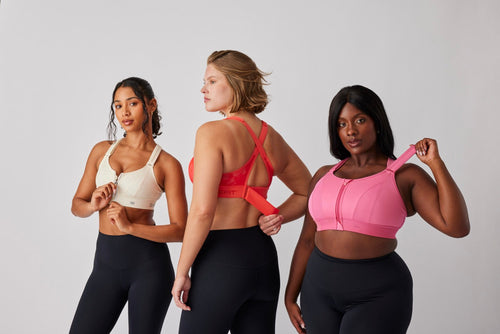
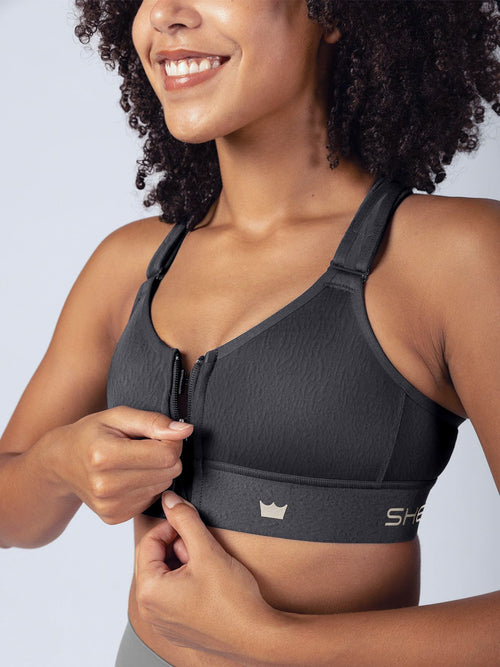
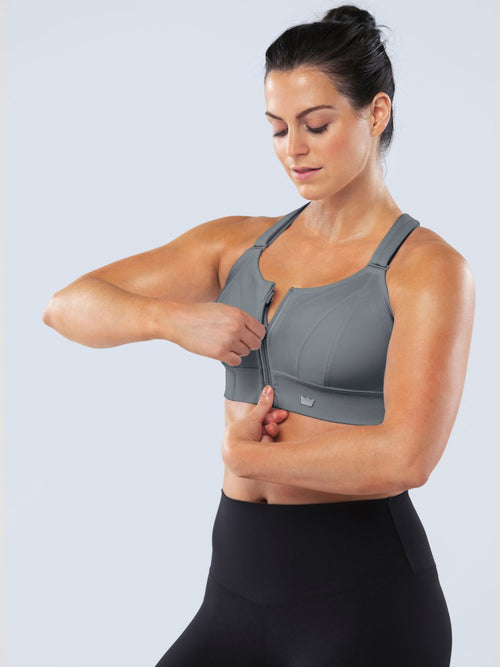
The Ultimate Sports Bra is our flagship. Patented adjustable shoulder straps and rib band let you dial in the exact level of support your body needs. Non-stretch straps maintain that support wash after wash, which is a point most competitors miss (stretch straps lose tension over time, and stretch means bounce). A front zipper makes it easy to get on and off without the overhead wrestling match.
-
Impact level: high
-
Cup design: encapsulation and compression
-
Strap type: non-stretch, adjustable
-
Removable modesty pads for customizable coverage
-
Sizes: XS-6Luxe, AA-I cups
-
Activities: running and HIIT to CrossFit and horseback riding
-
75,000+ 5-star reviews
University of Memphis research tested the Ultimate as the high-support condition and found it reduced vertical breast displacement by more than 50% compared to wearing no bra at all [3]. That level of motion control is what separates a bra that says "high impact" on the tag from one that delivers it.
The Flex Sports Bra
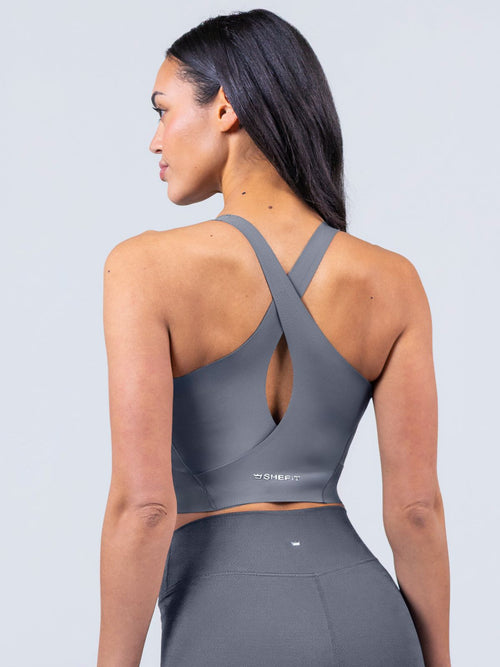
The Flex Sports Bra offers full coverage with a smoother silhouette. Smooth cups and patented adjustable features give you the same fit customization as the Ultimate in a sleeker profile. For women sized 32C and under, the Flex delivers high-impact support. For larger sizes, it performs at medium-impact, though our medium-impact rating delivers support that rivals what other brands call high-impact.
-
Impact level: high (32C and under), medium (larger sizes)
-
Cup design: encapsulation and compression with smooth cups
-
Activities: yoga and cycling to strength training and pickleball
Here is how the two bras compare side by side:
|
|
Ultimate |
Flex |
|---|---|---|
|
Impact level |
High (all sizes) |
High (32C and under), Medium (larger) |
|
Cup style |
Encapsulation + compression, removable modesty pads |
Encapsulation + compression, smooth cups |
|
Strap type |
Non-stretch, adjustable |
Adjustable |
|
Best for |
Running and HIIT to CrossFit and horseback riding |
Yoga and cycling to strength training and pickleball |
|
Sizes |
XS-6Luxe, AA-I cups |
XS-6Luxe, AA-I cups |
|
Durability |
Wash-tested to 25 cycles before showing obvious wear |
Wash-tested to 25 cycles before showing obvious wear |
Both bras are designed for all breast types, from small to large, enhanced or natural. Browse all SHEFIT sports bras to compare styles and find the one that matches your training.
FAQs About Full Coverage Sports Bras
What makes a sports bra "full coverage"?
Full coverage means a high neckline, full underarm enclosure, and individual cup space that contains breast tissue on all sides. It describes cup shape and coverage area, not impact rating.
Is full coverage the same as high impact?
No. Full coverage is a cup and neckline style. High impact is an activity rating. A bra can be full coverage and low impact, or full coverage and high impact. Look for both labels if you need complete coverage AND bounce control for activities like running.
What cup sizes benefit most from a full coverage sports bra?
Women with D+ cups benefit the most because their breast tissue extends further laterally and vertically. Full coverage contains tissue that standard cups leave exposed. That said, women of any cup size who want maximum modesty or plan to wear the bra as a top also benefit.
Can I wear a full coverage sports bra as a workout top?
Yes. The high neckline and full underarm panel mean no additional layer is needed. Full coverage bras provide the modesty and containment to function as a standalone top during training.
Why do I see armpit skin with a full coverage bra? Is that spillage?
No. Armpit skin visibility is a sign of proper lift. When a bra lifts your breasts higher on your torso, it reveals skin in the armpit area that was previously hidden. Spillage looks different: tissue pushing over the top or sides of the cup. If you see tissue escaping, size up. If you see armpit skin, your bra is working correctly.
How do I know what size full coverage sports bra to buy?
Start with your actual underbust and bust measurements in inches, not a cup letter from another brand. Bra sizing is not standardized across brands, so measurements are the only reliable input. SHEFIT's size chart reads those measurements directly to give you a size recommendation.
Does full coverage mean wireless?
Not always, but most purpose-built full-coverage sports bras are wireless. Underwire can dig into breast tissue during high-impact movement, and wireless encapsulation designs have advanced enough to match or exceed the support that wired bras used to provide.
Every woman deserves a sports bra that actually fits her body, not the other way around. Full coverage is the starting point for finding that fit: a bra built to work with your body across every workout you take on. Find your fit at SHEFIT.
References
[1] Risius, D., Milligan, A., Berns, J., Brown, N., & Scurr, J. "Understanding key performance indicators for breast support." Journal of Sports Sciences, 2017. https://pubmed.ncbi.nlm.nih.gov/27291899/
[2] Fong, H.B., Nelson, A.K., Storey, J.E., et al. "Greater Breast Support Alters Trunk and Knee Joint Biomechanics Commonly Associated With Anterior Cruciate Ligament Injury." Frontiers in Sports and Active Living, 2022. https://doi.org/10.3389/fspor.2022.861553
[3] Fong, H.B., Nelson, A.K., McGhee, D., Ford, K., & Powell, D.W. "Increasing breast support is associated with a distal-to-proximal redistribution of joint negative work during a double-limb landing task." Journal of Applied Biomechanics, 2022/2023. https://www.memphis.edu/healthsciences/pdfs/jab-biomech-2023.pdf
[4] Scientific Reports. "Breast-torso movement coordination during running in different breast support." Nature Scientific Reports, 2024. https://www.nature.com/articles/s41598-024-71337-y
[5] McGhee, D.E., & Steele, J.R. "Optimising breast support in female patients through correct bra fit." Journal of Science and Medicine in Sport, 2010. https://pubmed.ncbi.nlm.nih.gov/20451452/