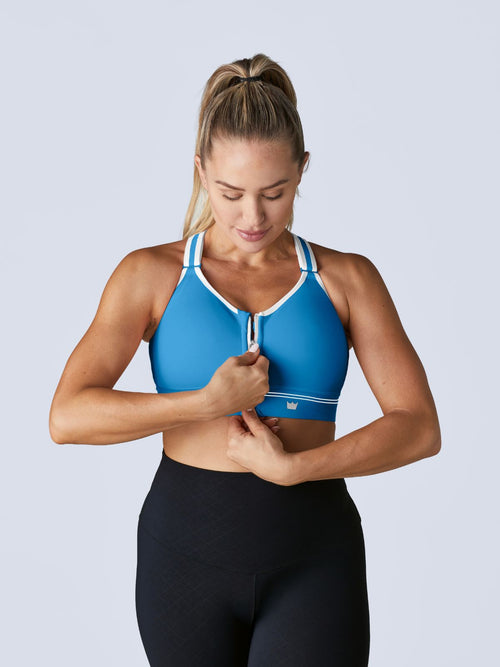
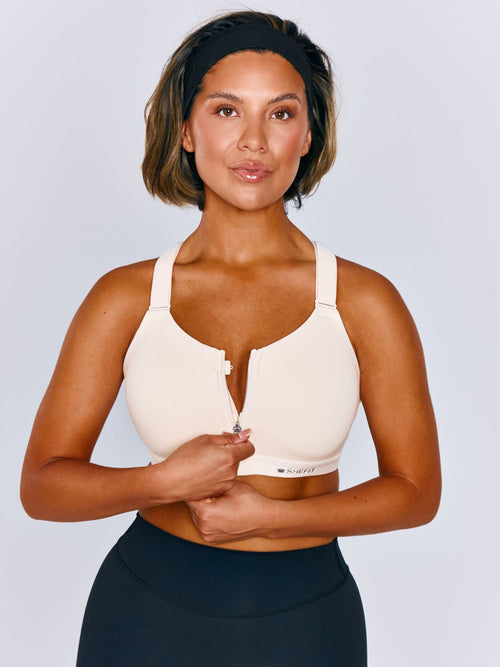
Which Bra Is Right for You? Learn More


Count the days you work out in a normal week, then add one. That number, usually somewhere between three and five, is how many sports bras keep you covered without a laundry scramble.
The spare does the heavy lifting in that formula. It covers the day a bra is still drying, the week laundry slips, and the morning you realize your favorite has finally stretched out. At SHEFIT, we design adjustable sports bras for every kind of training week, and this is the practical rule we come back to when women ask us how big their rotation needs to be.
The Short Answer: Match Your Count to Your Week
The formula is one bra per workout day you would rather not repeat, plus one spare. For most regular exercisers, that lands at three to five sports bras. If you move once or twice a week, one or two will do. If you train daily, mix several activities, or only get to laundry once a week, five to seven gives you breathing room.
No medical or industry body publishes a required number of sports bras. What follows is our practical guidance, built from how laundry and drying time interact with the workouts in a real week.
| Training week | Suggested count | Why |
|---|---|---|
| Occasional: 1-2 sessions | 1-2 bras | Enough time between sessions to wash and dry one bra |
| Regular: 3-4 sessions | 3-5 bras | One per session plus a spare while another dries |
| Daily or high volume: 5+ sessions | 5-7 bras | Back-to-back days leave no drying gap |
| Weekly laundry or frequent travel | Add 1-2 | Bras sit in the hamper longer before they are ready again |
Treat the table as a rule of thumb; the four factors below move your number up or down.
Why There Is No Official Number, and What Sets Yours
Retailers and bloggers suggest anywhere from two to six sports bras. None of those figures comes from a standard, and most skip the reasoning that actually decides your count.
Four things set the number for you:
- How often you launder. A bra worn for a sweaty session goes in the wash before its next wear. Weekly laundry means more bras waiting in the hamper.
- How many different activities you do. Running and yoga ask for very different support levels, so a mixed week needs more than one type of bra.
- How much support your body needs. Higher-impact training and fuller busts call for high-support bras, and you will want more than one of those if you do that training often.
- How long a bra takes to dry. Air drying takes time, and pulling on a damp bra is nobody's idea of a good warm-up.
The clearest real-world example comes from a demanding setting. A UK research programme on bras for British Army recruits in basic training, where women train hard every day and have limited access to laundry, concluded that three bras were not enough. The researchers recommended a minimum of five, specifically because of washing cycles [1].
Most of us are not in basic training, so treat that finding as an illustration rather than a rule for gym-goers. It shows the same logic at full volume: laundry sets the count.
Here is that logic in plain terms. If each bra goes in the wash after a sweaty session and then needs time to air dry, one bra per training day plus a spare means you are never choosing between a damp bra and your only bra.
Why Rotating Bras Helps Your Support Last
The strongest evidence on sports bra wear comes from the University of Portsmouth. In their study, 19 women washed identical sports bras 25 times, which took them about 85 days on average. Afterward, breast motion while running had increased by 16 to 20 percent in bras that were only washed, and by 25 to 32 percent in bras that were also worn between washes, depending on the direction of movement [2].
That finding needs some honest context:
- The change in absolute movement was small, under 4.2 mm.
- Only one bra model was tested.
- The study authors themselves call for clearer guidance on how long sports bras last.
So the study does not prove that every bra loses a fixed share of its support after a set number of washes. What it does show is that washing and wearing measurably changed how well one bra controlled movement over about three months.
What a Rotation Does for Each Bra
Our reasoning from here is simple arithmetic. If you wear one bra for every session, it reaches 25 washes in roughly 25 workouts. Spread those same workouts across four bras, and each one reaches that mark about four times later. Rotation also means you can retire a worn bra without being left with nothing to train in.
Drying time matters too. The Army research above advises washing bras at a lower temperature and air drying them, and a rotation gives each bra the time to dry [1].
Care habits stretch the life of every bra in the set. Our guide on how to wash sports bras without losing support walks through the full routine. Our bras are built to handle a low-heat dryer cycle, though laying them flat to air dry remains the way we recommend caring for them.
Build Your Set by Activity: A Four-Bra Starting Mix
A good set is built around support level, not colors. For someone training three to four times a week, we suggest this starting point:
- Two high-support bras for running, jumping, HIIT, and court sports, the sessions you are most likely to do more than once a week.
- Two medium-impact bras for weights, hiking, cycling, studio classes, yoga, and walking.
Here is how that maps to our lineup:
| Activity | Support you want | The SHEFIT bra that fits |
|---|---|---|
| Running, jumping, HIIT, high-impact classes | Highest support | Ultimate Sports Bra® |
| Weights, hiking, cycling, studio classes, yoga, walking | Medium impact | Flex™ Sports Bra |
| Weights, hiking, cycling, studio classes, yoga, walking | Medium impact, with extra comfort if you wear it longer | Emerge™ Sports Bra |
The High-Support Slot
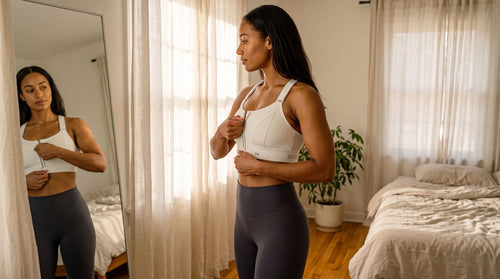
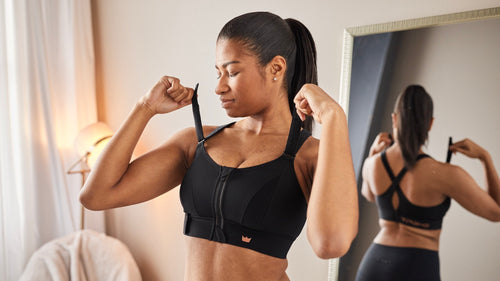
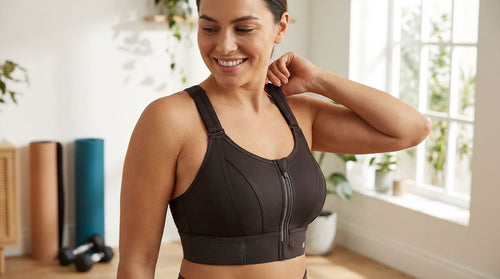
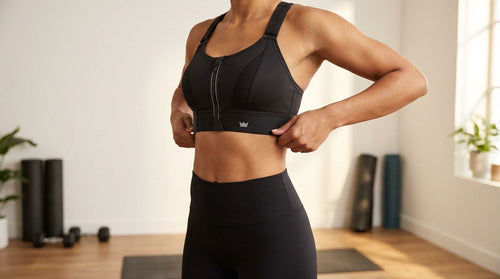
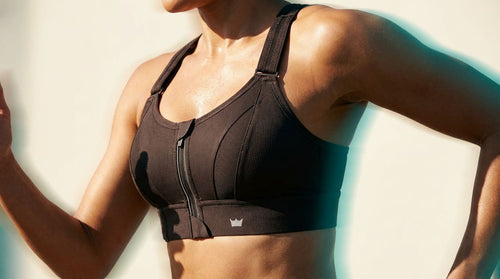
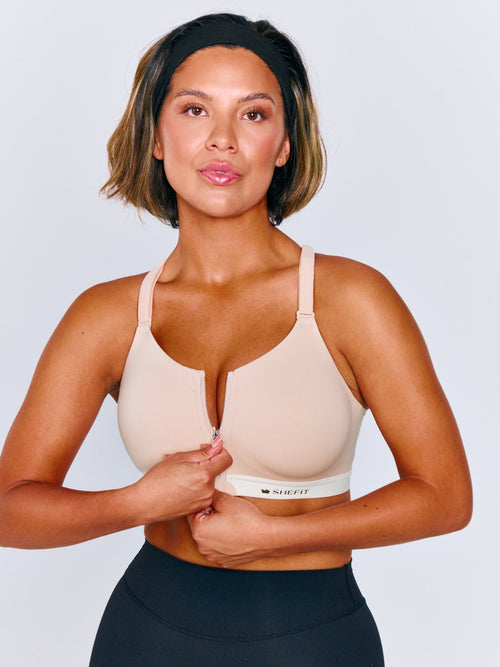
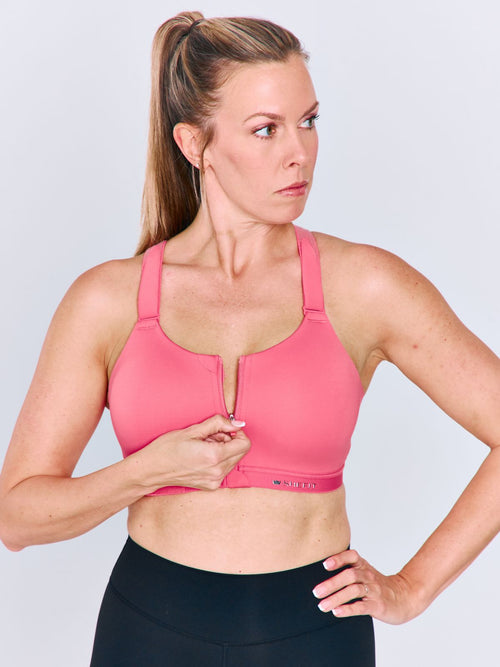
The Ultimate Sports Bra® is our highest-support bra. It uses our patented Zip. Cinch. Lift.® adjustability: a front zipper for easy on and off, a cinchable rib band that sets compression and support, and adjustable shoulder straps that set lift. Individually seamed cups, removable padding, and power-mesh reinforced cups keep high-impact movement in check. Two of these cover your hardest sessions and give you a backup when one is in the wash.
The Medium-Impact Slots
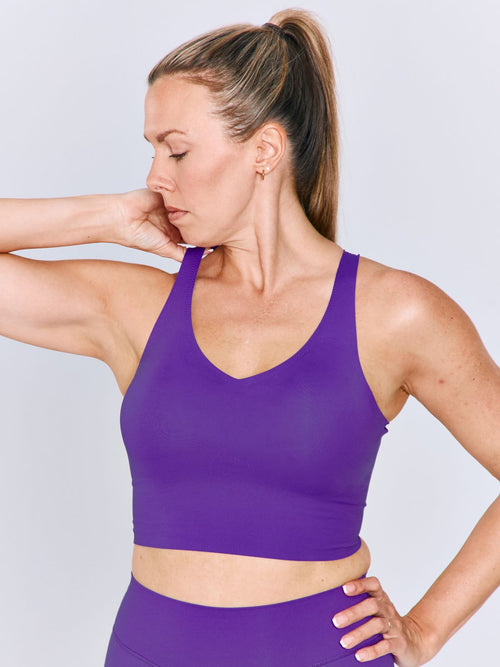
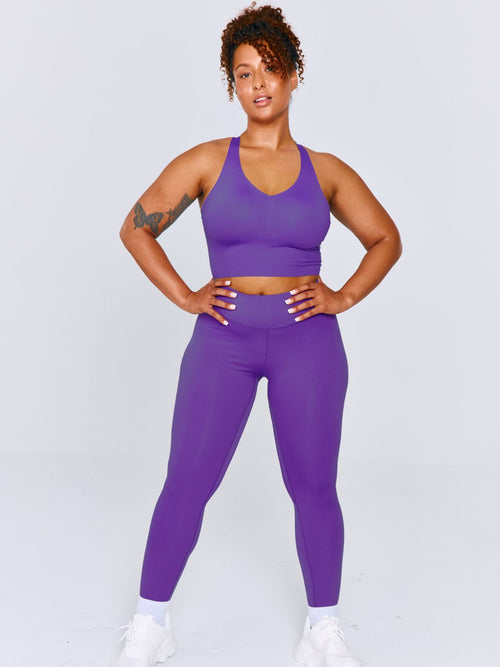
The Flex™ Sports Bra and Emerge™ Sports Bra are both medium-impact bras, designed to give a little less support than the Ultimate Sports Bra® so you can wear them for longer if you choose to. Both are made for the same activities, and both are rated medium impact for C+ cups and high impact for A-B cups.
The Flex™ Sports Bra has non-padded cups made from four-way stretch fabric lined with power mesh, which makes it more supportive than other brands' high-support bras, though not as strong as the Ultimate Sports Bra®. It carries the same front zipper, rib band, and adjustable straps.
The Emerge™ Sports Bra is wire-free with seam-free smooth cups and a light integrated pad, plus our AdaptiveFit™ technology. Its newer design is made to be more comfortable, so if you end up staying in it after your workout or want to wear it all day, it is ready for that too.
All three are $69 and come in sizes XS-6Luxe. Because the straps are non-stretch, they keep their lift wash after wash, and the adjustable rib band lets one bra follow small changes in your fit over time.
If you are choosing sizes for a new set, measure your underbust and bust in inches rather than relying on a cup letter from another brand. Our sports bra size chart reads those measurements directly. Between sizes? Go with the larger size for more coverage, or the smaller size for more control.
When You Need More, and When Fewer Will Do
The four-bra mix is a starting point. Plenty of women land above or below it.
| Add bras if | Fewer will do if |
|---|---|
| You train most days of the week | You exercise once or twice a week |
| You only do laundry weekly | Most of your movement is walking or yoga |
| You travel and pack for several sessions | You wash and air dry right after each session |
| You cross-train across several support levels | You stick to one type of activity |
| Your support needs shift across your cycle or life stage | Your size and routine stay steady |
A Note on Wearing Two Bras at Once
Some women layer. Sports Medicine Australia notes that athletes with breasts larger than a DD cup commonly need to wear two bras at the same time to get enough support [3]. A University of Colorado sports medicine handout also describes some women wearing two bras, an encapsulation style under a compression style, when their breasts are sore [4].
If you find yourself doubling up, it is worth checking your size and the support level of the bra you are wearing. Our view is that nobody needs to wear two bras to feel secure. A bra in the right size with the right level of support, and with a band and straps you can adjust to your body, can do that job on its own.
When to Retire One: Signs Your Bra Is Done
Even a well-rotated set wears out eventually. These are the signs, and what each one means for support:
- The band feels loose at its tightest setting. A loose band cannot anchor the bra during impact, so movement goes up.
- The straps keep slipping after you adjust them. Lift drops, and the bra stops holding you where you set it.
- The elastic looks thin or stretched. The fabric no longer springs back, so it controls less movement.
- The bra rides up your back or into your armpits. That usually means the band has stretched, and riding up causes chafing.
- You notice new chafing. Chafing comes from movement, so new rubbing often means the bra is letting you move more than before.
- Your size has changed. A bra that fit a different body will not give the same support.
Sports Medicine Australia points out that many women keep wearing sports bras past their use-by date, with overstretched elastic and a band, cups, or straps that have become too big, and that these bras need replacing. Its mirror test is a quick way to spot one: breast discomfort at 0 out of 10 and movement no higher than 3 to 4 out of 10, where 10 is running without a bra [3].
For a timeline, UEFA's sports bra guide, developed with University of Portsmouth researchers, suggests replacing a sports bra at least every 6 to 12 months, after about 25 washes, or sooner if the elastic loosens or your size changes [5]. That is a rule of thumb for athletes, not a scientific expiry date. It does line up with the Portsmouth washing study above, where 25 washes were enough to measure a change in one bra [2].
A Quick Fit Self-Check
Before you retire a bra, run it through this check:
- Mirror test. Jog or jump in place in front of a mirror and rate your comfort and movement on the scale above.
- Jump test. Jump a few times. You want to feel secure, with minimal movement.
- Band check. Raise your arms overhead. The band stays firm and level instead of sliding up.
- Cup check. The cups contain all of your breast tissue.
One note on that cup check. If you see a strip of armpit skin while wearing a well-lifting bra, that is your bra doing its job and lifting you up. Spillage is different: tissue pushing over the top or sides of the cup signals the wrong size.
Because our bras adjust, a loose band can often be re-cinched before you retire the bra. Once the rib band is already at its tightest and the bra still fails these checks, that is your sign. Our complete sports bra fit guide covers each check in more detail.
Sports Bra Count Questions, Answered
How many sports bras do I need if I work out three times a week?
Three to four. That gives you one bra for each session plus a spare, so a bra still drying from your last workout never holds up the next one. If you only do laundry once a week, lean toward four, or add a fifth if your three sessions call for different support levels.
Can I wear the same sports bra two days in a row?
You can, though a rotation makes life easier. A bra worn for a sweaty session goes into the wash, and it needs time to dry fully before you wear it again. Rotating between two or more bras means you always have a clean, dry one ready, and it spreads washes and wear across your set.
How often should I replace a sports bra?
There is no universal interval. UEFA's sports bra guide offers a rule of thumb of at least every 6 to 12 months, after about 25 washes, or sooner if the elastic loosens or your size changes [5]. In practice, the signs of wear above tell you more than the calendar does.
Do I need a different sports bra for each workout?
Match bras to support level rather than to activity names. Running, jumping, and HIIT all call for high support, so one bra type covers all three. Weights and cycling sit in the middle, and yoga or walking need the least. Most women can cover a full week with two or three support levels.
Is it okay to wear two sports bras?
Yes, and plenty of athletes with fuller busts do, as we covered above. If you find you need to double up, check your size and the bra's support level. A bra with an adjustable band and straps in the right size can often give you the same security on its own.
Building Your Set One Bra at a Time
You do not need to buy a full rotation in one go. Start with the bra you reach for most often, usually the one for your hardest sessions. Add the support level you are missing next, then a spare so laundry day never decides whether you work out.
Swap out bras one at a time as they wear, and your set stays fresh without a big reset. When you are ready to fill a slot, find your fit with SHEFIT and build the rotation that matches your week.
References
[1] Emily Paines, Gemma Milligan, Mike Tipton, et al. "Establishing Suitable Bra Characteristics for Tactical Athletes: A Mixed-Method Multi-Study Approach." Sports Medicine (PubMed Central), December 15, 2025. https://pmc.ncbi.nlm.nih.gov/articles/PMC13198511/
[2] Joanna Wakefield-Scurr, Caitlin Hamilton, Katie Reeves, Melissa Jones, Brogan Jones. "The effect of washing and wearing on sports bra function." Sports Biomechanics, 2024 (published online 2022). https://doi.org/10.1080/14763141.2022.2046147
[3] "Exercise and Breast Support." Sports Medicine Australia, 2025. https://sma.org.au/wp-content/uploads/2025/08/Exercise-and-Breast-Support.pdf
[4] "Choosing a Sports Bra." University of Colorado Hospital, University Sports Medicine, 2004 (reviewed 2009). https://www.ucdenver.edu/docs/librariesprovider65/clinical-services/sports-medicine/choosing-a-sports-bra.pdf?sfvrsn=5a325bb9_2
[5] Burbage and Wakefield-Scurr (University of Portsmouth). "UEFA Sports Bra Guide." UEFA, 2026. https://editorial.uefa.com/resources/02a3-2014c126244e-5f37bdc7d455-1000/uefa-sports_bra_guide-v3.pdf