Which Bra Is Right for You? Learn More


You own two sports bras in the same labeled size. One digs into your shoulders after ten minutes, rides up your back by mile two, and leaves you tugging at straps mid-set. The other one disappears the moment you zip it up. Same size on the tag, completely different experience on your body. The difference is fit, and at SHEFIT, we built our entire product line around getting it right. This guide gives you a five-point fit check you can run in under a minute, explains what too big and too small actually look like, and walks you through measuring for the size that matches your body.
The 5-Point Sports Bra Fit Check
Your bra either passes all five of these checks or it does not fit correctly. Research estimates that 85% of women are wearing the wrong bra size [1], and most of those women have simply gotten used to the discomfort. Run through each checkpoint the next time you try on a sports bra.
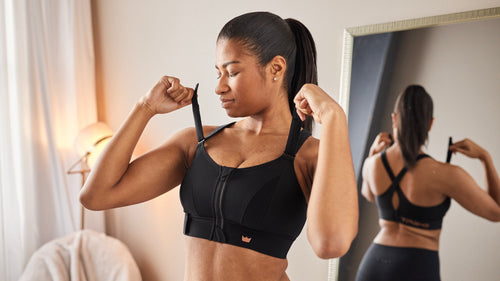
Band position. The band carries roughly 90% of your bra's support. It needs to sit level across your back, stay level when you raise both arms overhead, and allow two fingers underneath without gaping. If the band rides up when you move, it is too loose. A well-fitted band feels snug like a hug, not like a tourniquet.
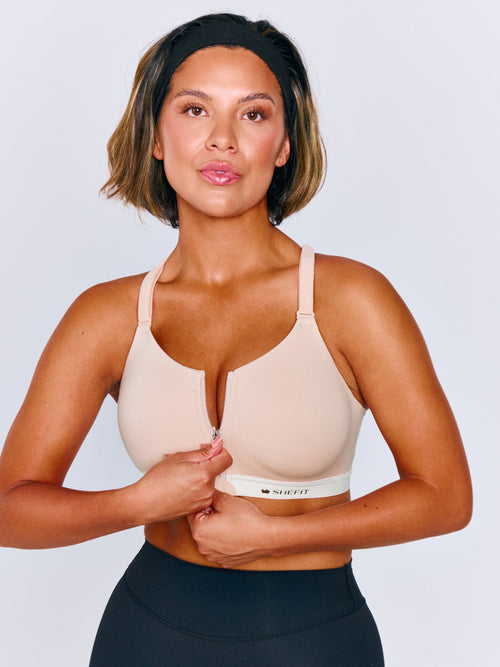
Cup containment. Each cup needs to fully contain your breast tissue on all sides. No wrinkles at the top (too large), no gaps between cup and breast (too large), and no tissue pushing over the cup rim or out the sides (too small). Pay attention to the underarm panel: breast tissue extending beyond it is actual spillage and a sign the bra is too small.
Strap function. Straps provide lift, but they are not doing the heavy lifting. You should be able to slide one finger under each strap without it digging into your shoulder. Non-stretch straps, like the ones we use on the Ultimate Sports Bra, maintain this calibration wash after wash because they do not lose tension the way elastic straps do.
Neckline and coverage. No tissue should be visible above the neckline or outside the underarm panel. If you see skin in the armpit crease, that is actually a sign of proper lift. Your bra is raising breast tissue higher on the chest wall, which exposes the natural fold of skin underneath. That is anatomy, not spillage. Spillage means tissue pressing over the cup edge itself.
Bounce test. Put it on, then do 30 seconds of jumping jacks or high knees. Your breasts should feel controlled in all directions: up and down, side to side, and front to back. If you feel significant lateral or forward movement, the bra is not containing tissue properly and may need a different size or a higher support level.
Signs Your Sports Bra Is Too Big (and What Happens Next)
Too-big bras are more common than you might think. Many women buy their regular bra size without accounting for the fact that workout support needs to be tighter to do its job. Here are the failure modes to watch for:
Band rides up the back. This is the single most common sign of a too-large sports bra. When the band lifts, it drags into your armpits and causes chafing. It also means you are losing 90% of your support structure.
Straps slide off your shoulders. If you have to keep pulling them back into place, the bra frame is too large for your torso.
Cups gape or wrinkle. Visible space between the cup fabric and your breast tissue means the cup volume exceeds what your body fills.
Band does not lay flat against your ribcage. A band that puckers or lifts away from the body cannot anchor the bra during impact, which transfers all the movement load to the straps and cups.
Wing fabric pulls into the band hardware. This means the bra is trying to close a gap that should not exist, and the hardware will twist under tension.
Each of these symptoms compounds during high-impact activity. A band that rides up at rest will ride up faster and farther during a run, creating friction burns that make you dread the next workout.
Signs Your Sports Bra Is Too Small
A too-small sports bra creates different problems, and they are easier to spot.
Tissue bulges over the top or sides of the cup. This is true spillage, and it means the cup volume cannot contain your breast tissue.
Straps dig in and leave red marks. The strap is compensating for a cup that cannot do its job, pressing harder into your shoulders to keep everything in place.
You cannot scoop breast tissue fully into the cups. When you reach in and try to settle tissue into the cup space, it immediately pushes back out.
Hardware twists or buckles at an angle when you tighten. The structure is under more tension than it was designed for.
One important distinction: a too-small bra and a properly-fitted bra with visible armpit skin can look similar at a glance. The difference is where the tissue is. Spillage means breast tissue pressing past the cup boundary. Armpit skin means your bra is lifting tissue higher on the chest wall, revealing the natural fold underneath. One is a fit failure. The other is the bra doing exactly what it was designed to do.
How to Measure for the Right Sports Bra Size
Bra sizing is not standardized across brands. The size you wear at one brand is not a reliable predictor of the size you need at another. Your actual measurements in inches are the only input that travels reliably from brand to brand [2].
Here is how to measure yourself accurately:
Wear the right bra. Put on a comfortable everyday bra, not a compressive sports bra or a padded push-up. Compression will skew your measurements smaller and result in a size that is too small for what you actually need.
Measure your bust. Wrap a fabric measuring tape around your back and slide it up to the fullest part of your bust, just above the nipple. Pinch the start and end together at the center of your chest. Use a mirror to confirm the tape sits flat and level. Round to the nearest whole number.
Measure your rib cage. Same process, but wrap the tape directly under your bust at the underbust. Keep it snug but not tight. Round to the nearest whole number.
Cross-reference the size chart. Take both numbers to our size chart. We use bust and rib cage measurements in inches, not traditional cup letters, because inch measurements are consistent regardless of brand.
SHEFIT Size Chart
Size |
Bust |
Rib Cage |
|---|---|---|
XSmall |
29-31" |
22-27" |
Small |
32-35" |
25-32" |
Medium |
35-38" |
26-33.5" |
Luxe |
38-40" |
29-36" |
1Luxe |
40-42" |
31-38" |
2Luxe |
42-44" |
32-40" |
3Luxe |
44-46" |
35.5-43" |
4Luxe |
46-49" |
37.5-44" |
5Luxe |
49-52" |
37-47.5" |
6Luxe |
52-55" |
38.5-49.5" |
If you fall between two sizes: the larger size gives you more coverage, and the smaller size gives you more control. Choose based on whether your priority is containment or compression.
Not sure which size is right even after measuring? We offer three paths to get there. The Fit Advisor is a 30-second questionnaire that gives you a personalized recommendation. The Free Virtual Fitting is a 15-minute private video call with a SHEFIT fitter who walks you through measurements, makes product recommendations, and includes a discount at the end. Or you can use the self-measurement method above and cross-reference our chart directly.
How Support Level Affects Fit
A perfectly fitted sports bra in the wrong support level will still let you down during activity. Support level needs to match both what you are doing and how much tissue you are supporting [3].
Impact Level |
Activities |
Cup Size Consideration |
|---|---|---|
Low |
Walking / yoga / pilates / stretching |
A-C cups can stay at low for these activities |
Medium |
Cycling / hiking / strength training / golf / pickleball |
D+ cups may need high support even for these activities |
High |
Running / HIIT / CrossFit / horseback riding |
All cup sizes need high support for high-impact movement |
The general rule: if you wear a D cup or above, bump your support level up one tier from what the activity alone suggests. What a smaller bust can handle at medium impact often requires high support at larger sizes, because there is simply more tissue to control.
For a complete breakdown, our guide to understanding impact levels covers how to match your activity to the right support tier for your size. Women with large cup sizes often find that the support level printed on the label underestimates what they actually need.
What Proper Fit Feels Like in Motion
A sports bra can pass every static fit check and still fail during movement. This is the part most fit guides skip, and it matters.
During running, your breasts move in a figure-eight pattern, traveling roughly four inches vertically on each stride [4]. That movement stresses the Cooper's ligaments, the connective tissue that gives breasts their shape. Once those ligaments stretch, they do not bounce back. This is not a cosmetic concern; it is structural.
University of Portsmouth research found that women change their running gait based on how much support their bra provides. Less support means shorter strides, more guarded arm swing, and altered landing mechanics. You compensate without realizing it, and that compensation ripples down through your lower-body joints. Research has shown that inadequate breast support can lead to increased embarrassment and decreased willingness to exercise altogether [5].
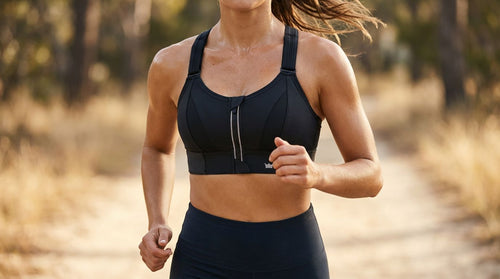
A properly fitted bra in motion feels like it is moving with you, not against you. Your breasts stay contained in all three planes of movement: up and down, side to side, and front to back. You do not think about your chest during a sprint, a box jump, or a burpee. That absence of awareness is the clearest signal that the fit is correct.
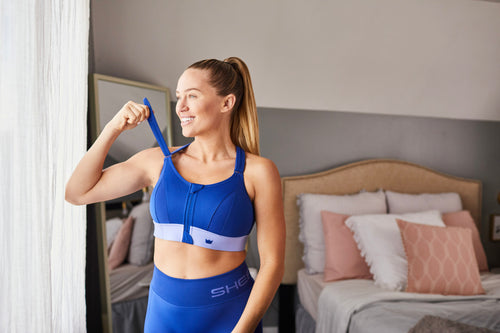
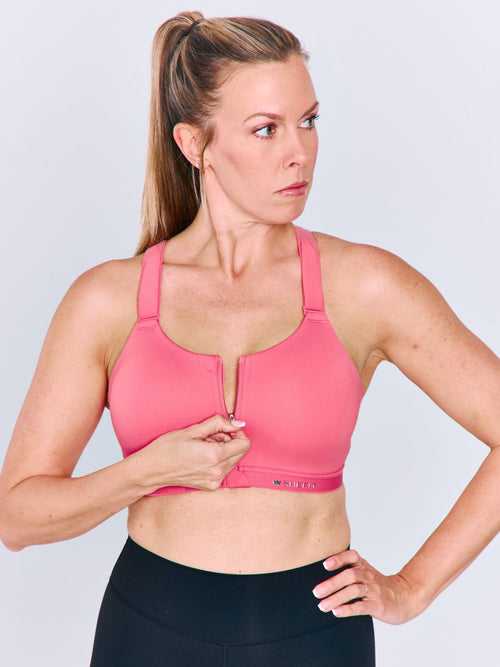
We designed our bras with patented adjustable shoulder straps and a rib band that you tighten to your exact body, so the fit customizes to how you move. Static sizing guesses what your body needs. Adjustable fit lets you dial it in.
SHEFIT Sports Bras Built Around Fit
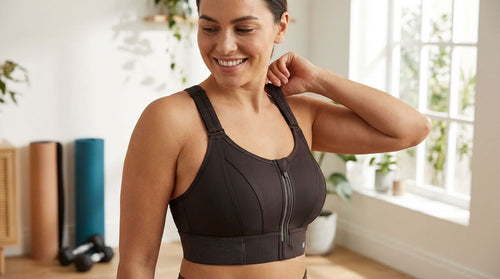
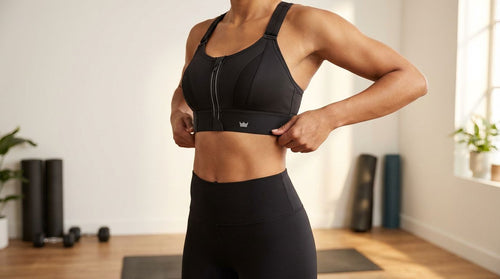
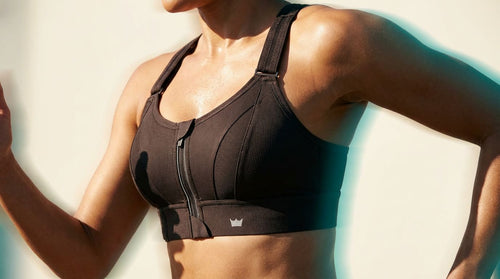
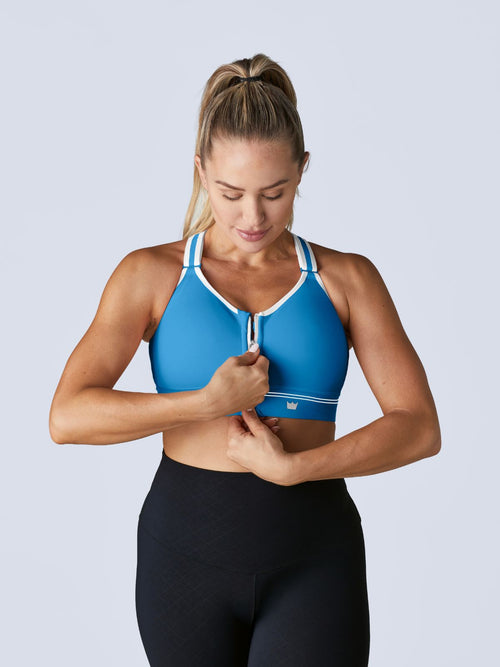
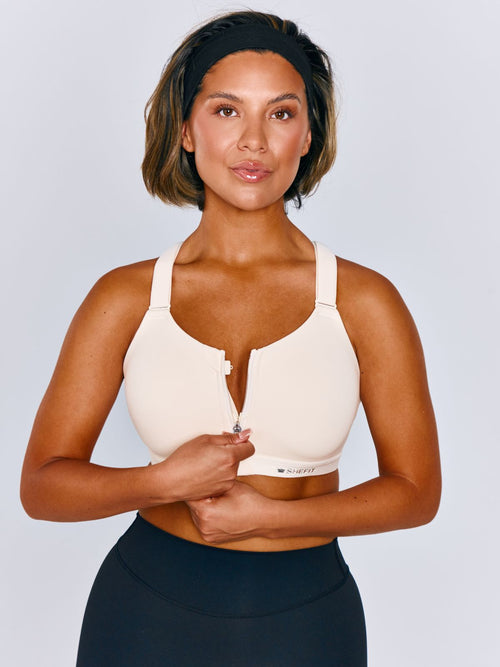
Standard sports bras give you a fixed size and hope for the best. We took a different approach: patented Zip. Cinch. Lift. technology with adjustable shoulder straps and a rib band that let you customize fit to your exact body. Even when your size changes up or down, the same bra adjusts with you.
University of Memphis research confirms the principle. In controlled testing, high-support bras reduced breast motion significantly compared to low-support options [6]. Greater breast support was also associated with biomechanical profiles linked to lower ACL injury risk, including reduced knee valgus angles and greater trunk flexion during landing [6].
Feature |
||
|---|---|---|
Impact Level |
High |
High (smaller busts) / Medium (larger busts) |
Cup Design |
Encapsulation and compression with removable modesty pads |
Encapsulation and compression with smooth cups |
Best For |
Running / HIIT / CrossFit / horseback riding |
Cycling / strength training / yoga / pickleball |
Sizes |
XSmall-6Luxe, AA-I cups |
XSmall-6Luxe, AA-I cups |
Price |
$69 |
$65 |
Both bras feature non-stretch shoulder straps that maintain lift wash after wash. We test durability through 25 wash cycles before showing obvious wear, compared to most brands that test through only five.
Not ready to commit to a size? Try Before You Buy lets you order up to five bras, try them for seven days, and pay only for what you keep. Our Game Changer Promise gives you 30 days to return with free return shipping. Find your fit and see the difference adjustable support makes.
Frequently Asked Questions
How do I know if my sports bra fits correctly?
Run the five-point fit check: band level and snug with two fingers underneath, cups fully containing tissue with no gaps or overflow, straps providing lift without digging, no tissue above the neckline or past the underarm panel, and minimal bounce during 30 seconds of jumping jacks. If all five pass, the fit is correct.
Should I size up or down in a sports bra?
If your measurements land between two sizes, go up for additional coverage or down for tighter compression. All-day wear benefits from the roomier option, while high-impact workouts like running or HIIT benefit from the snugger one.
Why do I see armpit skin when I wear my sports bra?
Armpit skin visibility is a sign of proper lift, not poor fit. When a sports bra raises breast tissue higher on the chest wall, it exposes the natural skin fold underneath. This is anatomy. Spillage is different: it means breast tissue pressing over the cup edge or past the underarm seam. If the tissue itself is contained and only skin is showing, your bra fits correctly.
How often should I replace a sports bra?
Most sports bras lose meaningful support after as few as 25 washes [4]. We test ours through 25 wash cycles to confirm structural integrity. If your band feels loose without tightening, your straps are not providing lift, or you are bouncing more than usual during activity, it is time for a new bra.
Should a sports bra be the same size as a regular bra?
Not necessarily. Bra sizing is not regulated across brands, so a 36C in one brand does not translate directly to any other brand. Sports bras also need to fit tighter than everyday bras to control movement during impact. Use your actual bust and rib cage measurements in inches and cross-reference them against the specific brand's size chart.
How tight should a sports bra band be?
The band should feel snug like a hug, not like it is cutting off circulation. You should be able to slide two fingers underneath the band at the back without the band riding up. If the band feels restrictive at rest, it is too tight. If it moves when you raise your arms, it is too loose.
What size sports bra do I need if I'm between sizes?
Measure your bust and rib cage in inches. If the numbers place you between two sizes on the chart, go larger for more coverage or smaller for more control. You can also use our Fit Advisor for a personalized recommendation, or book a Free Virtual Fitting where a SHEFIT fitter measures with you on a private video call. For sister sizing guidance, our sister size guide covers how adjacent sizes relate to each other.
Every woman deserves a sports bra that fits her body, not a label that hopes for the best. Whether you are lacing up for a 5K or powering through a HIIT class, the right fit changes everything. Explore our collection and find the support that actually works.
References
[1] McGhee, D.E., & Steele, J.R. "Optimising breast support in female patients through correct bra fit." Journal of Science and Medicine in Sport, 13(6), 568-572, 2010.
[2] Paige Frederick-Pape. "Sports Bras: Sizing & Measuring." REI Expert Advice. https://www.rei.com/learn/expert-advice/sports-bras.html
[3] Rizzone, K.H., et al. "Sports Bra Preferences by Age and Impact of Breast Size on Physical Activity among American Females." International Journal of Environmental Research and Public Health, 2021. https://pmc.ncbi.nlm.nih.gov/articles/PMC8657319/
[4] Runners Need Editorial. "How to Find Your Perfect Sports Bra." Runners Need. https://www.runnersneed.com/expert-advice/gear-guides/sports-bra-buying-guide.html
[5] Risius, D., et al. "Understanding key performance indicators for breast support." Journal of Sports Sciences, 35(9), 842-851, 2017.
[6] Fong, H.B., et al. "Greater Breast Support Alters Trunk and Knee Joint Biomechanics Commonly Associated With Anterior Cruciate Ligament Injury." Frontiers in Sports and Active Living, 2022. https://doi.org/10.3389/fspor.2022.861553