Which Bra Is Right for You? Learn More


Reach into almost any sports bra on the market today and you will feel them: two soft foam inserts tucked behind the cups. Most women never think about why they are there. Some pull them out and toss them in a drawer. Others leave them in and assume the padding is doing something for support. Both instincts miss what padding actually is, and what it is not.
At SHEFIT, we make bras with padding and bras without it, and we hear the same question constantly: does a padded sports bra hold you better, or is the foam just for show? The honest answer is that padding and support are two separate things. One handles coverage and shape. The other handles bounce. Confusing them is how women end up in a heavily padded bra that still fails them at a run.
This guide breaks down what the padding in a sports bra really does, the different ways it shows up, and how to decide whether you want it at all.
What "Padded" Actually Means in a Sports Bra
In a sports bra, "padded" refers to foam or molded cups built into the garment to add shape and coverage while keeping you modest. This is a different job than the padding in an everyday push-up bra, which exists to add volume and lift. Sports bra padding is not about making you look bigger. It is about smoothing the silhouette, covering the nipple, and keeping the shape of the cup consistent while you move.
There are two main ways padding gets built in. Some bras use removable pads that slide into an interior pocket, so you can take them out, wash them separately, or skip them entirely. Others build the padding in permanently, whether as sewn-in pads, molded cups, or a light integrated pad that is part of the cup itself. Most bras on the market today use built-in padding of some kind, which is why a reviewer testing our Ultimate Sports Bra flagged the removable pads as unusual for the category.
That single design choice, removable versus fixed, ends up shaping most of the decision we cover below.
The Four Things Sports Bra Padding Actually Does
Padding earns its place in a sports bra through a few practical functions. None of them involve controlling bounce, which is worth stating plainly before we go further. Here is what the foam is actually for:
- Nipple coverage and modesty. The most common reason women want padding. A layer of foam prevents show-through under thin or light-colored tops, which matters more in a fitted tank than a loose shirt.
- Shape preservation. Molded or padded cups hold a consistent, smooth shape as you move, rather than shifting or flattening the way an unlined cup can during activity.
- A micro-layer of cushioning. The foam adds a thin buffer between your body and the bra fabric that helps dampen small vibrations. It is a comfort layer, not a support system.
- Chafe reduction. That same layer sits between breast tissue and seams or fabric, cutting down on the rubbing and irritation that show up on longer or sweatier workouts.
Notice what is missing from that list: nothing about reducing bounce or holding your breasts against high-impact movement. That work belongs to the bra's support structure, and it operates independently of whether the cups are padded. We will come back to why that distinction matters.
Types of Sports Bra Padding
Not all padding is built the same way, and the differences change how a bra fits and washes and how much it adapts to you. Removable pads give you the most control. Sewn-in pads, integrated pads, and molded cups lock in a look but take the decision out of your hands. The table below maps the main types.
| Padding Type | How It Works | Best For | Adjustability |
|---|---|---|---|
| Removable pads | Foam inserts slide into an interior pocket; take them out or leave them in | Women who want the option of coverage without committing to it, like our Ultimate Sports Bra | High: full control, wash separately |
| Sewn-in pads | Foam stitched permanently into the lining | A consistent look with no fuss, but no way to remove | Low: fixed in place |
| Integrated pad | A light pad built directly into a seam-free, smooth cup | A natural shape with coverage built in and no inserts to manage, like our Emerge Sports Bra | Low: part of the cup itself |
| Molded/contoured cups | Pre-formed foam cups holding a set shape | Structured silhouette, common across competitors | None: shape is built in |
| Smooth cups (unpadded) | No foam layer; a lined but flat cup | Women who prefer a natural feel, like our Flex Sports Bra | N/A: no padding to adjust |
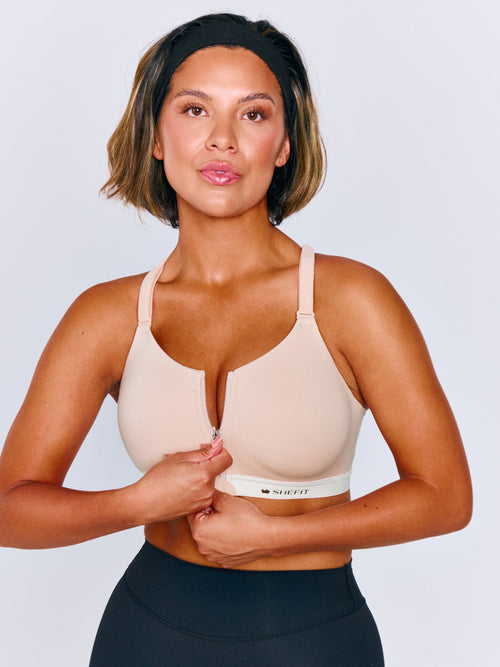
Removable pads are the genuine differentiator here. Because most bras use built-in padding, the ability to simply take the foam out and put it back is uncommon in the high-support category. Our Ultimate Sports Bra gives you the padded look when you want it and the option to remove it when you do not, all in the same bra. And for women who want the opposite, coverage that is simply always there, an integrated pad like the one in our Emerge Sports Bra builds a light layer into the cup so there is nothing to insert, shift, or lose in the wash.
Padded vs Unpadded Sports Bra: Which Is Right for You?
This is the decision no sports bra guide seems to help with, so we will. Neither option is better in the abstract. The right choice depends on what you are wearing, how much you sweat, and what feels right against your body. Padded cups give you coverage and a smooth shape. Unpadded smooth cups give you a lighter, more natural feel. Both are valid.
Use the matrix below to point yourself in the right direction.
| Your Situation | Choose Padded If | Choose Unpadded If |
|---|---|---|
| Nipple coverage | You want reliable show-through prevention | Coverage is not a concern for you |
| High sweat or heat | You are fine with a removable pad you can pull for ventilation | You want the lightest, most breathable layer |
| Preferred shape | You like a smooth, defined silhouette | You prefer a natural, low-profile feel |
| Wearing under thin tops | The top is fitted or light-colored | You layer under looser or darker clothing |
| Simplicity | You want the cup shape decided for you | You would rather skip the foam entirely |
If you cannot decide, a bra with removable pads settles the argument by giving you both. Our Ultimate Sports Bra lets you wear the pads for coverage or take them out for a lighter feel, and our Flex Sports Bra skips them entirely with smooth cups for women who already know they prefer the natural option. There is also a middle path: our Emerge Sports Bra uses a light integrated pad in a seam-free, smooth cup, so you get reliable coverage and a natural shape without ever thinking about inserts.
How Impact Level Affects Your Padding Choice
Here is the part most shoppers get backwards: padding and support are independent variables. You can find a heavily padded bra with weak structure that lets you bounce all over the place, and you can find an unpadded bra that locks you down through a sprint. The foam is a coverage feature. The support that handles your activity comes from the bra's construction, whether that is compression, encapsulation, or a hybrid of both.
That means your padding preference and your support needs are two separate decisions. Sort out the support level your activity demands first, then pick padded or unpadded based on feel.
| Impact Level | Activity Examples | What to Look For |
|---|---|---|
| Low | Walking and yoga | Light compression, comfort over lockdown |
| Medium | Cycling and strength training | Firmer band with moderate structure |
| High | Running and HIIT | Strong band with adjustable straps and a hybrid support design |
If you want to understand how the support structure itself works, our guides on the compression sports bra and the encapsulation sports bra break down which construction suits which activity. Padding sits on top of all of that. It never replaces it.
The Science Behind Breast Support and Why Padding Alone Is Not Enough
Breasts contain Cooper's ligaments, connective tissue that provides structural support and shape. During exercise, unsupported breast tissue moves in three dimensions: up and down, forward and back, and side to side. Repeated stretching of these ligaments during high-impact movement can lead to discomfort and, over time, may contribute to tissue changes. No amount of foam padding addresses this. Padding cushions and covers; it does not restrain movement.
The research on breast support is consistent about why the structure matters. Fit is the starting point, and most women get it wrong. A cross-sectional study found that 85% of women were wearing ill-fitting bras, with both self-selection and standard sizing methods proving unreliable for finding the correct fit [1]. When support falls short, the consequences go beyond comfort. Research examining breast support during running found that willingness to exercise was among the measures most affected by support level, meaning poor support can quietly shrink how much a woman wants to move at all [2].
The benefits of getting support right reach further than most people expect. Research has found that greater breast support is associated with lower-body biomechanics linked to reduced injury risk [3]. Separately, work on bra design found that combining breast elevation and compression provided significantly greater comfort than encapsulation alone during physical activity [4]. All of this points the same direction: the support system, not the padding, is what carries the load.
This is why a padded bra that does not fit cannot substitute for a bra designed around adjustability and support structure. The foam might make the cup look right in the mirror, but if the band and straps are not doing their job, you feel it the moment you start moving. Coverage is a nice-to-have. Support is the whole point.
How to Find Your Fit in a Padded Sports Bra
Padding only works well when the bra underneath it fits. A well-fitted bra, padded or not, should pass a few simple checks. Run through this list before you commit:
- The band sits level all the way around and does not ride up in the back.
- There is no spillage over the top or sides of the cups.
- The straps lift without digging into your shoulders.
- Coverage reaches the edge of the breast tissue without cutting into your armpit.
- It passes the bounce test: 30 seconds of jumping jacks with minimal movement.
One SHEFIT-specific note on sizing. If you land between sizes, size up for more coverage or down for more control, depending on what you are after. And a detail that trips people up: a little visible skin near the armpit is not spillage. It usually means the bra is lifting the tissue properly, which is exactly what you want. If you want to nail your measurements before buying, our sizing guide walks you through it step by step, or you can take the 30-second Fit Advisor quiz at shefit.com/pages/fit-central-new.
Common Myths About Padded Sports Bras
A lot of what people believe about sports bra padding is either half-true or flat wrong. Here are the ones we hear most, and what is actually going on.
Myth: Padding adds volume like a push-up bra. False. Push-up bras use padding to increase size and lift. Sports bra padding is about coverage and a smooth shape, not adding volume. The goals are different, and so is the construction.
Myth: Padded bras are always hotter and sweatier. Partly true. It depends on the material and design. Dense, fixed padding can trap heat, but removable pads let you pull the foam out for better ventilation on hot days, which is one reason the removable option is so practical.
Myth: You do not need padding if you have a large cup size. False. Nipple coverage and show-through prevention are preferences that exist at every size. Cup size does not decide whether you want padding; your comfort and wardrobe do.
Myth: More padding means more support. False, and this is the important one. Padding and support are separate design elements. A heavily padded bra with a weak band and stretched-out straps gives you poor support no matter how thick the foam is.
Myth: Unpadded bras always show through clothing. Not necessarily. Show-through depends on the top and the bra color. Nude or skin-tone options manage it well, and plenty of women wear smooth cups under fitted clothing without a second thought.
SHEFIT's Approach to Padded and Unpadded Support
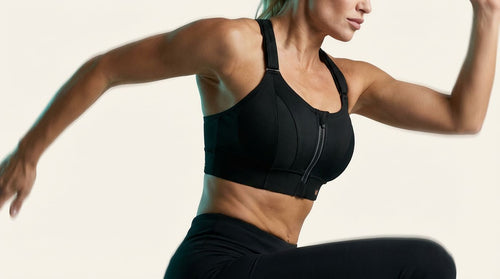
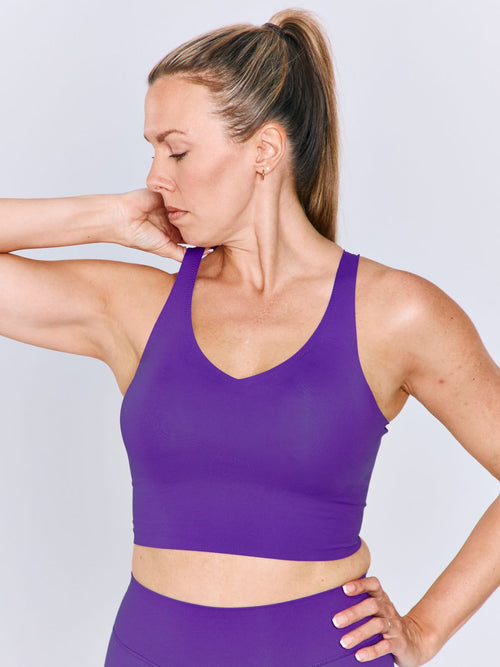
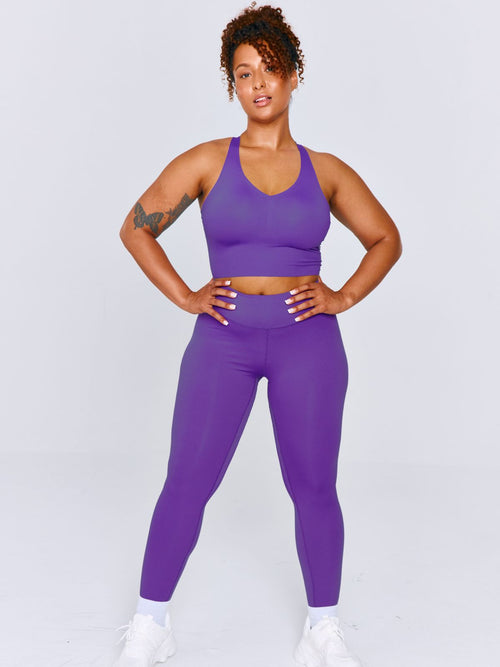
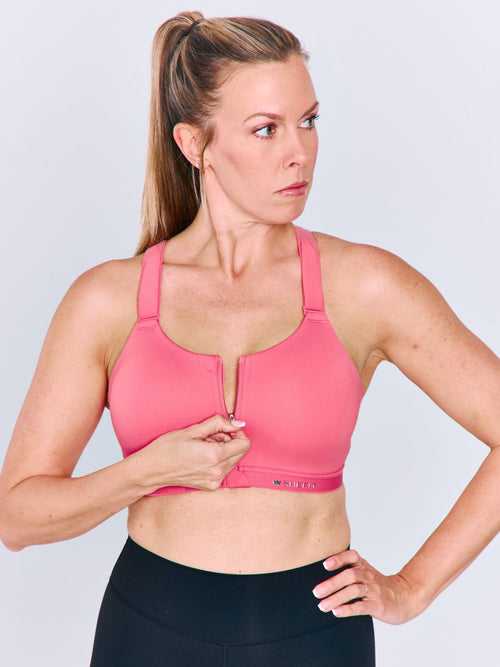
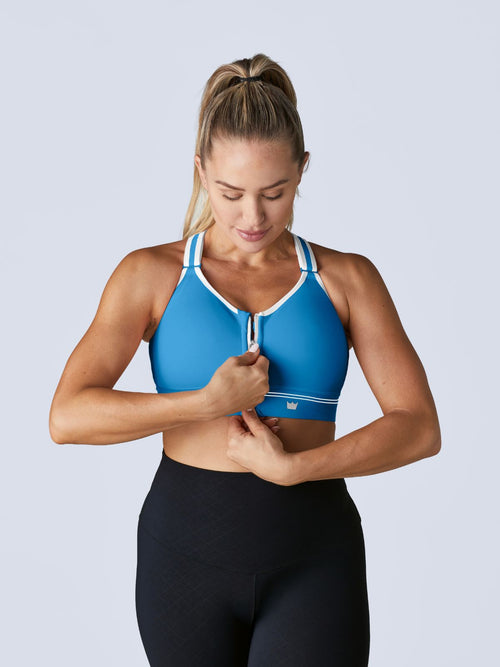
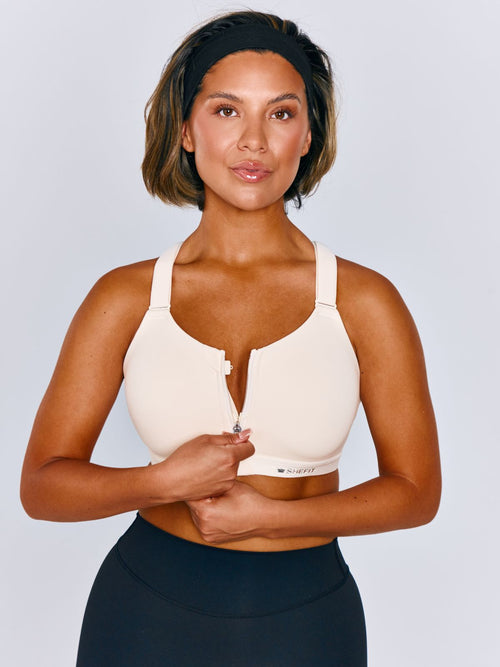
We build for every padding preference because women are not all looking for the same thing. Our Ultimate Sports Bra comes with removable modesty pads, so you get coverage when you want it and a lighter feel when you do not. Our Emerge Sports Bra takes the built-in route with what our designers call an integrated pad: a light, wire-free layer that is part of the seam-free, smooth cup itself, giving you a natural shape with nothing to remove. And our Flex Sports Bra uses smooth cups with no padding, built for women who already know they prefer the natural option. All three are built on the same patented Zip. Cinch. Lift.® adjustability: a front zipper for easy on and off, a cinchable rib band that sets your compression, and adjustable shoulder straps that set your lift. That means the support does not change based on whether there is foam in the cup.
| Feature | Ultimate Sports Bra | Emerge Sports Bra | Flex Sports Bra |
|---|---|---|---|
| Price | $69.00 | $69.00 | $69.00 |
| Cup Style | Cup with pad pocket | Seam-free, smooth cup | Smooth cup |
| Padding | Removable modesty pads | Integrated pad (light, built into the cup) | None (smooth cups) |
| Closure | Front zip | Front zip | Front zip |
| Straps | Fully adjustable | Fully adjustable | Fully adjustable |
| Size Range | XS to 6Luxe | XS to 6Luxe | XS to 6Luxe |
| Impact Level | High | Medium (high for A to B cups) | Medium to high |
| Best For | Maximum coverage and support with the option to remove pads | All-day wear with built-in light coverage and a natural shape | A lighter, natural feel without foam |
Our bras are backed by more than 75,000 five-star reviews and the same adjustable design that started the company. If you are not sure which one fits your body and your workout, take the 30-second Fit Advisor quiz and we will point you to the right size and style.
FAQs About Padded Sports Bras
What is the point of padding in a sports bra?
Padding provides nipple coverage, prevents show-through under thin tops, holds a smooth cup shape, and adds a thin cushioning layer that reduces chafing. It is a coverage and comfort feature. It does not control bounce, which is the job of the bra's support structure.
Are padded sports bras better for large busts?
Not inherently. Coverage from padding is a personal preference at any cup size. What matters more for a larger bust is the support structure, meaning a firm band, adjustable straps, and a hybrid or encapsulation design. A padded bra without that structure will not hold you well.
Can I remove the pads from a padded sports bra?
Only if the bra uses removable pads. Many bras have sewn-in, integrated, or molded padding that cannot be taken out. Our Ultimate Sports Bra uses removable modesty pads that slide out of an interior pocket, which is uncommon in the high-support category, while our Emerge Sports Bra uses an integrated pad that is part of the cup and stays put.
Do padded sports bras provide more support?
No. Padding and support are independent. A padded bra can have weak support, and an unpadded bra can have excellent support. The padding cushions and covers, while the band and straps and overall construction control movement.
Is a padded sports bra the same as a push-up sports bra?
No. A push-up bra uses padding to add volume and lift for a fuller look. Sports bra padding is designed for coverage and shape during movement, not to increase size. The two serve different purposes.
How do I care for a sports bra with removable pads?
Take the pads out before washing, then wash the bra on a gentle cycle or by hand and lay it flat to dry. Removing the pads first helps them keep their shape and lets both the bra and the foam dry evenly.
References
[1] McGhee, D.E. & Steele, J.R. "Optimising breast support in female patients through correct bra fit. A cross-sectional study." Journal of Science and Medicine in Sport, 2010. https://pubmed.ncbi.nlm.nih.gov/20451452/
[2] Risius, D., Milligan, A., Berns, J., Brown, N., & Scurr, J. "Understanding key performance indicators for breast support." Journal of Sports Sciences, 2017. https://pubmed.ncbi.nlm.nih.gov/27291899/
[3] Fong, H.B., Nelson, A.K., Storey, J.E., et al. "Greater Breast Support Alters Trunk and Knee Joint Biomechanics Commonly Associated With Anterior Cruciate Ligament Injury." Frontiers in Sports and Active Living, 2022. https://doi.org/10.3389/fspor.2022.861553
[4] McGhee, D.E. & Steele, J.R. "Breast elevation and compression decrease exercise-induced breast discomfort." Medicine & Science in Sports & Exercise, 2010. https://pubmed.ncbi.nlm.nih.gov/20019639/