Which Bra Is Right for You? Learn More


Poor posture costs more than most women realize. Rounded shoulders strain your upper back. Forward head position loads your cervical spine. Over time, the discomfort becomes background noise you stop noticing until it limits what your body can do. So when posture-correcting bras started trending (fueled by celebrity endorsements and $158+ price tags), millions of women asked the same question: do they actually work?
At SHEFIT, we wanted to know the answer as much as you did. We went to the peer-reviewed research, read the physical therapist reviews, and compared what the science says to what these bras actually deliver. What we found was more nuanced than the marketing suggests, and it points to a different kind of solution than most women expect.
What Posture-Correcting Bras Actually Do (And What They Don't)
Posture-correcting bras use elastic tension bands, typically in a criss-cross pattern across the back, to pull your shoulders into a retracted position. The idea is straightforward: when you round forward, the elastic resists and reminds you to sit or stand upright.
The research supports part of this claim. A 2021 study published in Gait & Posture found that a biomechanically designed posture bra improved scapula retraction by 6 degrees during sitting and standing, and reduced breast motion by 17% during walking compared to an everyday bra. After three months of consistent wear, participants showed significant improvement in scapula depression [1].
That sounds promising. Here is the part most brands leave out.
The improvements happen while you are wearing the bra. Multiple expert reviews, including physical therapist assessments and an orthopedic spine surgeon's analysis, confirm the same finding: posture bras provide support and proprioceptive cueing during wear, but the postural improvements do not persist once you take the bra off. Your muscles receive external assistance rather than building the strength to hold position on their own.
There is also a breathing problem. Expert reviews from physical therapists have consistently noted that posture bras create restrictive ribcage compression. Research published in Medicine and Science in Sports and Exercise found that increased bra underband tightness impairs breathing mechanics during activity, and PTs have linked chronic ribcage restriction to pelvic floor dysfunction through diaphragm-pelvic floor coupling. When a bra designed to improve your posture simultaneously limits how deeply you can breathe, the tradeoff becomes harder to justify.
The Science Behind Breast Support and Posture
The connection between breast support and posture runs deeper than shoulder position. It starts with how your body handles the weight of unsupported breast tissue during movement.
Research from the University of Portsmouth found that inadequate breast support during physical activity can increase spinal loading by up to 56% [2]. That additional load cascades through your body: your thoracic spine curves forward, your shoulders round to compensate, your head shifts forward to maintain balance. Over time, this creates the "upper crossed syndrome" pattern that chiropractors and physical therapists see regularly.
A critical 2025 finding changed the conversation. University of Portsmouth researchers published data in the European Journal of Sport Science showing that bras designed to eliminate 100% of breast bounce may actually increase spinal loading [2]. Using a first-of-its-kind whole body female-specific musculoskeletal model, they demonstrated that completely restricting breast movement shifts mechanical forces to the spine rather than distributing them naturally.
The takeaway is important: the goal is not maximum restriction. It is balanced support that controls excessive movement without locking your torso into a rigid position. This distinction matters when evaluating any bra marketed for posture improvement.
A separate study published in Prosthetics and Orthotics International found that a well-designed breast support garment reduced back stiffness by 34%, discomfort by 33%, and pain by 23% compared to a control condition, outperforming even professionally fitted standard bras after four weeks of use [3]. The results suggest that proper support, not specialized posture correction, is what makes the biggest difference.
What to Look for in a Bra That Supports Your Posture
The features that genuinely improve your posture overlap heavily with the features of a well-engineered sports bra. Here is what the research and expert reviews point to as the features that matter most.
Feature |
What It Does for Posture |
What to Watch For |
|---|---|---|
Adjustable rib band |
Provides 80% of total support; controls ribcage compression |
Must be continuously adjustable, not limited to 2-3 hook positions |
Non-stretch straps |
Maintains consistent shoulder positioning throughout the day |
Stretchy straps lose tension within weeks, reducing lift over time |
Encapsulation + compression |
Distributes breast weight across the torso, reduces forward pull |
Compression alone flattens without controlling individual breast movement |
Front closure |
Allows easy adjustments without removing the bra |
Pull-on styles stretch out and lose structural integrity |
Breathable construction |
Prevents the ribcage restriction found in dedicated posture bras |
If you cannot take a full, deep breath, the bra is too restrictive |
The rib band deserves special attention. Most women focus on straps when evaluating a bra for posture, but the band is doing the heavy lifting. An adjustable band lets you dial in compression that supports your ribcage without restricting your breathing, the exact balance that research shows matters most for long-term posture and spinal health.
For step-by-step guidance on dialing in your band and strap settings, finding your perfect SHEFIT size walks through the full measurement and fitting process.
How Your Breast Size Changes Your Posture Needs
Breast size directly affects how much forward pull your spine has to counteract. A larger bust creates more gravitational load on your anterior chest wall, which increases the postural compensation your upper back and shoulders must provide.
A-C cups have more flexibility in support style for lower-impact activities. Your posture may still benefit from proper band support and non-stretch straps during high-intensity sessions, but the forward pull is manageable across a wider range of bra designs.
D+ cups need encapsulation and compression combined for virtually all activities. The forward pull from unsupported breast tissue at this size directly alters thoracic curvature and shoulder position. A compression-only bra flattens without controlling independent breast movement, which means the postural load remains poorly distributed.
All breast types benefit from adjustability. Whether you are small to large, enhanced or natural, your ideal tension changes with your menstrual cycle, hydration levels, time of day, and the specific activity you are doing. A bra that fits perfectly on Monday morning may need a quarter-inch adjustment by Thursday afternoon.
For size-specific recommendations, sports bras for large cup sizes covers options by activity level and cup size.
Exercises That Complement Your Bra's Posture Support
A well-fitted bra addresses the support side of posture. Strengthening the muscles that hold your spine in alignment addresses the other half. These five exercises target the postural muscles that tend to weaken from prolonged sitting.
Wall angels. Stand with your back flat against a wall, arms at 90 degrees like a goalpost. Slowly slide your arms up and down the wall while keeping full contact with the surface. 10 reps.
Chin tucks. Sit or stand tall and pull your chin straight back, creating a double chin. Hold for 5 seconds. This strengthens the deep neck flexors that counteract forward head posture. 15 reps.
Band pull-aparts. Hold a resistance band at shoulder width, arms extended in front of you. Pull the band apart by squeezing your shoulder blades together. 15 reps.
Thoracic extension over foam roller. Place a foam roller horizontally under your upper back. Support your head with your hands and gently extend backward over the roller. Hold for 5 seconds at each vertebral level. Move the roller up or down and repeat.
Scapular squeezes. Sit or stand tall and squeeze your shoulder blades together and down, as if tucking them into your back pockets. Hold for 10 seconds. 10 reps.
Pair these exercises with a bra that provides proper support throughout your day, and you address posture from both directions: external support and internal strength.
Why Adjustability Matters More Than a "Posture" Label
Premium posture-correcting bras from brands like Forme and Etalon cost $158 to $199, and reviewers consistently report the same limitations: they restrict breathing, they are not suitable for running or high-impact exercise, and the postural benefits disappear when you take them off.
A properly fitted, adjustable sports bra addresses the same biomechanical factors, for less money, without those tradeoffs.
Here is why. The root causes of bra-related posture problems are poor fit and inadequate support. When your band is too loose, your breasts move freely and your body compensates with forward rounding. When your straps stretch out, you lose the shoulder positioning that keeps your scapulae retracted. When your bra lacks encapsulation, breast tissue migrates and the weight distributes unevenly across your chest.
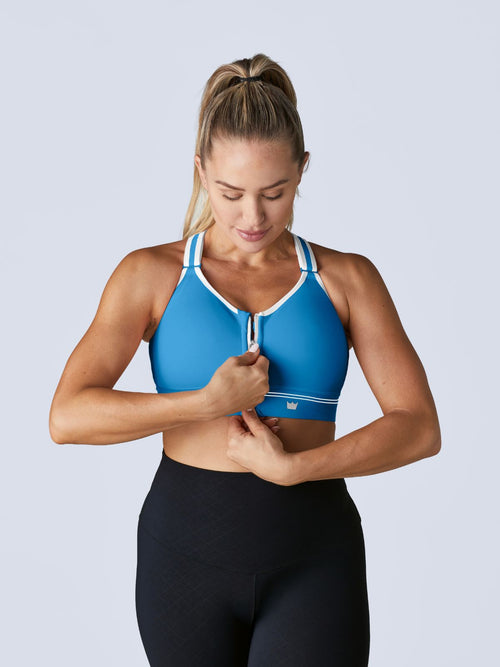
An adjustable sports bra with a continuously variable rib band, non-stretch straps, and an encapsulation-plus-compression design solves each of these problems. It gives you the shoulder positioning, ribcage support, and weight distribution that posture bras promise, with the added capability of handling high-impact activities like running or HIIT that dedicated posture bras cannot.
University of Memphis research confirms what this approach delivers in practice: their studies found that greater breast support is associated with reduced peak knee valgus angles and greater trunk flexion at initial contact during landing movements, biomechanical profiles linked to lower ACL injury risk [4]. The bra supporting those findings was not a posture bra. It was an adjustable sports bra engineered for performance.
SHEFIT Sports Bras: Posture Support Built Into Every Feature
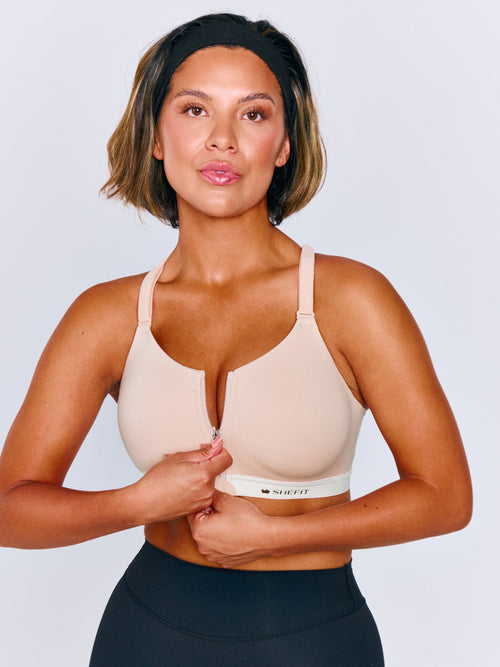
Every feature that matters for posture support (adjustable band, non-stretch straps, encapsulation with compression, front closure) exists in our product line because the biomechanics demanded it. University of Memphis research confirms our Ultimate Sports Bra reduces vertical breast displacement by more than 50% compared to other brands' high-support options [4].
The Ultimate Sports Bra
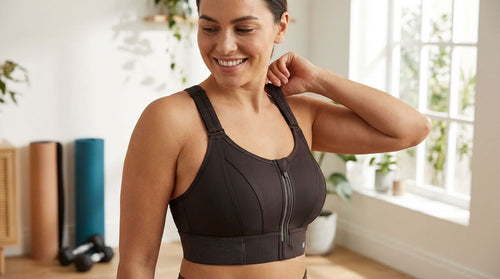
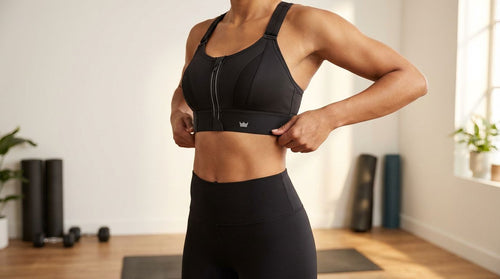
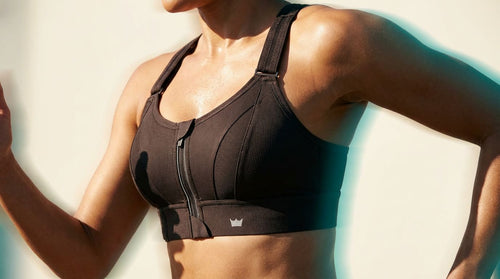
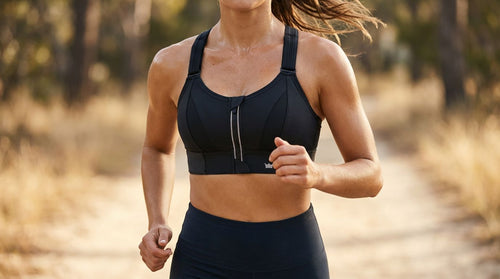
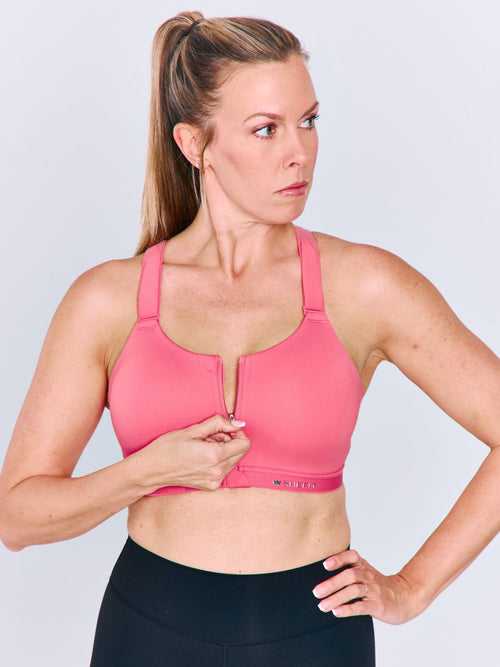
The Ultimate Sports Bra ($69) delivers our maximum support for high-impact training and all-day posture support.
Key features:
Patented adjustable shoulder straps and rib band for custom fit
Encapsulation and compression design for complete motion control
Non-stretch straps that maintain lift wash after wash
Removable modesty pads for customizable coverage
Front zipper for easy on and off
Sizes XS-6XL, AA-I cups
The Ultimate handles everything from running to HIIT to CrossFit to horseback riding. With 45,000+ reviews, it has proven effective for all breast types, from small to large, enhanced or natural.
The Flex Sports Bra
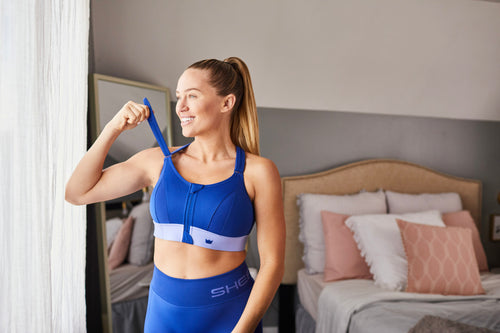
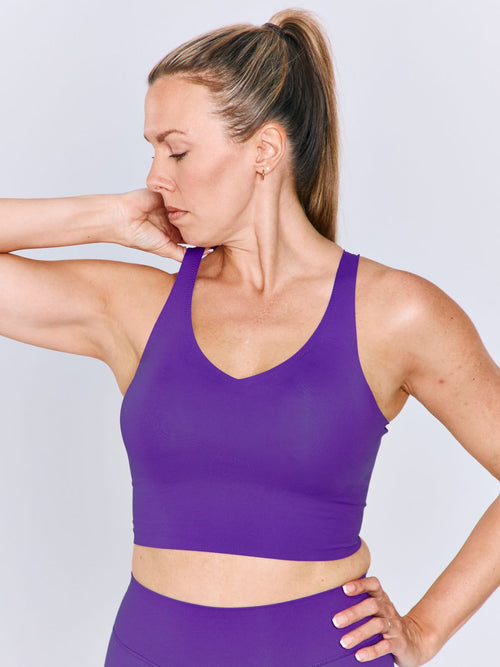
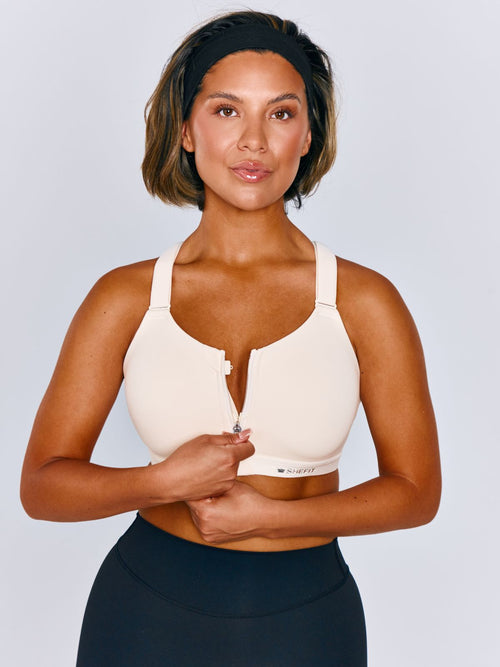
The Flex Sports Bra ($65) offers patented adjustable features with smooth cups for a sculpted look. It provides high-impact support for smaller bust sizes (32C and under) and medium-impact for larger sizes. Worth noting: our medium-impact rating delivers support that rivals what other brands call high-impact.
Best for: cycling, strength training, pickleball, or any varied-intensity session.
How They Compare
Feature |
SHEFIT Ultimate |
SHEFIT Flex |
|---|---|---|
Support level |
Maximum (all sizes) |
High (32C and under) / Medium (larger sizes) |
Adjustable band |
Yes (patented) |
Yes (patented) |
Adjustable straps |
Yes (patented, non-stretch) |
Yes (patented) |
Design type |
Encapsulation + compression |
Encapsulation + compression |
Cup style |
Removable modesty pads |
Smooth cups, sculpted look |
Size range |
XS-6XL, AA-I cups |
XS-6XL, AA-I cups |
Best activities |
Running and HIIT, plus horseback riding |
Cycling and strength, plus pickleball |
Durability testing |
25 wash cycles |
25 wash cycles |
Price |
$69 |
$65 |
Both bras are wash-tested to 25 cycles before showing obvious wear, compared to the industry standard of roughly 5 washes. Adjustability extends lifespan further: as elastic naturally relaxes over time, you compensate by tightening rather than replacing.
FAQs About Posture-Correcting Bras
Do posture-correcting bras really work?
They improve shoulder position while you wear them. Research confirms a 6-degree improvement in scapula retraction during use [1]. The limitation is that these gains do not carry over after you take the bra off. For lasting change, you need to strengthen your postural muscles alongside wearing supportive garments.
What should I look for in a bra for better posture?
An adjustable rib band (controls 80% of support), non-stretch straps (maintain shoulder positioning), and a design that combines encapsulation with compression (distributes breast weight evenly). The bra should support you without restricting deep breathing.
Can a sports bra help with back pain?
Research shows that a well-designed breast support garment can reduce back stiffness by 34% and discomfort by 33% compared to going without proper support [3]. The key factor is adequate support and proper fit, not a specific "posture" label.
How long should I wear a posture bra?
If using a dedicated posture bra, physical therapists recommend limiting wear to avoid dependency and breathing restriction. A properly fitted adjustable sports bra, in contrast, is designed for all-day wear because it supports without restricting your ribcage.
Do I need a special posture bra or will a supportive sports bra work?
A properly fitted, adjustable sports bra that provides adequate band support, non-stretch straps, and encapsulation with compression addresses the same biomechanical factors as a dedicated posture bra. The difference: it also handles high-impact exercise, costs less ($65-69 vs $158-199), and does not restrict your breathing.
Does breast size affect how much a bra can help my posture?
Yes. Larger breast sizes create more forward gravitational pull, which increases the postural compensation your upper back must provide. D+ cups benefit most from maximum support features, including encapsulation and compression combined, for virtually all activities.
The research is clear on one point: proper breast support matters for posture, and it matters more as breast size increases. Where the research gets more nuanced is in what "proper support" actually means. Proper support means a bra that fits precisely, supports adequately, and lets your body move the way it needs to. When that support is built into a bra you can wear all day and train in at full intensity, you get posture benefits without the compromises that dedicated posture bras ask you to accept.
References
[1] Jones M, Mills C, Exell T, Wakefield-Scurr J. "A novel multi-study intervention investigating the short and long term effects of a posture bra on whole body and breast kinematics." Gait & Posture, 2021. https://pubmed.ncbi.nlm.nih.gov/33161276/
[2] Mills C et al. "Hold-up - are high support bras bad for the back?" University of Portsmouth / European Journal of Sport Science, 2025. https://www.port.ac.uk/news-events-and-blogs/news/hold-up-are-high-support-bras-bad-for-the-back
[3] Haworth L, May K, Janssen J, Selfe J, Chohan A. "Does an alternative breast support garment provide symptomatic relief for larger breasted women with chronic non-specific back pain?" Prosthetics and Orthotics International, 2024. https://pmc.ncbi.nlm.nih.gov/articles/PMC11005674/
[4] Fong HB, Nelson AK, Storey JE, et al. "Greater Breast Support Alters Trunk and Knee Joint Biomechanics Commonly Associated With Anterior Cruciate Ligament Injury." Frontiers in Sports and Active Living, 2022. https://doi.org/10.3389/fspor.2022.861553