Which Bra Is Right for You? Learn More


You grabbed the first bra in the drawer, clipped it on, and drove to your morning bootcamp class. Forty seconds into burpees, you felt it: the underwire shifting, the lace band riding up your ribcage, straps sliding off one shoulder while you tried to hold a plank. By the time you got home, you had red marks across your ribs, chafed skin under each strap, and a silent vow to never make that mistake again. You wore a regular bra to a high-impact workout, and your body spent the entire hour reminding you why that does not work.
At SHEFIT, we make sports bras engineered for exactly the kind of movement that regular bras were never designed to handle. We also know that regular bras serve a real purpose: shape, comfort, and all-day wearability. The question is not which bra is "better." It is which bra matches what you are actually doing when you put it on.
This guide breaks down the core differences between sports bras and regular bras, maps activities to the right support level, covers what the peer-reviewed research says about breast health during exercise, and explains the design technology that separates a high-performance sports bra from everything else in your drawer.
What Makes a Sports Bra Different from a Regular Bra?
The difference starts with intent. A regular bra is designed for shape and comfort across a full day of low-movement activity: commuting, sitting at a desk, running errands. Sports bras exist to control breast movement during exercise, when forces on breast tissue multiply dramatically.
That intent drives every design choice.
Regular bras use underwire or wire-free cups for shaping, with materials chosen primarily for aesthetics rather than performance. The band closure is typically a rear hook-and-eye system. Straps are narrower, offering a range of styles from halter to racerback to traditional over-the-shoulder. These bras prioritize how the wearer looks and feels under everyday clothes.
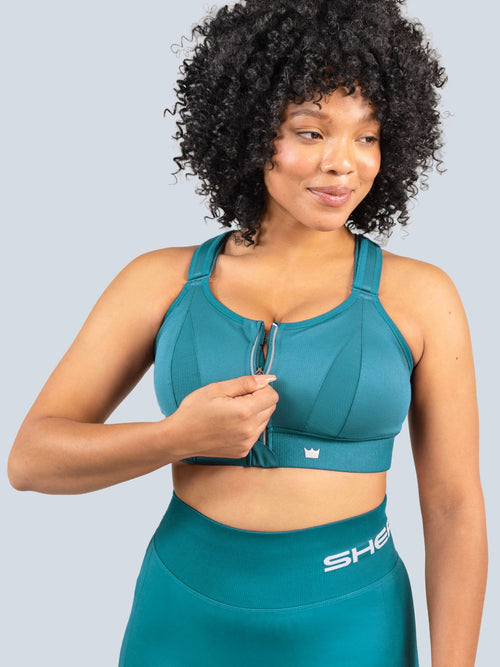
Sports bras flip those priorities. The fabrics are moisture-wicking and breathable, built to handle sweat without retaining heat. Bands sit snugger against the ribcage because the band carries 80 to 90 percent of the bra's support during movement. Straps are wider to distribute load across a larger surface area, and many designs use racerback or Y-back configurations to keep straps in place during overhead motion. Closures vary from pullovers to front zippers, with front-zip designs making it easier to get the bra on and off when you are sweaty.
| Feature | Sports Bra | Regular Bra |
|---|---|---|
| Primary purpose | Minimize breast movement during activity | Support shape and aesthetics for daily wear |
| Materials | Moisture-wicking, breathable synthetics | Lace and soft decorative fabrics |
| Support mechanism | Compression, encapsulation, or both | Underwire or wire-free cups + straps |
| Strap width | Wide, often racerback or Y-back | Narrower, varied styles |
| Neckline | Higher, fuller coverage | Variable (plunge to full coverage) |
| Clasp/closure | Often front-zip or pullover | Typically back hook-and-eye |
| Band fit | Snug (designed for movement) | Comfortable for all-day wear |
| Best for | Exercise and high-impact activity | Daily wear and going out |
The functional gap between these two categories grows wider as impact increases. For a slow walk around the neighborhood, either type of bra might feel fine. For a HIIT class, a CrossFit WOD, or a 5K at tempo pace, the difference in breast control is not subtle.
When to Wear a Sports Bra (and When Not To)
Activity dictates support needs, and support needs dictate which bra belongs on your body. A yoga flow and a box-jump session place completely different forces on breast tissue, and matching the bra to the activity protects both comfort and long-term breast health.
High-Impact Activities
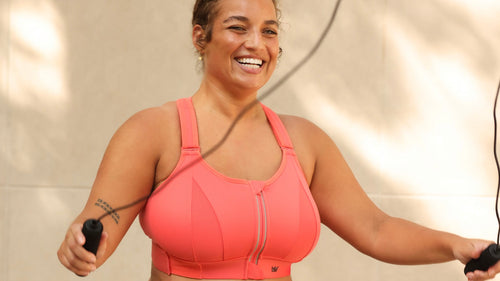
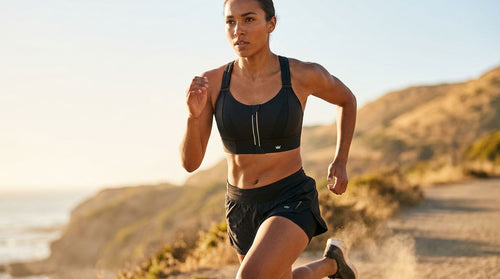
Any activity with significant vertical and lateral breast movement qualifies as high impact. Running is the clearest example: breasts move in a figure-eight pattern across three planes of motion with every stride. HIIT sessions and CrossFit workouts generate the same kind of forces, as do jumping rope and horseback riding. A high-impact sports bra is non-negotiable for these activities, regardless of cup size. If you ride horses, the combination of vertical bounce and forward lean makes this one of the highest-demand activities for breast support, even though it does not always get classified alongside running.
Medium-Impact Activities
Cycling and strength training fall into medium territory, as do hiking and pickleball. Dedicated breast support is strongly recommended here, especially for women with D+ cups. The forces are lower than running, but repetitive enough over a 45-minute to two-hour session that a regular bra will lose its fight against gravity and lateral movement. For a deeper breakdown, our guide on understanding impact levels covers how impact categories map to specific sports.
Low-Impact Activities and Everyday Wear
Low-impact movement like yoga and pilates involves minimal bounce. Purpose-built support is still the better choice for most women during these activities, but smaller cup sizes (A and B cups) may find a well-fitted regular bra adequate for gentle movement.
For daily life outside the gym, a regular bra is purpose-built for the job. The range of aesthetics and silhouette options in regular bras serve daily life in ways that most sports bras do not.
| Activity | Impact Level | Recommended Bra |
|---|---|---|
| Running / HIIT / CrossFit | High | High-impact sports bra |
| Horseback riding | High | High-impact sports bra |
| Cycling and strength training | Medium | Sports bra (especially D+ cups) |
| Hiking, pickleball | Medium | Sports bra |
| Yoga / pilates / walking | Low | Sports bra or comfortable regular bra |
| Office, everyday wear | Daily | Regular bra or comfortable sports bra |
| Going out, special occasions | Daily | Regular bra (aesthetics and shaping) |
Can a sports bra replace a regular bra for daily wear? It depends on the design. Compression-style sports bras press both breasts against the chest as a single unit, which creates a uni-boob silhouette that does not sit well under most everyday clothes. Encapsulation and hybrid designs preserve a more natural breast shape and work better for extended wear. If you want one bra that crosses over from workout to errand day, look for a hybrid design with individual cup space rather than a pure compression style.
The Disadvantages of Sports Bras (Honest Answer)
Sports bras are built for a specific job, and that specialization comes with trade-offs worth knowing about.
Compression-style designs flatten both breasts against the ribcage. That is effective for bounce control during exercise, but it produces a uni-boob look under T-shirts, button-downs, and fitted tops. If you have somewhere to be after the gym, you may want to change.
Sports bras also show under regular clothing more easily. Wider bands, higher necklines, and racerback configurations can peek out from tank tops, V-necks, and off-the-shoulder styles. Regular bras are designed with clothing compatibility in mind; sports bras prioritize function over discretion.
Some women find that performance-oriented sports bras feel too restrictive for all-day wear. One designed to lock everything down during a one-hour HIIT session may feel constrictive across a ten-hour workday. This is where understanding support levels matters: a high-impact bra worn for low-impact daily activity can feel like overkill because it is overkill.
Regular bras offer far more aesthetic variety: lace finishes, bold colors, plunge necklines, convertible straps, strapless options. If what you wear under your clothes matters to how you feel in them, regular bras have a library of options that sports bras simply do not match.
The takeaway: sports bras and regular bras serve different purposes. Neither is universally superior. Choosing between them is a question of activity, not quality.
Are Sports Bras Actually Better for Your Health?
The short answer: during exercise, yes. For your normal day-to-day routine, a regular bra is perfectly fine.
The research is specific about context. The health consequences of inadequate breast support show up during physical activity, when forces on breast tissue spike dramatically compared to sitting or standing.
What the Research Shows
A 2017 study in the Journal of Sports Sciences found that without sufficient breast support during exercise, women experience increased embarrassment, decreased willingness to exercise, and increased breast discomfort or pain [1]. The barrier is real: women who feel unsupported are less likely to work out at all, and that has downstream effects on cardiovascular health, mental health, and longevity.
Two studies from 2022 examined what happens biomechanically when breast support improves. Researchers found that greater breast support was associated with reduced peak knee valgus angles and greater trunk flexion during landing movements, a biomechanical profile linked to lower ACL injury risk, and that greater breast support was also associated with reduced oxygen consumption and greater running economy during treadmill running [2]. In plain terms: better breast support made women more efficient runners and reduced stress on their knees.
A 2024 study published in Nature Scientific Reports measured breast-torso coordination during running. Wearing a sports bra synchronized breast movement with torso movement in over 90% of running strides, compared to roughly two-thirds of strides without a bra [3]. That synchronization matters because unsynchronized breast movement creates additional load on the upper body, altering running form and increasing energy expenditure.
Cooper's Ligaments: The Tissue That Does Not Come Back
Connective tissue in the breast, known as Cooper's ligaments, gives breasts their internal structure and shape. These ligaments have very limited regenerative capacity; once stretched, they do not recover their original structure. Regular bras during high-impact activity leave Cooper's ligaments unsupported during repeated high-force movement, which can lead to permanent tissue elongation over time.
A regular bra at the office poses no risk to Cooper's ligaments. A regular bra during a 30-minute HIIT class does.
The Key Differences in Support: Compression, Encapsulation, and Why It Matters
Not all sports bras manage breast movement the same way. Three design categories exist, and each uses a fundamentally different approach to control.
Compression
A compression bra presses both breasts against the chest wall as a single unit. Think of it as a tight layer that flattens and restricts. Compression works well for smaller cup sizes at lower impact levels, but it creates that uni-boob silhouette and can feel restrictive for C+ cups during extended wear. For a full breakdown of how compression sports bras work, we cover the mechanics and best-fit scenarios in detail.
Encapsulation
An encapsulation sports bra surrounds each breast in its own cup space, supporting the left and right breast independently. This preserves a more natural shape while controlling movement in all directions across the three planes of motion. Encapsulation works better for C+ cups and higher-impact activities because it addresses each breast's movement pattern individually rather than binding them together.
Hybrid (Encapsulation + Compression)
Research from 2010 published in Medicine & Science in Sports & Exercise found that bras incorporating both breast elevation and compression provided significantly greater comfort than standard encapsulation alone for women with large breasts during physical activity. The hybrid approach takes the best of both designs: dedicated space for each breast with natural shaping and independent support, combined with compression elements that add a secondary layer of movement restriction.
Regular bras use underwire or structured cups for shaping, but they are not designed to limit multi-directional movement at all. The functional gap between a regular bra and any sports bra design is largest during high-impact exercise, where breast tissue can move more than 15 centimeters per stride without proper support.
How to Find the Right Fit (For Either Bra Type)
Fit determines whether any bra, sports or regular, actually does its job. Research estimates that 85% of women are wearing the wrong bra size [4], and the consequences range from discomfort to reduced performance to long-term tissue damage during exercise.
The core fit principles overlap between sports bras and regular bras: the band carries 80 to 90 percent of support and needs to sit level across the back, cups need to contain all breast tissue without gapping or overflow, and straps provide lift without digging. Where sports bras differ is in the standard of containment. A regular bra that shifts slightly during a meeting is a minor inconvenience. One that shifts during a run is a functional failure.
Sports Bra Fit Checklist
- Band sits level across the back and does not ride up when you raise your arms
- Each breast sits fully within its cup with no tissue spilling over the top or sides
- Straps hold firm without digging
- No gapping between cup and breast
- Bounce test: jump in place and check for multi-directional movement
- Visible armpit skin is normal. It means the bra is lifting breast tissue higher on the chest wall, exposing the natural skin fold underneath. That is anatomy, not spillage. Spillage means tissue pressing over the cup edge or past the underarm seam.
Getting Your Size Right
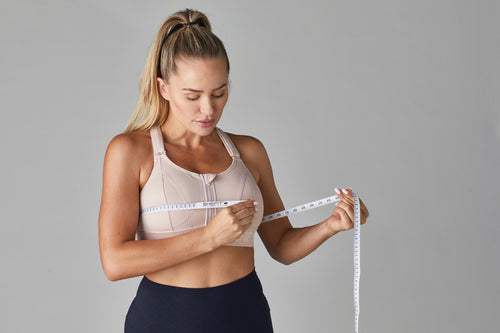
Bra sizing is not standardized across brands. A 36D in one brand may fit completely differently in another. We recommend using your actual underbust and bust measurements in inches rather than relying on a cup letter from another brand. Our Fit Advisor quiz takes about 30 seconds to match you with the right size.
If you fall between sizes: go with the larger size for more coverage, smaller size for more control. And for women with larger cup sizes who have struggled to find support that works, fit is the single biggest variable between a bra that performs and one that fails.
SHEFIT Sports Bras: Built for When It Actually Matters
When the activity demands real support, the design details determine whether the bra survives the workout or you spend the whole session adjusting. Both of our core products use a hybrid design that combines encapsulation and compression, because the research confirms that neither mechanism alone is enough for high-impact performance.
Patented Zip. Cinch. Lift.® Technology
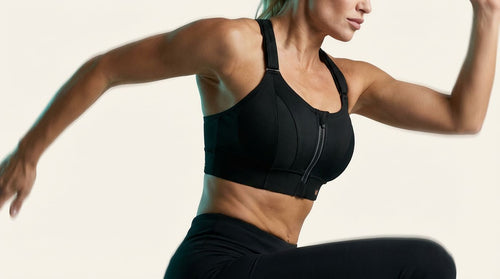
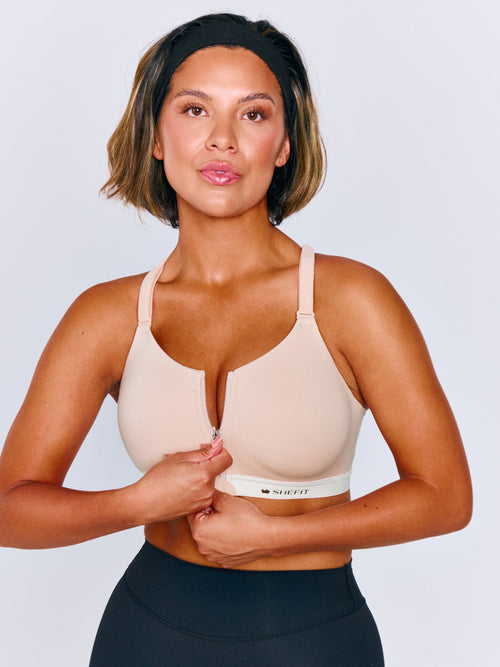
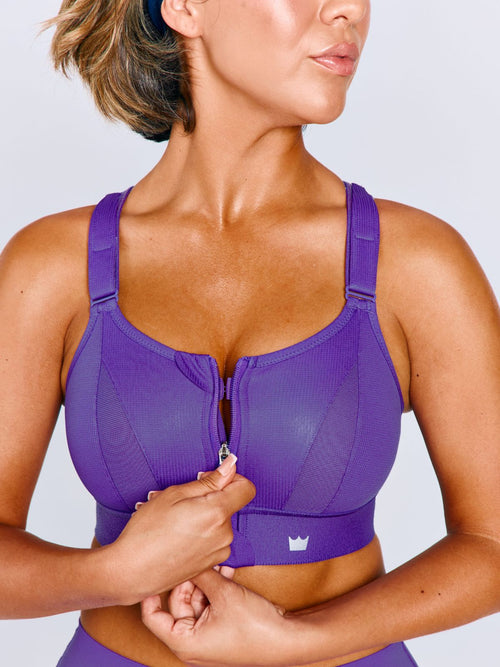
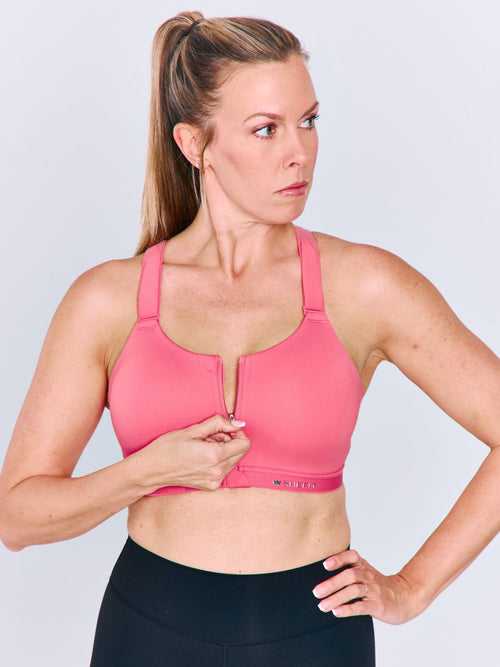
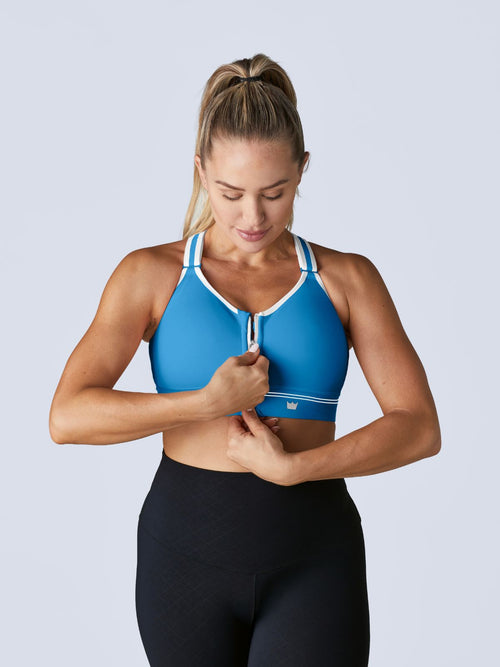
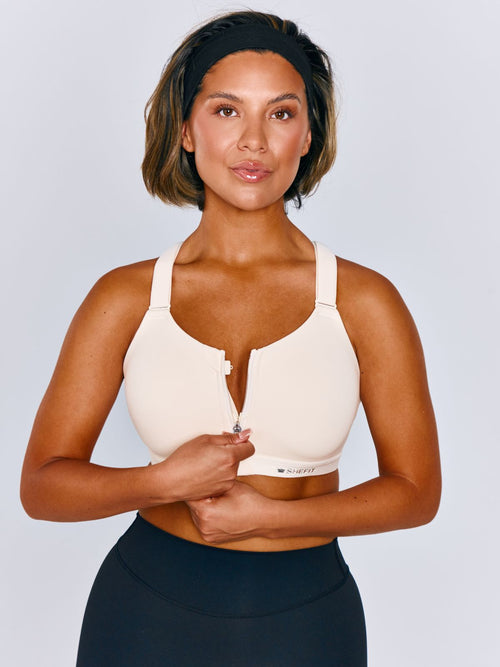
Both the Ultimate Sports Bra and the Flex Sports Bra use our patented adjustable system. The front zipper provides easy on-and-off access (especially when you are sweaty). The adjustable shoulder straps and rib band let you dial in the exact compression and lift your body needs, and those settings hold during the workout because the straps are non-stretch. Every wash, every session, the fit stays where you set it.
University of Memphis Research
Independent research at the University of Memphis Breast Biomechanics Research Center has examined breast displacement and biomechanical outcomes across different levels of breast support [2]. Both the Ultimate and Flex use the same hybrid encapsulation-compression design validated by that research to maximize support during high-impact movement.
| Feature | Ultimate Sports Bra | Flex Sports Bra |
|---|---|---|
| Price | $69 | $65 |
| Impact level | High (all sizes) | High (32C and under), Medium (larger sizes) |
| Cup design | Encapsulation + compression, individual cup space, removable modesty pads | Encapsulation + compression, smooth non-padded cups |
| Closure | Front zipper | Front zipper |
| Straps | Non-stretch, adjustable | Non-stretch, adjustable |
| Size range | XS-6Luxe, AA-I cups | XS-6Luxe, AA-I cups |
| Best activities | Running / HIIT / CrossFit / horseback riding | Cycling / strength training / yoga / pickleball |
| Durability | Tested to 25 wash cycles | Tested to 25 wash cycles |
The Flex carries a medium-impact rating for larger sizes, but our medium-impact rating delivers support that rivals what other brands call high-impact. Both products come with our Sure-Fit Promise (30-day returns and free exchanges). With over 75,000 5-star reviews and more than $1.2 million donated through the Sports Bra Project, we are committed to making real support accessible to every woman who needs it.
Browse the full lineup in our sports bra collection.
FAQs
Are sports bras better for you than regular bras?
During exercise, yes. The peer-reviewed research consistently shows that adequate breast support during physical activity reduces injury risk, improves running economy, and protects connective tissue that does not regenerate once damaged. For everyday wear at low activity levels, a regular bra is perfectly appropriate and comfortable.
What are the disadvantages of sports bras?
Compression-style sports bras create a uni-boob silhouette that does not work under most everyday clothing. Sports bras also show under regular shirts more easily due to wider bands and higher necklines. Performance-focused designs can feel too restrictive for all-day wear. Regular bras offer significantly more aesthetic variety for daily life.
Can a sports bra be worn as a regular bra?
Yes, particularly hybrid or encapsulation designs that preserve a natural breast shape. Pure compression bras are less comfortable for extended daily wear. If you want something that transitions from workout to errands, choose a style with separate cups for each breast rather than flat compression.
What is the difference between a sports bra and a regular bra?
A sports bra minimizes breast movement during physical activity using moisture-wicking fabrics, snug bands, and wide straps. A regular bra provides shape and comfort for everyday life. The core difference is that sports bras are engineered to handle multi-directional forces during exercise, while regular bras are designed for low-movement comfort.
How do I know if I need a sports bra or a regular bra?
Match the bra to the activity. Any exercise involving repetitive bouncing, jumping, or running calls for a sports bra. Daily tasks like office work, commuting, and low-impact movement are well-served by a regular bra. If you are unsure, the bounce test tells the truth: jump in place and see if you feel controlled in all directions.
References
[1] Risius, D., Milligan, A., Berns, J., Brown, N., & Scurr, J. "Understanding key performance indicators for breast support: an analysis of breast support effects on biomechanical, physiological and subjective measures during running." Journal of Sports Sciences, 2017. https://pubmed.ncbi.nlm.nih.gov/27291899/
[2] Fong, H.B., Nelson, A.K., Storey, J.E., Hinton, J., Puppa, M., McGhee, D., Greenwood, D., & Powell, D.W. "Greater Breast Support Alters Trunk and Knee Joint Biomechanics Commonly Associated With Anterior Cruciate Ligament Injury." Frontiers in Sports and Active Living, 2022. https://doi.org/10.3389/fspor.2022.861553
[3] Williams, G.K.R., Reeves, J., Vicinanza, D., Mills, C., Jones, B., & Wakefield-Scurr, J. "Breast-torso movement coordination during running in different breast support conditions." Nature Scientific Reports, 2024. https://www.nature.com/articles/s41598-024-71337-y
[4] McGhee, D.E. & Steele, J.R. "Optimising breast support in female patients through correct bra fit: a cross-sectional study." Journal of Science and Medicine in Sport, 2010. https://pubmed.ncbi.nlm.nih.gov/20451452/