Which Bra Is Right for You? Learn More


Open-back straps that crisscross into a cage or lattice pattern. A low scoop in front, thin bands fanning across the shoulder blades. The strappy sports bra looks like it belongs in a boutique fitness class, and the industry has quietly agreed on what that look means: light support, low impact, save it for yoga.
That agreement is a mistake. The straps on your back have almost nothing to do with how much your bust moves when you run. Support comes from the cups, the band, and the material underneath, not from the geometry of the straps. At SHEFIT, we have spent years building adjustable, high-impact bras, and the research we lean on says the same thing: a bra can be visually strappy and still lock you down for a sprint, or it can be plain-strapped and offer almost nothing.
This guide breaks down what "strappy" actually describes, where the low-support assumption came from, what genuinely determines support in any bra, and how to tell whether a strappy design will hold up for the activity you have in mind.
What Makes a Sports Bra 'Strappy'?
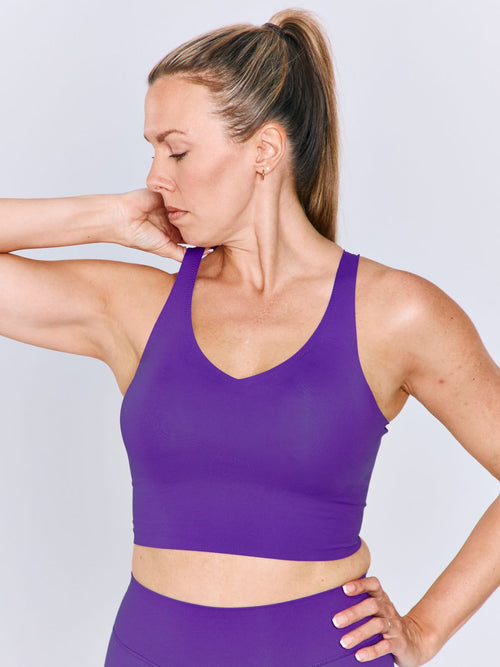
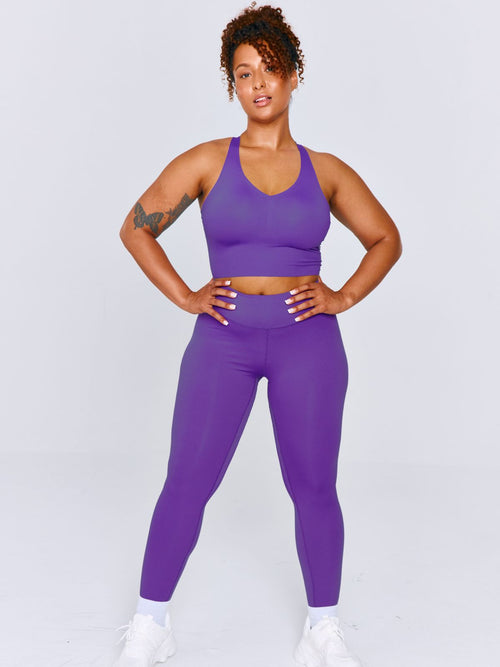
"Strappy" is a description of the back, not a rating of the bra. It refers to a strap configuration built around visual geometry: multiple thin bands, crisscross or cage-back lattices, ladder cutouts, or open-back designs that leave the spine exposed. The front is usually a scoop or V-neck, and the whole design draws the eye to how the straps are arranged rather than to a solid panel of fabric.
That sets it apart from the two most common alternatives. A standard bra runs two parallel straps straight down from each shoulder. A racerback angles the straps inward so they meet between the shoulder blades in a Y or T shape. The strappy version multiplies and reroutes those straps into a pattern, which is why it reads as fashion-forward. But the pattern is aesthetic. It tells you where the straps sit and how much skin shows. It does not tell you the impact rating, the cup construction, or how well the bra controls movement.
There is one place where strap geometry matters beyond decoration: anchoring. Straps that are routed to stay put, whether they crisscross, ladder, or run straight, keep the bra from shifting during movement, and a well-anchored strappy back can hold as steady as any other. That is a function of how securely the straps are set and how little they stretch, not of the pattern itself. The aesthetic and the mechanics are not opposed. They are just separate questions.
Understanding that distinction matters because the sports bra market is organized around visual shorthand. Labels like "yoga bra" or "studio bra" appear on open-back designs not because those designs cannot handle more, but because marketers have matched the aesthetic to a presumed use case. The strappy design ended up in the yoga column. Whether it belongs there depends on what is underneath the look, not on the look itself.
The Assumption Everyone Makes About Strappy Bras
Search for strappy sports bras and the framing is remarkably consistent. Buying guides file them under "low-impact" and steer them toward activities that avoid sudden, intense movement. Many brands rate their own strappy styles as light support only, positioning them for stretching, walking, or a gentle flow class. The message lands before you read a single spec: strappy equals delicate.
The logic behind that framing is thin. It assumes that because the straps are narrow and the back is open, the bra cannot deliver serious control. But strap width and back coverage are not the load-bearing parts of a sports bra. The band and the cups do that work. A design can show plenty of skin across the back and still run a firm, non-stretch band and encapsulating cups underneath.
What has actually happened is that a design choice got confused for a support judgment. The strappy back became shorthand for "not a real workout bra," and that shorthand stuck across product pages and buying guides alike. The rest of this article takes that assumption apart, because the mechanics of support do not care what your back looks like.
What Actually Determines Support in Any Sports Bra
Support comes from construction. When researchers at the University of Portsmouth analyzed the characteristics that improve a sports bra's performance, measured as how much it reduces breast movement, they identified five features that made the difference [1]:
- Encapsulation cup style: the single biggest factor, improving breast movement reduction by about 10% over non-encapsulation designs
- Cup padding: a further improvement of roughly 3.75%
- Nylon as the principal fiber: around 3.79%
- An adjustable underband: about 3.05%
- A higher neckline: roughly 0.75% for every centimeter the neckline rises toward the collarbone
Read that list again and notice what is missing. Strap width is not on it. Back coverage is not on it. Whether the straps crisscross, ladder, or run straight down is not on it. Every feature that moves the needle lives in the cups, the band, the fabric, and the front neckline. A strappy design can incorporate all five of these markers, and if it does, it performs like any other high-support bra that hits them.
This is the core of the matter. Encapsulation gives each breast its own cup and contains it directionally, which controls the three-dimensional motion that compression alone tends to miss. Combine that with a firm underband and a higher front neckline and you have a genuinely supportive bra, regardless of what the back looks like. Strap aesthetics are a styling decision layered on top of that foundation, not a substitute for it.
Strappy vs Other Strap Styles: What the Design Trades Off
Every strap configuration trades coverage against security against airflow. Strappy designs earn real advantages here, and they carry a couple of genuine risks worth naming.
| Strap Style | Back Exposure | Movement Security | Ventilation | Best For |
|---|---|---|---|---|
| Strappy / crisscross | High; open cage or lattice back | High when straps are anchored and non-stretch; slippage risk if thin and unadjustable | High; open back sheds heat | Studio classes and warm-weather training with the right construction |
| Racerback (Y or T) | Moderate; center back covered | High; straps lock between shoulder blades | Moderate | Most workouts, high-impact activity |
| Parallel straps | Low; both shoulders covered | Moderate; can slip during overhead movement | Lower; more back fabric | Everyday wear, low-impact activity |
| Halter | High; back fully open | Low to moderate; single anchor at the neck | Moderate | Swimming, fashion-forward styling |
The open back is where strappy designs shine. More exposed skin means better airflow, which matters in a hot studio or a summer run, and the crisscross geometry can hold a bra steady during a wide range of motion. The risk sits in the straps themselves. When women rank what they dislike most about sports bras, two complaints tie at the top: straps digging into the shoulders and straps slipping off, each cited as "extremely disliked" by 34% of respondents [2]. Thin, unadjustable straps are exactly the kind that dig in or slide. The fix is not to abandon the strappy look. It is to demand adjustability and non-stretch material so the straps stay put and spread their load.
That is the difference between an open-back design that frustrates you and one that disappears the moment you start moving. The design is not the problem. Cheap execution of the design is.
The Impact Level Question: Can Strappy Bras Handle High-Impact?
Here is the tension the whole category runs into. The industry files strappy bras under low-impact. The research says support is a function of construction. So a strappy-style bra can absolutely handle high-impact activity, as long as the construction underneath is built for it.
Impact level is really a question of how much control your activity and your body demand. The bra has to match both.
| Impact Level | Typical Activities | What the Design Needs |
|---|---|---|
| Low | Yoga and walking | Light encapsulation or compression; strap style is mostly a comfort preference |
| Medium | Cycling and strength work | Encapsulation and compression; a firm band; adjustable straps, especially for larger cup sizes |
| High | Running and HIIT, plus horseback riding | Encapsulation and compression, a firm or adjustable underband, and non-stretch straps for every cup size |
A strappy bra that hits the high-impact column, with encapsulating cups, a firm band, and non-stretch anchored straps, will control motion as well as any racerback built the same way. The same silhouette with stretchy spaghetti straps and a compression-only build will not, and that is the version the "low-impact only" reputation is built on.
Support at higher impact levels matters for reasons that go past comfort. In a study at the University of Memphis, greater breast support was associated with trunk and knee joint biomechanics linked to a lower risk of ACL injury, a pattern that showed up when comparing a high-support bra against a low-support one [3]. That does not mean a bra prevents injuries, but it does mean the level of support you choose has downstream effects on how your body moves under load. Inadequate support has a measurable cost elsewhere too: unsupported breast movement during running has been tied to shortened stride and wasted energy over distance [4]. The takeaway is that impact rating is not a marketing tier. It is a real requirement, and a strappy design can meet it or miss it depending entirely on what is built underneath.
It is also worth noting that cup size plays a role in how critical these construction details become. At smaller cup sizes, a compression-only strappy bra may hold up reasonably well for medium-impact work. At larger cup sizes, the margin for error shrinks: compression alone flattens tissue without containing it, and thin unsecured straps cannot anchor enough to prevent the side-to-side and three-dimensional movement that encapsulation controls. The higher your cup size, the more the checklist in the next section matters.
What to Look for in a Strappy Sports Bra
If you want the strappy look without giving up support, run any candidate through this checklist. Each item traces back to a construction feature that research links to performance, not to the strap pattern.
| Feature | What to Look For |
|---|---|
| Cup construction | Encapsulation or a combination of encapsulation and compression, not compression alone, especially for larger busts |
| Underband | Firm and non-stretch, or adjustable; the band carries the primary load, so it cannot be an afterthought |
| Strap material | Non-stretch straps hold their tension; stretchy straps loosen over time and let bounce creep back in |
| Strap width and adjustability | Adjustable straps you can set precisely; thin, fixed straps are the leading comfort complaint |
| Neckline | A higher front neckline correlates with better support; every centimeter counts |
A properly fitted encapsulating bra will not restrict your breathing during exercise, so you do not have to trade support for comfort [2]. If a bra checks these boxes, its open back and crisscross straps become a bonus rather than a compromise. If it fails them, no amount of aesthetic appeal will keep you supported through a real workout.
SHEFIT's Approach to Strappy Sports Bra Design
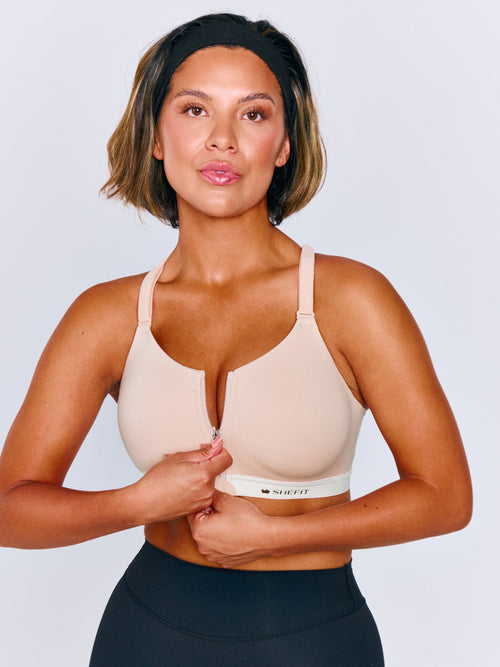
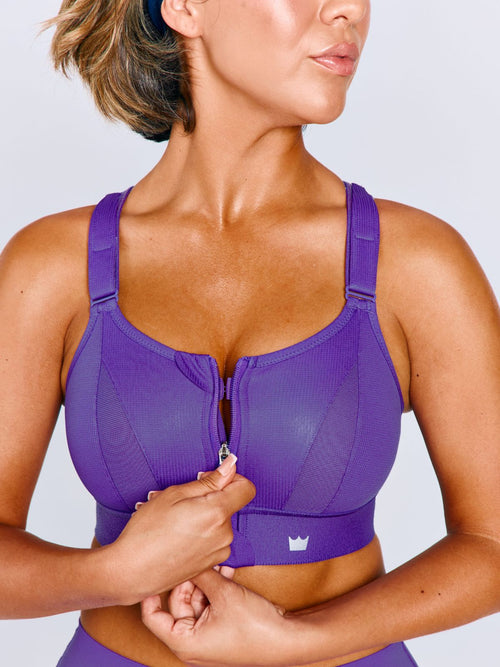
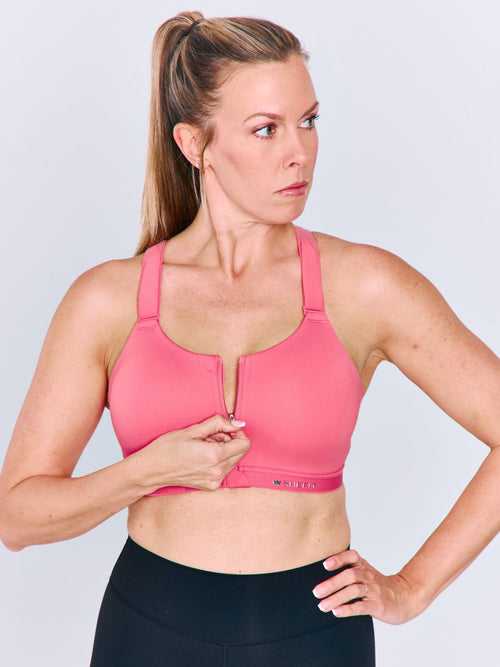
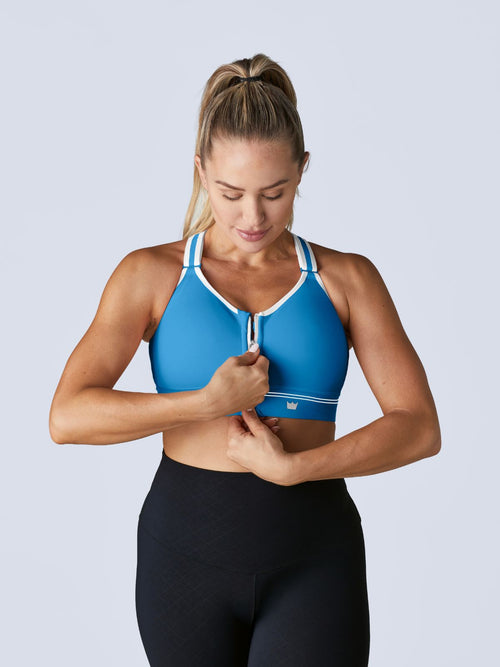
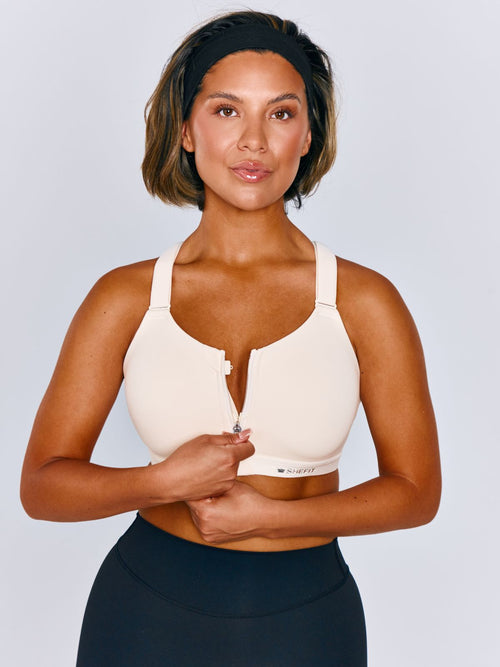
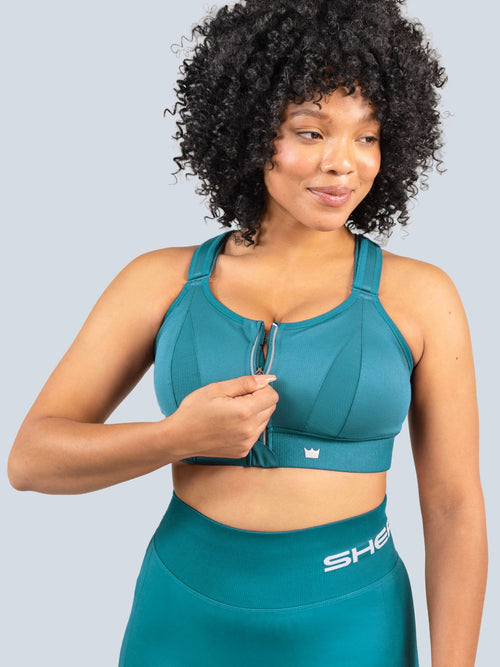
We built our bras around a single idea: support should adjust to your body instead of asking your body to fit a size chart. The mechanism behind that is our patented Zip. Cinch. Lift.® system. Zip is the front zipper, which opens and closes the bra for easy on and off; it is an access feature, not a compression control. Cinch is the adjustable rib band, which sets your compression by tightening or loosening around the ribcage. Lift is the pair of non-stretch shoulder straps, which set how much the bra lifts. Because the neckline height and strap tension are things you set yourself, you can dial in the support features that research ties to performance rather than accepting whatever a fixed design gives you [1].
Both of our core bras use encapsulation and compression construction, so they hit the biggest support marker regardless of how you style the straps.
| Feature | Ultimate Sports Bra | Flex Sports Bra |
|---|---|---|
| Impact Level | High | Medium |
| Cup Construction | Encapsulation and compression | Encapsulation and compression |
| Padding | Removable modesty pads | Smooth cups, no padding |
| Size Range | XS to 6Luxe, AA to I cups | XS to 6Luxe, AA to I cups |
| Strap Type | Non-stretch adjustable | Non-stretch adjustable |
| Best For | Running and horseback riding | Strength training and pickleball |
The Ultimate Sports Bra ($69) is our high-impact option, built for running and horseback riding. The Flex Sports Bra ($65) is our medium-impact option, and its adjustable rib band delivers support that rivals what other brands call high-impact, which is why it suits strength training and pickleball. Both run the same size range and both use the adjustable strap and band system, which is what lets them hold up across activities. Independent research at the University of Memphis found that our high-support bra reduces breast motion by more than 50% compared to previously reported values from other brands' high-support bras [5]. If you want to weigh impact levels before choosing, our guide to understanding impact levels walks through where each bra fits.
How to Find Your Fit
The right bra in the wrong size still fails you. Research consistently finds that most women are wearing the wrong bra size, and the number on your current tag is often a starting point rather than an accurate reading. Our approach leans on measurements over cup letters, because bra sizing is not regulated and a cup size from one brand rarely translates cleanly to another.
The band does the heavy lifting. It provides the primary foundation of support, which is why we treat your underbust measurement as the anchor and let the adjustable rib band fine-tune from there. Your traditional bra size, something like 34D, gets you into the right range on a sports bra size chart, and the adjustability handles the rest. If you land between sizes, go larger for more coverage or smaller for more control. Our full size range runs from XS to 6Luxe and AA to I cups, so plus sizing is Luxe, not an afterthought tacked onto the end of a standard run.
One point worth clearing up, because it trips people up with high-support bras: if you see armpit skin when you raise your arms, that is the bra lifting you properly, not spillage. Spillage is breast tissue pushing over the top or sides of the cup. The skin that appears under your arms when you are properly lifted is normal anatomy doing what it should.
If you want help dialing it in, we offer three paths:
- Fit Advisor quiz: a short questionnaire that returns a personalized size recommendation
- Free Virtual Fitting: a live video session with a Fit Expert who walks you through measurements at no cost
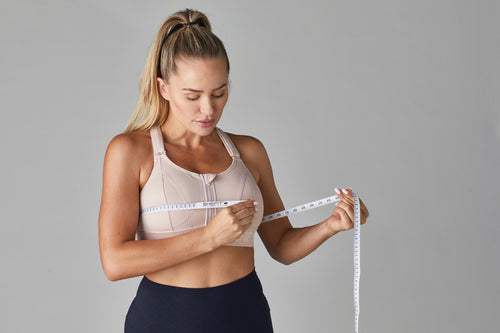
- Self-measurement guide: a step-by-step walkthrough for measuring at home
If you order and the fit is not right, our Sure-Fit Promise covers a free exchange within 30 days. Getting the size correct the first time matters most, which is why we built three different paths to get there. But if the adjustable system takes a couple of rounds to dial in, the exchange option means you are not penalized for experimenting with the Cinch tension or strap height.
FAQ
Are strappy sports bras good for large busts?
They can be, as long as the construction is right. The strappy back is fine for any bust size; what matters is encapsulation and compression cups, a firm underband, and non-stretch adjustable straps. For larger busts, avoid compression-only designs, which tend to flatten rather than support. As long as those support features are present, the open-back style works as well as any other.
Can a strappy sports bra be high-impact?
Yes. Support comes from the cup and band construction, not the strap arrangement on your back. One with encapsulating cups, a firm or adjustable band, and non-stretch straps can handle running and HIIT. One with stretchy, unanchored straps cannot, which is where the low-impact reputation comes from.
What is the difference between a strappy sports bra and a racerback?
Both describe the back strap configuration. A racerback angles the straps inward to meet between the shoulder blades in a Y or T shape. A strappy design uses multiple thin bands or crisscross patterns, often with an open cage back. Neither indicates a support level on its own; that depends on the construction underneath.
Do thin straps cause discomfort in sports bras?
They can. Thin straps that dig into the shoulders and straps that slip off are the two most-disliked features women report in sports bras. The solution is adjustability and non-stretch material, which spread the load and hold the straps in place, rather than avoiding the strappy look entirely.
Does SHEFIT make a strappy sports bra?
Our current lineup centers on our adjustable Ultimate and Flex bras, which use non-stretch adjustable straps and a patented rib band rather than a fixed strappy cage. If the strappy aesthetic is your priority, the checklist above tells you what construction to look for so the design does not cost you support.
References
[1] Norris, M., et al. "How the characteristics of sports bras affect their performance." Ergonomics, 2021. https://pure.port.ac.uk/ws/files/23048531/Norris_et_al_2020_AAM.pdf
[2] Bowles, Kelly-Ann. "Sports bra design for active women." University of Wollongong (Doctoral thesis, School of Health Sciences), 2012. https://ro.uow.edu.au/articles/thesis/Sports_bra_design_for_active_women/27660711
[3] Fong, H.B., Nelson, A.K., Storey, J.E., Hinton, J., Puppa, M., McGhee, D., Greenwood, D., Powell, D.W. "Greater Breast Support Alters Trunk and Knee Joint Biomechanics Commonly Associated With Anterior Cruciate Ligament Injury." Frontiers in Sports and Active Living, 2022-05-20. https://doi.org/10.3389/fspor.2022.861553
[4] Renwick, N.H. "Wearing a well-fitting sports bra can improve your performance – an expert advises how to find one." University of Portsmouth, 2023-08-25. https://www.port.ac.uk/news-events-and-blogs/blogs/improving-health-and-wellbeing/wearing-a-well-fitting-sports-bra-can-improve-your-performance-an-expert-advises-how-to-find-one
[5] Fong, H.B., Nelson, A.K., McGhee, D., Ford, K., Powell, D.W. "Increasing breast support is associated with a distal-to-proximal redistribution of joint negative work during a double-limb landing task." Journal of Applied Biomechanics, 2023. https://www.memphis.edu/healthsciences/pdfs/jab-biomech-2023.pdf