Which Bra Is Right for You? Learn More


Ten seconds into your first box jump of the day, you feel it. Not pain exactly, but a pull, a shift, a split-second where your attention leaves the workout and goes to your chest. By the third round, you are adjusting straps between sets. By the fifth, you are thinking about what to wear next time instead of your next rep. That distraction has a cost, and it goes deeper than comfort.
At SHEFIT, we have spent years studying what actually happens to a woman's body during high-intensity training. The research tells a clear story: breast support during explosive movement is not about preference. It is about biomechanics, breathing efficiency, and protecting your body from forces that accumulate with every rep. Understanding the science behind support changes how you evaluate every sports bra on the shelf.
What Happens to Your Body During High-Intensity Exercise
High-intensity training generates significant forces through your entire body. Your breasts, which are supported only by skin and connective tissue (not muscle), absorb those forces with every impact.
The movement is more complex than most women realize. Breasts do not simply bounce up and down. They move in three dimensions simultaneously: up to 19cm vertically, 4cm side to side, and several centimeters forward and back [1]. High-intensity activities like sprinting, burpees, and box jumps amplify all three planes of motion at once.
That multi-directional movement creates real consequences:
-
Pain during and after exercise. Research shows 72% of women experience breast pain when exercising. Even as little as 2cm of breast motion can trigger discomfort.
-
Altered movement patterns. When your body anticipates pain, it compensates. Shortened stride length, reduced arm swing, and protective posturing all reduce the effectiveness of your workout.
-
Exercise avoidance. Over 27% of active women report that inadequate breast support directly prevents them from exercising. The barrier increases significantly with breast size.
The difference between moderate and high-intensity activity matters here. Walking generates manageable forces. But the moment you add vertical displacement through plyometrics or sprint intervals, the forces multiply and your support needs change entirely.
How Proper Breast Support Affects Your Performance
Your sports bra is doing more than holding things in place. It is affecting how efficiently your body performs under load.
The breathing connection most women miss. The rib band provides approximately 80% of your total support, yet most women focus on straps when evaluating fit. A 2024 study in Medicine & Science in Sports & Exercise found that when sports bra underbands were too tight, the work of breathing increased by 16% during maximal running [2]. Runners in the tight condition took faster, shallower breaths and consumed approximately 1.3% more oxygen at submaximal speeds compared to those with properly fitted bands.
That 1.3% matters more than it sounds. Over a 5K, it translates to measurable fatigue. Over a marathon, it compounds significantly. The takeaway: a band that is too loose fails to support you, but a band that is too tight impairs your breathing and wastes energy. Adjustability is not a luxury feature. It is the mechanism that resolves this tension.
The injury connection. University of Memphis research demonstrates that greater breast support is associated with reduced peak knee valgus angles and greater trunk flexion at initial contact during landing movements [3]. These are biomechanical profiles linked to lower ACL injury risk. In practical terms, the right sports bra helps your entire kinetic chain absorb impact more safely, from your trunk through your knees.
Female athletes face significantly elevated ACL injury risk compared to males in the same sports. Proper breast support addresses one contributing biomechanical factor that most training programs overlook entirely.
What Separates Real Support from Marketing Claims
"High-impact support" appears on countless sports bra tags. But the phrase means different things depending on the construction behind it. Here is what actually matters when the intensity goes up.
|
Feature |
What It Does |
Why It Matters for High-Intensity |
What to Watch For |
|---|---|---|---|
|
Support design |
Controls breast movement |
Compression alone flattens but fails to control multi-directional motion for D+ cups |
Look for hybrid: encapsulation AND compression combined |
|
Strap material |
Manages lift and upward displacement |
Stretchy straps lose tension mid-workout and degrade over time |
Non-stretch straps maintain consistent lift |
|
Band adjustability |
Controls 80% of total support |
Fixed hook closures limit you to 2-3 positions; too tight impairs breathing |
Continuously adjustable rib band for precise fit |
|
Cup construction |
Shapes and separates each breast |
Individual cup space prevents breast-to-breast friction and controls independent motion |
Encapsulation with individual cup space |
|
Closure type |
Affects ease of use and security |
Pull-on styles stretch over time; back hooks are hard to adjust during activity |
Front zipper with adjustable band |
An estimated 75-85% of women wear the wrong bra size [4]. The support design table above explains why sizing alone does not solve the problem. Two women in the same size can need fundamentally different levels of compression and lift depending on breast type, activity intensity, and how their body feels that day.
How Your Breast Size Changes What You Need
Breast size affects your personal support threshold independently of the activity you choose. A D-cup walking still needs more support than an A-cup doing jumping jacks.
Research confirms that larger breast size is significantly associated with exercise avoidance. This is not a comfort preference. It is a documented barrier to physical activity that affects women's health outcomes.
What breast size changes about your support needs:
-
A-C cups have more flexibility in support style for low-to-medium impact activities. High-intensity still requires proper encapsulation and compression, but lighter options may work for yoga or walking.
-
D+ cups need hybrid support (encapsulation and compression combined) for virtually all activities. Compression-only designs flatten the chest without controlling independent breast movement, which increases discomfort and alters gait.
-
All breast types benefit from adjustability. Whether you are small to large, enhanced or natural, your ideal tension changes with your menstrual cycle, hydration levels, time of day, and postpartum recovery.
We designed our bras in sizes XS-6XL with AA-I cups specifically because proper support requires actual fit, not approximate sizing. For specific recommendations by cup size, sports bras for large cup sizes breaks down options by activity and preference.
Choosing a Supportive Sports Bra for Your Training
Accurate measurements are the foundation, but the real test happens during movement.
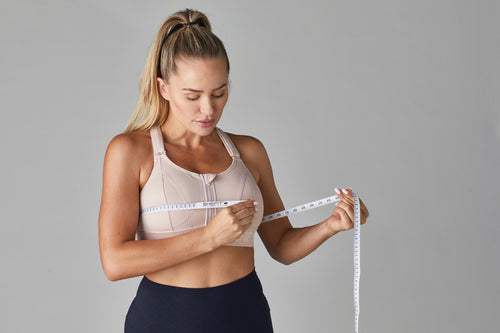
How to measure:
-
Band size. Wrap a flexible tape snugly around your ribcage directly under your breasts. Round to the nearest even number.
-
Cup size. Measure around the fullest part of your bust. The difference from your band size determines your cup: 1 inch = A, 2 inches = B, 3 inches = C, and so on.
-
Check the brand's chart. Sizes are not standardized. Use the manufacturer's guide, not your everyday bra size. For step-by-step guidance, finding your perfect SHEFIT size walks through the full process.
The fit checklist:
-
Band sits level across your back, not riding up
-
Each strap provides lift without digging into shoulders
-
No spillage over the top or sides of cups
-
Coverage does not extend too far under armpits
-
Minimal bounce during a 30-second jump test
-
Two fingers fit under the band comfortably
Once you pass the checklist standing still, run 30 seconds of your planned activity. Jumping jacks, running in place, dynamic stretches. If anything shifts, tighten. If anything digs, loosen. The goal is a fit that disappears during movement so you can focus entirely on training.
How SHEFIT Engineered Support for High-Intensity Training
Every feature discussed above (hybrid support design, non-stretch straps, adjustable band, encapsulation with compression) exists in our product line because the science demanded it.
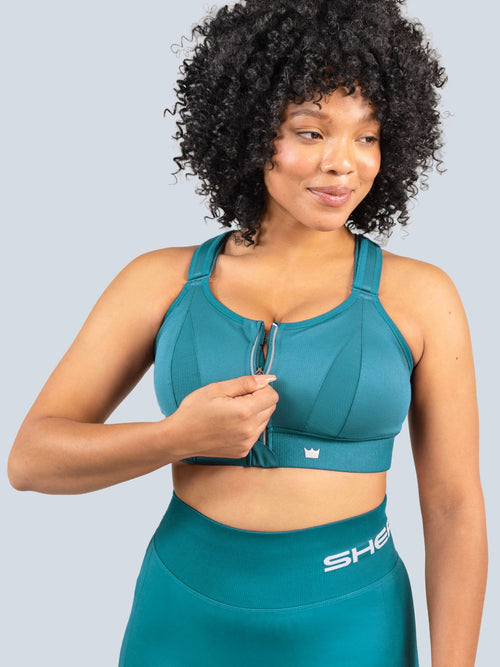
The Ultimate Sports Bra
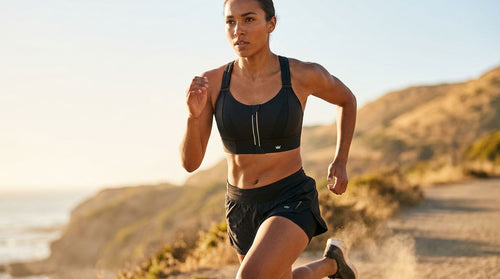
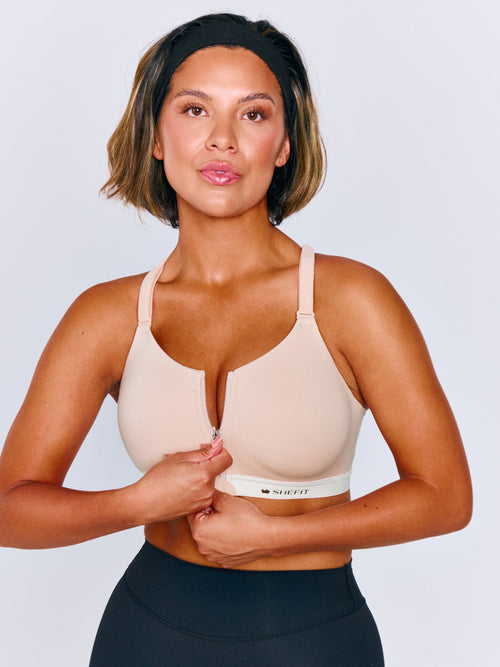
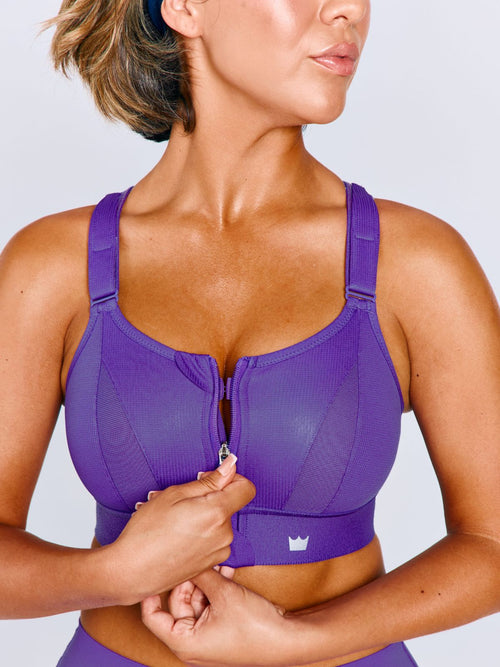
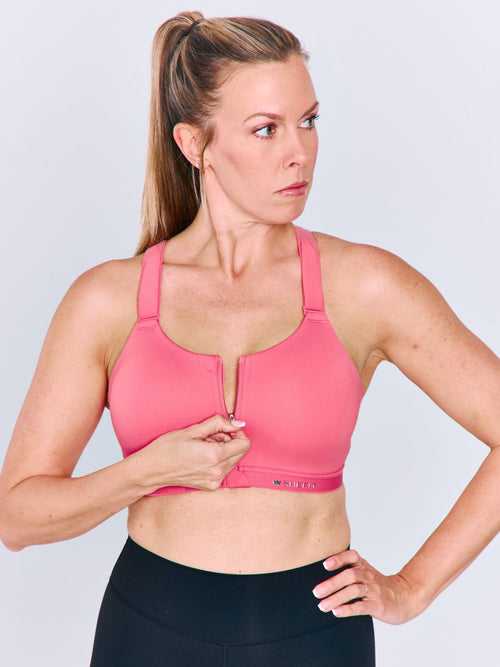
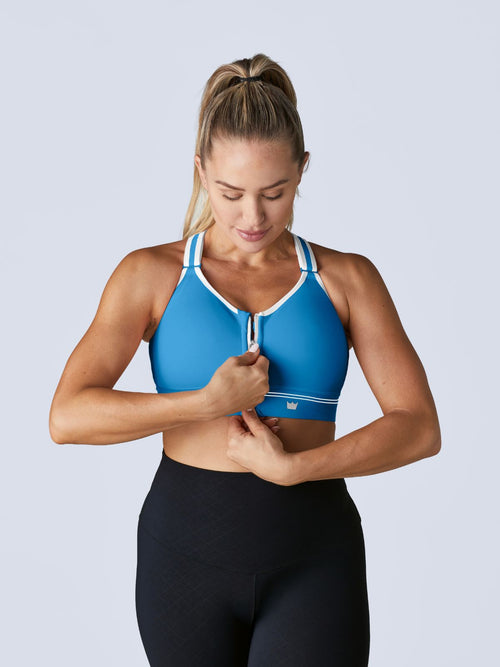
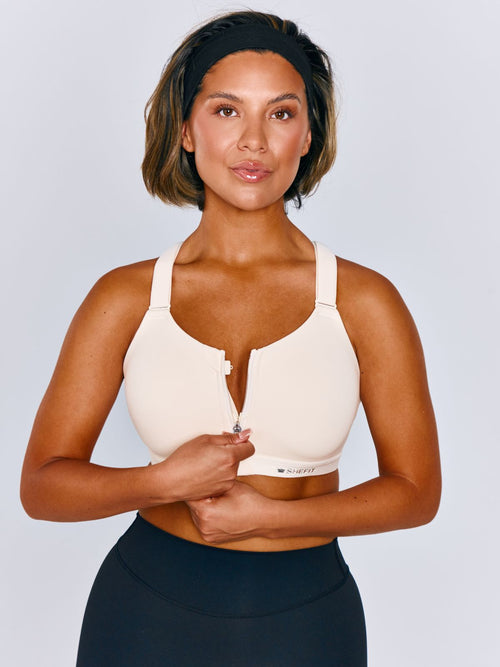
The Ultimate Sports Bra ($69) delivers our maximum support for high-intensity training. University of Memphis research confirms it reduces vertical breast displacement by more than 50% compared to other brands' high-support options, with greater breast support associated with biomechanics linked to lower ACL injury risk.
What makes it work:
-
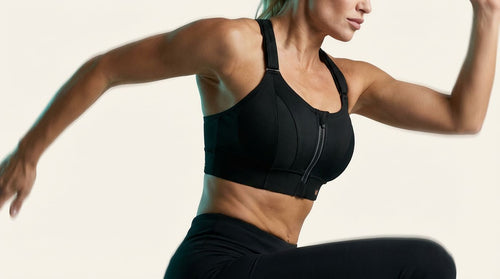
Patented adjustable shoulder straps and rib band for custom fit
-
Encapsulation and compression design for complete motion control
-
Non-stretch straps that maintain lift wash after wash
-
Removable modesty pads for customizable coverage
-
Front zipper for easy on and off
-
Sizes XS-6XL, AA-I cups
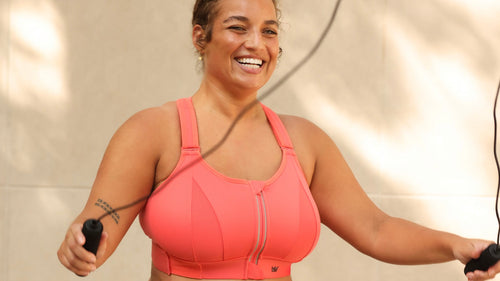
The Ultimate handles everything from HIIT to CrossFit to horseback riding. With 75,000+ 5-star reviews, it has proven effective across every activity level and breast type, from small to large, enhanced or natural.
The Flex Sports Bra
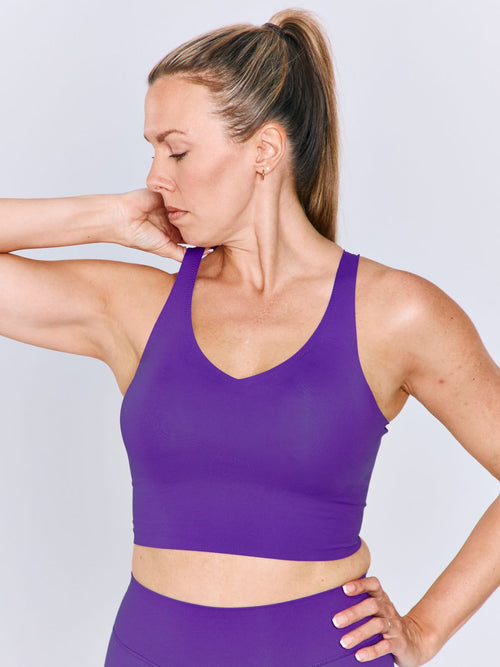
The Flex Sports Bra ($65) offers patented adjustable features with smooth cups for a sculpted look. It provides high-impact support for smaller bust sizes (32C and under) and medium-impact for larger sizes. Worth noting: our medium-impact rating delivers support that rivals what other brands call high-impact.
Best for: cycling and strength training, pickleball, or any mixed-intensity session.
How They Compare
Here is how the two bras stack up side by side.
|
Feature |
SHEFIT Ultimate |
SHEFIT Flex |
|---|---|---|
|
Support level |
Maximum (all sizes) |
High (32C and under) / Medium (larger sizes) |
|
Adjustable band |
Yes (patented) |
Yes (patented) |
|
Adjustable straps |
Yes (patented, non-stretch) |
Yes (patented) |
|
Design type |
Encapsulation + compression |
Encapsulation + compression |
|
Cup style |
Removable modesty pads |
Smooth cups, sculpted look |
|
Size range |
XS-6XL, AA-I cups |
XS-6XL, AA-I cups |
|
Best activities |
Running and HIIT, plus horseback riding |
Cycling and strength, plus pickleball |
|
Durability testing |
25 wash cycles |
25 wash cycles |
|
Price |
$69 |
$65 |
Both bras are wash-tested to 25 cycles before showing obvious wear, compared to the industry standard of roughly 5 washes. Adjustability extends lifespan further: as elastic naturally relaxes over time, you compensate by tightening rather than replacing.
FAQs About Supportive Sports Bras for High-Intensity Workouts
Can wearing the wrong sports bra actually affect my workout performance?
Yes. Research shows a too-tight underband increases your work of breathing by 16% during intense exercise, forcing faster and shallower breaths. That wasted energy compounds over the course of a workout. A properly fitted sports bra improves breathing efficiency and running economy.
What is the difference between encapsulation and compression support?
Compression bras press both breasts flat against your chest. Encapsulation bras give each breast its own cup space. For high-intensity activities, hybrid designs that combine both provide the best motion control, especially for D+ cups where compression alone fails to prevent multi-directional movement.
How do I know when my sports bra needs replacing?
Replace your sports bra when you notice reduced support, stretched elastic, or the need to constantly adjust during workouts. Quality bras last 12-24+ months with proper care. Air drying instead of machine drying extends lifespan considerably. Washing in cold water on a gentle cycle and avoiding fabric softener also help maintain structural integrity.
Does breast size determine what impact level I need?
Yes. Larger bust sizes need maximum support features for virtually all activities, including walking and yoga. Smaller sizes have more flexibility with lower-impact options for gentle activity but still need proper high-impact support for running and HIIT. Your breast size matters as much as your activity when selecting support.
Is it possible for a sports bra to be too tight for high-intensity exercise?
Absolutely. A 2024 study found that excessively tight underbands impair respiratory mechanics, increasing energy expenditure and changing breathing patterns during running. The goal is snug and secure without restricting deep breaths. You should fit two fingers under the band comfortably.
The science is clear: your sports bra is training equipment that affects how you breathe, how you move, and how safely your body absorbs impact. When support is engineered for the actual forces of high-intensity training, you stop managing your bra and start focusing on what you came to do. Your workouts deserve that kind of freedom.
References
[1] Australian Sports Commission. "Breast support and community sport." Research Article. https://www.ausport.gov.au/coaching/community/education/coaching-women-and-girls/resources/breast-support-and-community-sport-research-article
[2] Kipp, S., Leahy, M.G., & Sheel, A.W. "Sports Bra Restriction on Respiratory Mechanics during Exercise." Medicine & Science in Sports & Exercise, 2024. https://pubmed.ncbi.nlm.nih.gov/38350462/
[3] Fong, H.B. et al. "Greater Breast Support Alters Trunk and Knee Joint Biomechanics Commonly Associated With Anterior Cruciate Ligament Injury." Frontiers in Sports and Active Living, 2022. https://doi.org/10.3389/fspor.2022.861553
[4] Texas A&M University Graduate School. "Bras: The Continuing Research Saga." 2024. https://grad.tamu.edu/aggie-life/aggie-voice/bras-the-continuing-research-saga