Which Bra Is Right for You? Learn More


Search "no bounce sports bra" and you land in threads of women asking for the same thing in almost the same words: something tight, something that holds, something with absolutely no bounce. Not a better silhouette. Not a prettier strap. Just stillness.
That ask is not vanity, and it is not unreasonable. Breast tissue contains no internal muscle. Skin and the Cooper's ligaments are the only structures holding it in place, which means nothing inside your body is built to resist the force of a landing. Every stride, every box jump, every trot on horseback sends that tissue moving, and the only thing that changes the outcome is what you put on top of it.
We are SHEFIT, and we have spent a decade engineering around exactly that problem. What follows is what the research actually says about why bras bounce, what construction genuinely controls movement, and why the bra you own may be failing you for a reason that has nothing to do with how hard you cinched it this morning.
What "No Bounce" Actually Means
Vertical displacement is the technical name for the thing you are feeling. Unsupported, breast tissue can move up to 19 centimeters during exercise, roughly the length of your forearm from wrist to elbow [1]. When a woman types "absolutely no bounce" into a search bar, she is not exaggerating a minor annoyance. She is describing a measurable distance her body is covering that she cannot control on her own.
The consequences show up in the research. In a survey of UK female athletes, 51% reported breast pain, and 29% said a poorly fitting bra affected their performance [2]. That is not a niche complaint from a handful of women with unusually demanding workouts. It is roughly half the athletes surveyed, dealing with pain that a piece of equipment is supposed to prevent.
Here is what that means for you: if your current bra is not delivering, the problem is almost certainly mechanical, not personal. You did not choose the wrong activity or push too hard. The bra simply is not doing the job it was sold to do.
The Real Reason Bras Bounce: Ligaments, Not Muscle
Most of your body handles impact through muscle. You land, your quads and glutes absorb the force, and your nervous system adjusts in milliseconds. Breast tissue has none of that. It has skin on the outside and Cooper's ligaments running through it, and neither one contracts on command.
That single anatomical fact reframes the whole problem. You cannot train your way to less bounce. You cannot brace for it. The only variable you control is external, which is why construction matters more than effort, and why "just size down" is such bad advice. A smaller bra squeezes harder in one direction; it does not necessarily hold better.
Research from the University of Portsmouth's breast health group points to a consistent set of construction features that actually reduce movement:
- Encapsulation, meaning each breast sits in its own supportive space rather than being flattened together
- Structured cups that hold shape under load instead of collapsing
- A secure, adjustable band that anchors the bra to your ribcage
- A higher neckline, which limits how far tissue can travel upward
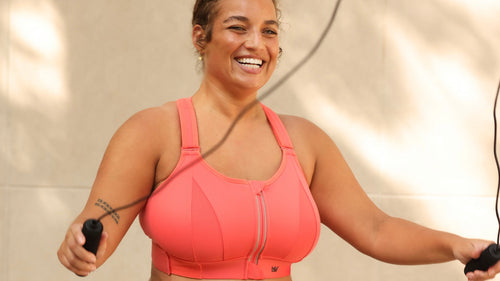
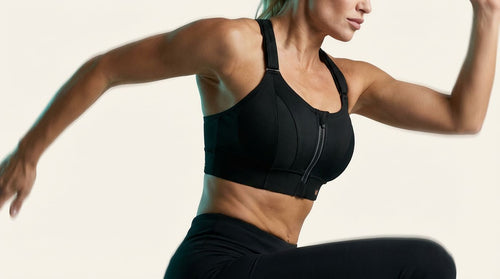
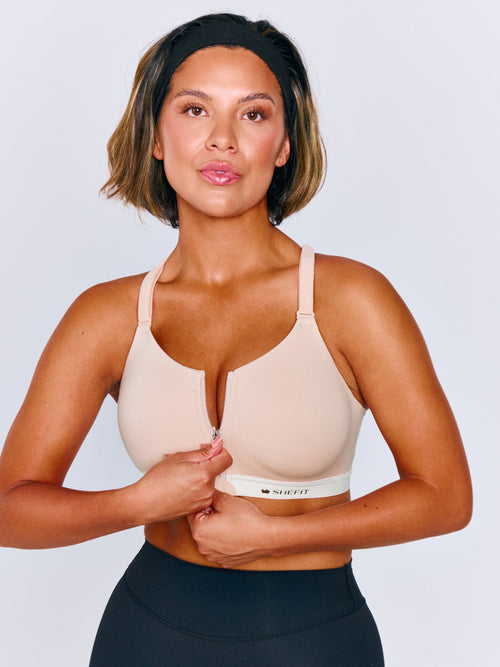
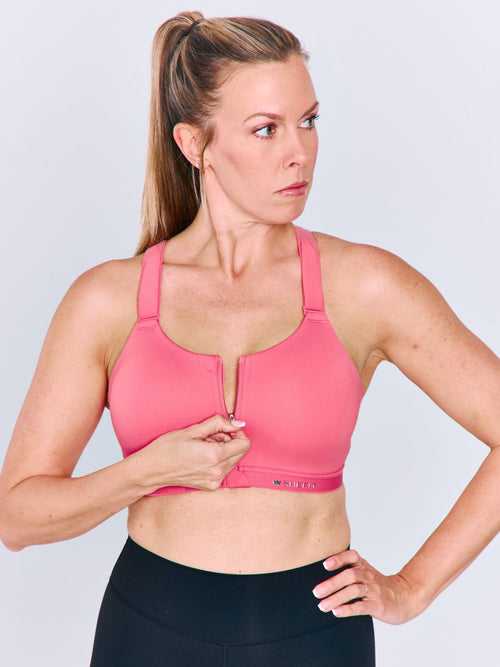
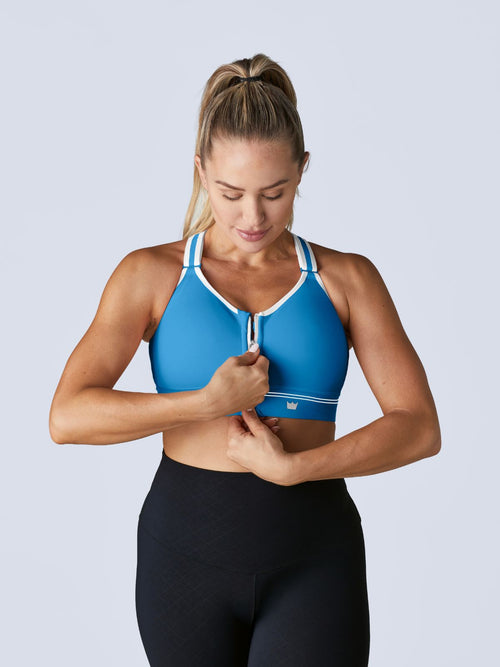
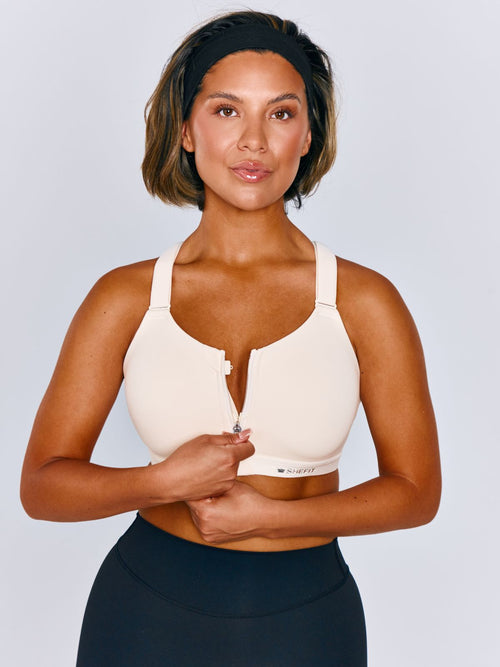
Our own construction is built around that list. Our patented adjustable system is three separate parts doing three separate jobs: a front zipper for easy on and off, a cinchable rib band that sets compression and support, and non-stretch adjustable shoulder straps that set lift. The rib band is the piece most women underestimate. The majority of a bra's support, roughly 80 to 90%, comes from the band, not the straps, which is why a band you can tighten by hand is worth more than any amount of fabric stretch.
Non-stretch straps matter for the same reason. Stretchy straps lose tension over time, and stretch means bounce. Straps that do not stretch hold the lift you set, wash after wash.
What Uncontrolled Bounce Costs You
Bounce is easy to file under discomfort, something you tolerate and then forget about in the shower. The research puts it somewhere more consequential than that.
Start with the thing you can feel. Without sufficient support, women report higher levels of breast discomfort and pain, more embarrassment, and a measurably lower willingness to exercise at all. The bra stops being equipment and becomes a reason to skip the workout.
Then there is the part you cannot feel. Breast support changes how you move from the trunk down. Research links greater support to reduced oxygen consumption and better running economy, meaning the same pace costs you less. Other work has tied increased support to altered knee joint stiffness during running and to changes in trunk and pelvis rotation across all planes of motion. Your bra does not sit passively on top of your gait. It is part of it.
And movement is not only vertical. Breast displacement happens in three dimensions during walking and running, up and down, forward and back, side to side. A bra that only addresses the vertical axis is solving a third of the problem, which is one reason compression-only designs feel like they are working right up until you change direction.
Compression, Encapsulation, or Both
Sports bras control movement one of two ways, or both at once. Compression presses tissue toward the chest wall. Encapsulation gives each breast its own supported space. Most bras on the market pick one.
The testing does not favor compression. In a Cal State Fullerton study measuring breast acceleration at two running speeds, the compression-style bra produced the greatest acceleration of any condition tested, while the encapsulation-style bra was rated significantly more comfortable [3]. Compression alone, in other words, was both the worst performer on movement and the less comfortable option.
Movement and comfort ratings below come from the Cal State Fullerton acceleration testing [3].
| Approach | Movement control | Comfort | What it feels like |
|---|---|---|---|
| Encapsulation and compression (SHEFIT Ultimate Sports Bra, Flex Sports Bra) | Strongest, since tissue is both supported individually and held against the chest | High, because support is distributed rather than concentrated | Held in place, not crushed |
| Encapsulation only | Good individual support, less overall containment | Rated most comfortable in testing | Shaped and separated, with some residual movement |
| Compression only | Weakest in testing; highest measured acceleration | Rated least comfortable at higher effort | Flattened, with movement transferred rather than stopped |
Both our Ultimate Sports Bra and our Flex Sports Bra use encapsulation and compression together, with individual cup space for each breast plus a rib band that compresses against the torso. That combination is deliberate. Picking one mechanism means accepting the weakness of the other.
Researchers at the University of Memphis put the Ultimate Sports Bra through landing-task testing and found vertical breast displacement 33% lower than the low-support condition, and more than 50% lower than previously reported values for high-support bras from other sportswear companies [4]. That second number is the one worth sitting with. Other brands' high-support bras were the benchmark, and the gap was more than half.
Why "Zero Bounce" Is the Wrong Target
Here is the part no bra brand puts on a product page, including, until now, us.
A musculoskeletal modeling study simulated what would happen if a bra eliminated breast motion relative to the torso entirely, the theoretical 100% bounce-reduction condition that "no bounce" marketing implies. Peak lumbar extension moments went up, suggesting that a bra engineered toward absolute zero movement may increase internal spinal loading during running [5].
To be clear about what that study did and did not test: it modeled a theoretical extreme, not a product anyone sells or wears. No real bra, ours included, has been shown to cause or prevent back pain. But the finding matters because it reveals what the actual engineering target is. The goal is well-controlled movement, not the elimination of movement.
The strap research points the same direction. Stiffer straps control more movement, but only up to a point. Past that threshold the gains flatten out while shoulder pressure keeps climbing, so you trade discomfort for control you are no longer getting [6]. This is precisely why our straps adjust rather than arriving at one fixed tension. You set them where control and comfort meet for your body, and you re-set them as your body changes.
A maximally rigid bra was never the answer. A bra you can dial in is.
How Much Support You Need, By Activity
Impact level is not the only input. Your breast size matters too. Smaller busts have more flexibility across activity types, though HIIT still demands encapsulation, compression, and non-stretch construction regardless of size. Larger busts need maximum-support features across the board.
| Activity | Impact level | SHEFIT recommendation |
|---|---|---|
| Running, HIIT, CrossFit, horseback riding | High | Ultimate Sports Bra, built for maximum bounce control |
| Yoga, cycling, strength training, pickleball | Medium to high | Flex Sports Bra, high-impact for 32C and under, medium-impact for larger sizes |
| Walking, everyday wear, low-movement days | Low to medium | Emerge Sports Bra, with an integrated pad and wire-free construction |
The Flex Sports Bra sits in a spot worth explaining, since our own team describes it best: more supportive than other brands' high-support bras, but not as strong as its sister bra, the Ultimate Sports Bra. Both are above the competition. One is above the other.
Even committed athletes get this wrong. In a survey of women running the 2012 London Marathon, 75% reported sports bra fit issues, most commonly chafing and straps digging in, with the highest incidence among larger-breasted runners [7]. These were marathoners. If training volume alone solved the support problem, that number would not be three out of four.
One more reason to take support seriously: greater breast support has been associated with reduced knee valgus angles and moments and greater trunk flexion at initial contact, biomechanical profiles linked to lower ACL injury risk [8]. That is an association, not a promise, but it suggests the stakes reach further down the body than most women assume.
Getting the Fit Right So the Bra Can Do Its Job
No amount of engineering rescues a badly sized bra. Somewhere between 70 and 100% of women are estimated to be wearing an incorrectly sized one, partly for a methodological reason: traditional tape-measure fitting tends to overestimate band size and underestimate cup size, as the Portsmouth researchers note. Whatever the exact figure inside that range, it describes most women, and most of them have simply gotten used to it.
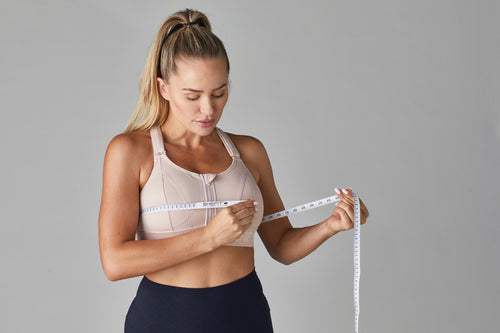
Our stance is measurements over cup letters. Bra sizing is not regulated, so a cup letter does not travel reliably from one brand to the next. Your underbust and bust measurements in inches do. Take those to our size chart rather than assuming the letter on your current bra will carry over. The band-and-cup figure you calculate is a traditional bra size, a starting point for cross-referencing, not a sports bra size.
If you land between two sizes, our rule is simple and worth using verbatim: larger size for more coverage, smaller size for more control.
Three ways to find your size, shortest to longest:
- Sports Bra Quiz, a short questionnaire on our site that returns a personalized size recommendation as you browse.
- Virtual Fitting, a video call with a professional fitter who shows you how to measure accurately and reviews your options.
- Self-measurement against our inches chart, for anyone who prefers to do it alone. If you are working between adjacent sizes, our Sister Size Guide covers how those relationships work.
Then there is the misread that comes up constantly in our fittings. If you see armpit skin, that is your bra doing its job, lifting you up. Spillage is different: it means tissue pushing over the top or sides of the cup. Women confuse the two all the time and size up unnecessarily, which costs them the control they were shopping for in the first place.
Our bras run snug by design. Think of a running shoe the first time you put it on. Supportive fabric has to be snug to control anything, and control is the entire point. As the script our fitters work from puts it: you would not wear a flip flop to go running, so why would you wear a loose bra?
The band is where most fit failures start, and it is also where most women look last. A band that rides up your back is not anchored to your ribcage, and a bra that is not anchored has nothing to push against when you land. Everything the straps and cups do is downstream of that anchor holding still.
Fit failures and what each one actually means
- Bra rides up into the armpits: too large, and it causes chafing
- Straps slide off the shoulders: too large
- Gapping between cup and breast: too large
- Band does not lay flat against the ribcage: too large, and it cannot anchor the bra during impact
- Band rides up the back: too large
No Bounce Sports Bra Questions, Answered
Can a sports bra really give absolutely no bounce for a large bust?
Not literally zero, and you would not want zero. Research on a theoretical no-motion condition found increased spinal loading [5]. What a properly built, properly fitted bra delivers is movement controlled enough that you stop noticing it, which is the outcome women are actually describing when they ask for no bounce.
What counts as "no bounce" in practice?
The honest benchmark is whether you can run, jump, or land without pain, without adjusting mid-workout, and without the movement pulling your attention away from what you are doing. If you are bracing, holding, or shortening your stride to compensate, yours has not gotten there yet.
Do wireless bras bounce more?
Not inherently. The wire gets credit that belongs to the band and the cup structure. A wire-free bra with encapsulation, a firm anchoring band, and non-stretch straps can outperform an underwire bra whose band is too loose to hold anything.
Why does my bra bounce more now than when I bought it?
Usually the elastic. Stretchy straps and bands lose tension over months of wear, and a bra with fixed elastic cannot get that tension back. Our bands and straps adjust by hand, so you re-set them as they relax and as your body changes.
How long should a bra hold its support?
Ours are built to last 12 to 24 months or more with proper care. That durability is deliberate: non-stretch straps and a rib band that adjusts by hand hold their tension wash after wash, which is part of why the difference turns up months into ownership rather than on day one.
Does one bra work if my size changes?
That is the argument for adjustability over fixed elastic. Because the rib band and straps set independently, the same bra keeps fitting when your size moves up or down, through training cycles, postpartum, or anything else that changes your measurements.
Choosing Support That Holds
The shift worth making is away from "tighter and smaller" and toward "engineered and adjustable." Bounce is not a willpower problem or a body problem. It is what happens when tissue with no internal muscle meets impact without adequate external support, and it responds to construction: encapsulation plus compression, a band that genuinely anchors, straps that hold their tension, and a size based on your measurements rather than a cup letter borrowed from another brand.
Get those four things right and the movement stops competing for your attention. Find your fit, and go rule your world.
References
[1] "Researchers work with adidas on new sports bra collection." University of Portsmouth. https://www.port.ac.uk/news-events-and-blogs/news/researchers-work-with-adidas-on-new-sports-bra-collection
[2] Nichola Renwick. "Wearing a well-fitting sports bra can improve your performance - an expert advises how to find one." University of Portsmouth (republished from The Conversation), 2023-08-25. https://www.port.ac.uk/news-events-and-blogs/blogs/improving-health-and-wellbeing/wearing-a-well-fitting-sports-bra-can-improve-your-performance-an-expert-advises-how-to-find-one
[3] Lindsey Ungerman. "The Effect of Sports Bras on Breast Acceleration." California State University, Fullerton (Master's Thesis), Spring 2018. https://scholarworks.calstate.edu/downloads/rf55z8591
[4] Fong, H.B., Nelson, A.K., McGhee, D., Ford, K., & Powell, D.W. "Increasing breast support is associated with a distal-to-proximal redistribution of joint negative work during a double-limb landing task." Journal of Applied Biomechanics, 2022. https://www.memphis.edu/healthsciences/pdfs/jab-biomech-2023.pdf
[5] "Modelling Female Breast Motion During Running: Implications of Breast Support on the Spine." PMC / NIH. https://pmc.ncbi.nlm.nih.gov/articles/PMC11967444/
[6] "Optimizing Breast Motion Control in Plus-Size Sports Bras." Applied Sciences (MDPI), 2026. https://www.mdpi.com/2076-3417/16/11/5276
[7] Brown N, White J, Brasher A, Scurr J. "An investigation into breast support and sports bra use in female runners of the 2012 London Marathon." Journal of Sports Sciences (PubMed), 2014. https://pubmed.ncbi.nlm.nih.gov/24479370/
[8] Fong, H.B., Nelson, A.K., Storey, J.E., Hinton, J., Puppa, M., McGhee, D., Greenwood, D., Powell, D.W. "Greater Breast Support Alters Trunk and Knee Joint Biomechanics Commonly Associated With Anterior Cruciate Ligament Injury." Frontiers in Sports and Active Living, 2022-05-20. https://doi.org/10.3389/fspor.2022.861553