Which Bra Is Right for You? Learn More


Fourteen weeks in, you reach for your go-to sports bra before a morning walk. The band digs into your ribs, the cups barely contain you, and the straps feel like they are fighting a losing battle. Two weeks ago, this bra fit fine. Now it feels like it belongs to someone else.
This is one of the least talked-about frustrations of pregnancy: your body is changing faster than your wardrobe can keep up, and your sports bra is often the first casualty. At SHEFIT, we hear this story constantly from women who assumed they could push through with their regular bras until after delivery. The reality is that pregnancy reshapes your breasts in ways that demand a completely different kind of support, and the sooner you understand those changes, the more comfortable the next several months will be.
This guide covers what happens to your breasts during each stage of pregnancy, what features actually matter in a maternity sports bra, and how to find support that works from your first trimester through postpartum recovery.
How Pregnancy Changes Your Breasts (And Why Your Regular Sports Bra Stops Working)
Your breasts start changing almost immediately after conception, and the changes do not follow a predictable, gradual curve. They happen in surges that can leave you outgrowing a bra within weeks.
An estimated 85% of women are already wearing the wrong bra size [1]. Add the rapid changes that come with growing a baby, and the fit problem compounds fast.
Here is what to expect at each stage:
Stage |
What Changes |
How It Affects Your Bra |
|---|---|---|
First trimester (weeks 1-12) |
Breast swelling and tenderness; increased sensitivity; visible veins |
Underwire and tight bands become painful; cups feel restrictive |
Second trimester (weeks 13-26) |
Ribcage expands to accommodate baby; milk ducts begin developing; under-bust measurement increases |
Band size changes even if cup size stabilizes temporarily; bras that fit at the bust may now dig into your ribs |
Third trimester (weeks 27-40) |
Rapid breast growth (up to 2-3 cup sizes total); breasts feel heavier as colostrum develops |
Most pre-pregnancy bras no longer fit at all; support becomes critical for back and shoulder comfort |
Postpartum (birth onward) |
Milk production causes further enlargement; breast size fluctuates throughout each day with feeding cycles |
Fixed-size bras cannot keep up with hourly fluctuations; nursing access becomes essential |
The core problem with standard sports bras during pregnancy is that they are built for one size. A bra that fits in week 10 will be too small by week 20 and completely inadequate by week 30. Stretchy fabric helps to a point, but stretch alone does not equal support. Once the elastic is maxed out, you lose the compression and lift that keep breast tissue stable during movement.
Underwire bras can be problematic during pregnancy and breastfeeding. Many lactation consultants advise wire-free designs during early breastfeeding, as poorly fitting underwire can press against breast tissue and may contribute to discomfort. Mastitis, a painful breast infection that is common during early breastfeeding, is more closely linked to poor bra fit than to underwire specifically, but wire-free construction reduces that risk by removing one more variable from an already changing fit equation.
What to Look for in a Maternity Sports Bra
The features that matter most in a maternity sports bra are the same ones that solve the problems outlined above: adjustability, wire-free support, and construction that accommodates growth without sacrificing structure.
Here is what separates a bra built to last through pregnancy from one you will outgrow in a month:
Feature |
Why It Matters During Pregnancy |
What to Look For |
|---|---|---|
Adjustable rib band |
Your ribcage expands as your baby grows, then contracts postpartum. The band provides roughly 80% of total support. |
Continuously adjustable band, not limited to 2-3 hook positions |
Adjustable straps |
Breast weight increases as pregnancy progresses, requiring more lift |
Non-stretch straps that maintain consistent tension wash after wash |
Wire-free construction |
Underwire can restrict breast tissue and contribute to blocked milk ducts |
Full support through combined encapsulation and compression instead of wire |
Cup accommodation |
Breasts grow 2-3 cup sizes during pregnancy; size fluctuates daily postpartum |
Individual cup space for each breast that adapts to changing volume |
Breathable fabric |
Hormonal changes increase body temperature and sweating during pregnancy |
Moisture-wicking materials that reduce friction without sacrificing structure |
Size range |
Pregnancy affects women of all breast types, from small to large, enhanced or natural |
Inclusive sizing from XS through extended sizes |
The adjustable band deserves emphasis. Most maternity bra guides suggest buying multiple bras in different sizes throughout your pregnancy. That works, but it is expensive and wasteful. A truly adjustable band lets you loosen it as your rib cage widens in the second trimester, then tighten it back as everything contracts postpartum. One bra that adjusts is more practical than three bras in fixed sizes.
Maternity Sports Bra vs Nursing Sports Bra: What Is the Difference?
The terms get used interchangeably, but there is a real distinction.
A maternity sports bra is designed to accommodate the breast and ribcage growth that happens during pregnancy. The priority is stretchy, supportive construction that keeps up with your changing body, typically without underwire.
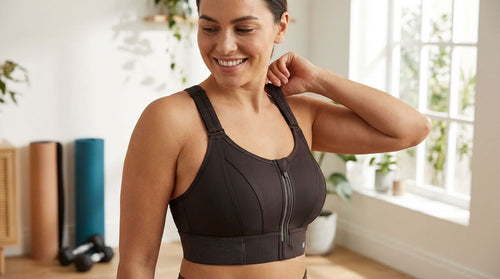
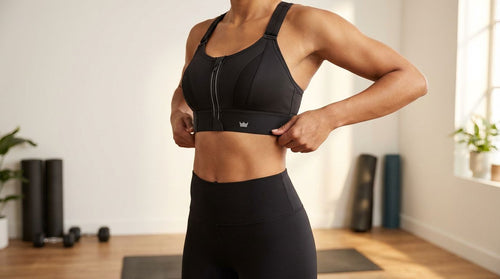
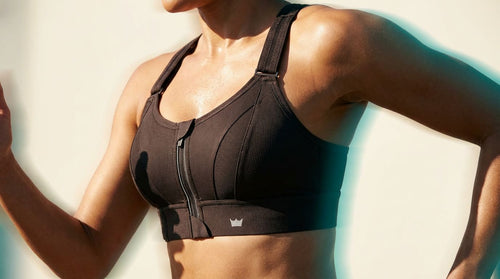
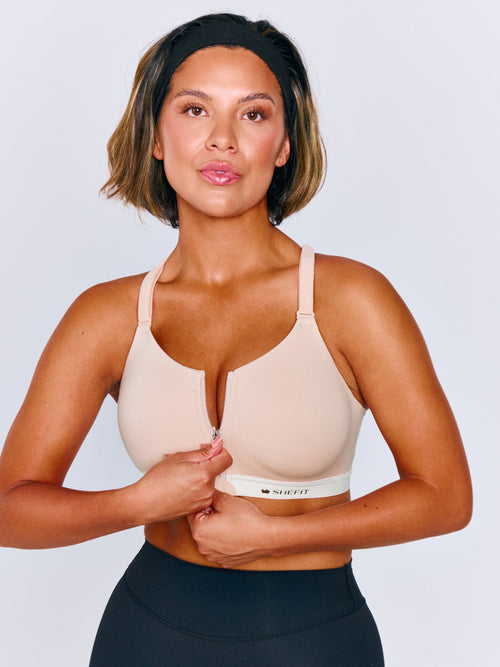
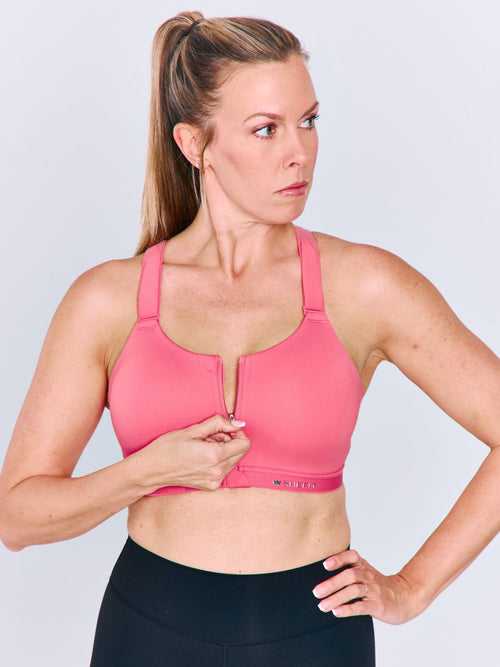
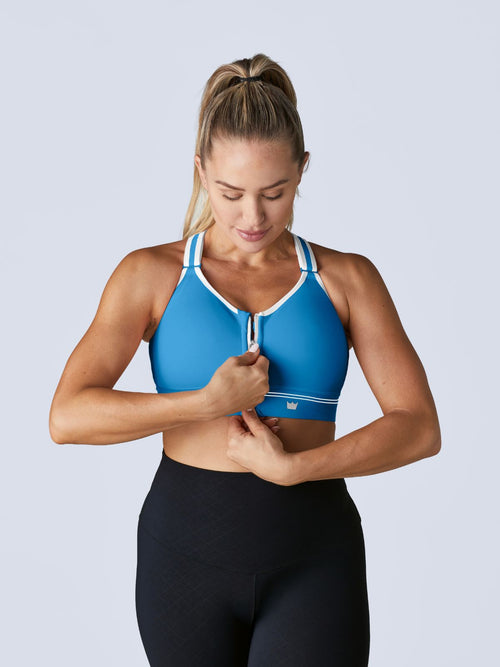
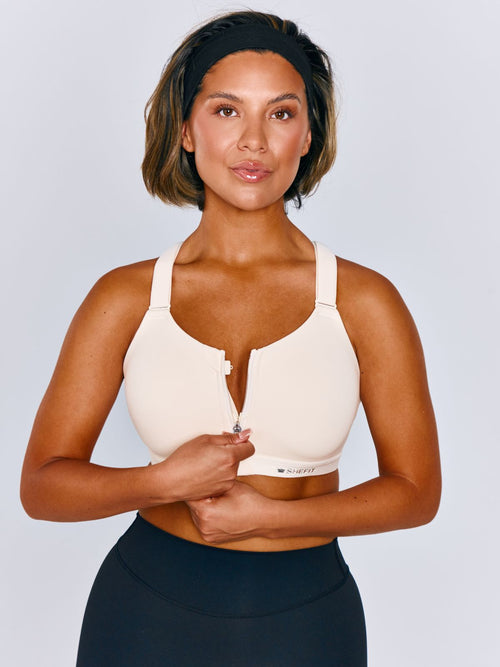
A nursing sports bra includes everything a maternity bra offers plus quick-access features for breastfeeding or pumping. On SHEFIT front-zip sports bras, you can unzip halfway and lock the zipper to expose the breast, while the Velcro strap can double as a shirt holder.
Some bras function as hybrids, working through both pregnancy and the postpartum nursing stage. The key advantage of a truly adjustable design is that it adapts to both phases: loosening as you grow during pregnancy, tightening as your body recovers postpartum, and accommodating the daily size fluctuations that come with breastfeeding. If you want a deeper look at finding a comfortable nursing sports bra, we have covered that topic in detail.
How to Choose the Right Support Level for Your Activity
Staying active during pregnancy benefits both you and your baby. The type of activity you choose determines how much support your sports bra needs to provide. Breast size plays an equally important role: your breast size matters when selecting a bra for activity, because a larger bust under the same impact conditions requires significantly more structural support.
Research from the University of Memphis demonstrates that greater breast support is associated with trunk and knee biomechanics linked to lower injury risk during high-impact movement [2]. That finding matters for pregnant women, whose shifting center of gravity already alters their movement patterns.
For low-impact activities like yoga, pilates, walking, and stretching, you need comfortable support with room for growth and lightweight breathable construction. Medium-impact activities like hiking, cycling, strength training, and pickleball call for dual support (encapsulation + compression) with adjustable straps that handle varying loads. High-impact activities like running, HIIT, jumping, and horseback riding demand maximum support with non-stretch straps, full encapsulation and compression, and a fully adjustable band.
For smaller bust sizes (32C and under), medium-impact activities may feel manageable with less structured support. For larger busts, dual support is necessary for almost every activity level. If you are working out while pregnant, matching your support to both your activity and your breast size prevents discomfort, reduces compensatory movement patterns, and helps you train safely through each trimester.
How Your Body Changes Postpartum (And What Your Bra Needs to Handle)
Most maternity bra guides focus on the nine months of pregnancy and stop there. The postpartum period brings its own set of challenges that are just as demanding on your bra.
When your milk comes in, typically between days two and five after birth, your breasts can increase significantly in size as volume ramps up over the following hours and days. From that point forward, your breast volume fluctuates throughout each day. You might be fuller in the morning, smaller after a feeding session, and engorged again by evening. A fixed-size bra cannot track those swings. An adjustable one can.
Your rib cage also shrinks back postpartum as your organs shift into their pre-pregnancy positions. The bra that accommodated your expanded frame during the third trimester now needs to tighten to maintain proper band support. If the band rides up in the back, it is too loose and is no longer providing the support your healing body needs.
There is another factor that gets overlooked: postpartum rib cage restriction. After months of expansion and the physical demands of delivery, the ribcage is often tight and limited in mobility. One that distributes support across the full garment, rather than concentrating all compression in a narrow chest strap, feels significantly more comfortable and supports core rehabilitation during recovery.
Fitting a Maternity Sports Bra: Getting It Right
A well-fitting maternity sports bra makes a noticeable difference in comfort, support, and how confident you feel staying active. Here is how to measure and check your fit.
How to measure:
Band size. Wrap a flexible tape snugly around your ribcage directly under your breasts. Round to the nearest even number.
Cup size. Measure around the fullest part of your bust without pulling the tape tight. The difference between bust and band determines your cup: 1 inch = A, 2 inches = B, 3 inches = C, and so on.
Check the size chart. Sizes are not standardized across brands. Use the manufacturer's guide, not your everyday bra size. For a full walkthrough, finding your perfect SHEFIT bra size covers every step.
Fit checklist:
Band sits level across your back without riding up
Each breast sits in its own cup space with no spillage over the top or sides
Straps provide lift without digging into your shoulders
Coverage does not extend too far under your armpits
Two fingers fit under the band comfortably
One thing that surprises many women during fitting: a bra with proper lift raises your breast tissue higher on your chest, which can reveal skin near the armpit that was previously hidden. Many women see this and assume it is spillage or excess tissue. It is neither. If you see armpit skin, that is your bra doing its job, lifting you up. Spillage is different: it means tissue pushing over the top or sides of the cup.
Once the bra passes the standing checklist, do 30 seconds of combined movement: walking briskly, arm circles, and gentle knee lifts. If anything shifts, tighten. If anything digs, loosen.
SHEFIT Sports Bras for Pregnancy and Beyond
We built our sports bras around one principle: adjustability changes everything. A static bra fits one way on one day. An adjustable bra fits your body the way it needs to be supported right now, whether that is your second trimester, your first week postpartum, or six months into breastfeeding.
Ultimate Sports Bra
The Ultimate Sports Bra ($69) delivers our maximum support for high-impact training through every stage of pregnancy and postpartum recovery.
Key features:
Patented adjustable shoulder straps and rib band for custom fit
Encapsulation and compression design for complete motion control
Non-stretch straps that maintain lift wash after wash
Removable modesty pads for customizable coverage
Front zipper for easy on and off
Sizes XS-6XL, AA-I cups
University of Memphis research found that the Ultimate reduces vertical breast displacement by more than 50% compared to previously reported values for other brands' high-support options [3]. For pregnant women whose breast weight is increasing month over month, that level of control translates directly to reduced back strain, less compensatory movement, and a more comfortable training experience.
Flex Sports Bra
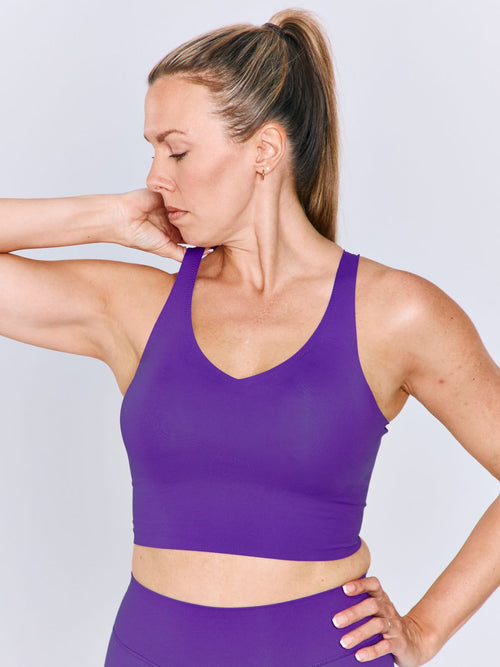
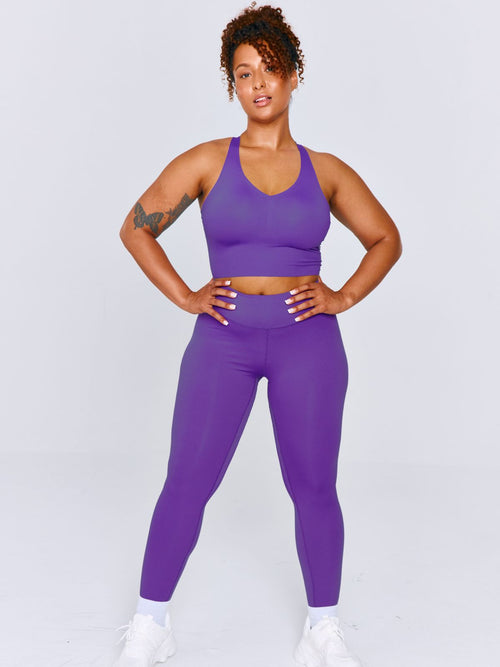
The Flex Sports Bra ($69) offers patented adjustable features with smooth cups for a sculpted look. It provides high-impact support for smaller bust sizes (32C and under) and medium-impact for larger sizes. Our medium-impact rating delivers support that rivals what other brands call high-impact.
Best for: cycling and strength training, pickleball, or any varied-intensity session throughout pregnancy.
How They Compare
Here is a side-by-side breakdown of both options:
Feature |
SHEFIT Ultimate |
SHEFIT Flex |
|---|---|---|
Support level |
Maximum (all sizes) |
High (32C and under) / Medium (larger sizes) |
Adjustable band |
Yes (patented) |
Yes (patented) |
Adjustable straps |
Yes (patented, non-stretch) |
Yes (patented) |
Design type |
Encapsulation + compression |
Encapsulation + compression |
Cup style |
Removable modesty pads |
Smooth cups, sculpted look |
Size range |
XS-6XL, AA-I cups |
XS-6XL, AA-I cups |
Best activities |
Running and HIIT; horseback riding |
Cycling and strength; pickleball |
Durability testing |
25 wash cycles |
25 wash cycles |
Price |
$69 |
$69 |
Both bras are designed for all breast types, from small to large, enhanced or natural. They are wash-tested to 25 cycles before showing obvious wear, compared to an industry standard of roughly 5 washes. With 75,000+ 5-star reviews across our product line, the adjustability works across every body type and every stage of the pregnancy-to-postpartum journey.
FAQs About Maternity Sports Bras
Is it okay to wear sports bras while pregnant?
Yes. Sports bras are often more comfortable during pregnancy than traditional bras because they typically skip underwire and provide broader coverage. The key is choosing one with enough adjustability to accommodate your changing size rather than compressing everything into a fixed shape.
What bras should I wear while pregnant?
Look for wire-free construction, an adjustable band, adjustable straps, and breathable fabric. The band should sit level and snug without digging. If you plan to breastfeed, a front-zip design or easy on-and-off construction saves you from buying a second set of bras after delivery.
What is the difference between a regular bra and a maternity bra?
A maternity bra is designed to accommodate the breast growth and ribcage expansion that happen during pregnancy. Regular bras use fixed sizing and often include underwire, both of which become problematic as your body changes. Maternity bras prioritize adjustability and wire-free support with enough stretch to grow alongside you.
How soon should I wear a maternity bra?
As soon as your current bra becomes uncomfortable. For many women, that is during the first trimester when breast tenderness and swelling begin. There is no benefit to waiting until a specific week or trimester.
Can I use the same sports bra during pregnancy and after?
If the bra is adjustable enough to accommodate the full range of size changes, yes. An adjustable band loosens as your rib cage expands during pregnancy and tightens as it contracts postpartum. Adjustable straps adapt to changing breast weight. This is more practical and cost-effective than buying separate bras for each stage. Our Ultimate Sports Bra is designed to work from pregnancy through postpartum and beyond.
Do I need a high-impact sports bra during pregnancy?
It depends on your activity level and breast size. For low-impact activities like yoga or walking, medium support may be sufficient. For running, HIIT, or any activity with bouncing or jumping, high-impact support with encapsulation and compression is important regardless of trimester. Larger bust sizes benefit from higher support levels even during moderate activities. Research shows that insufficient breast support can decrease willingness to exercise and increase discomfort [4].
Your body is doing remarkable work right now. The last thing you need is a sports bra that makes staying active harder than it has to be. When your bra adjusts to your body instead of the other way around, you stop thinking about support and start focusing on what matters: your health, your strength, and the life you are growing.
References
[1] McGhee, D.E. & Steele, J.R. "Optimising breast support in female patients through correct bra fit." Journal of Science and Medicine in Sport, 2010. https://pubmed.ncbi.nlm.nih.gov/20451452/
[2] Fong, H.B., Nelson, A.K., Storey, J.E., et al. "Greater Breast Support Alters Trunk and Knee Joint Biomechanics Commonly Associated With Anterior Cruciate Ligament Injury." Frontiers in Sports and Active Living, 2022. https://doi.org/10.3389/fspor.2022.861553
[3] Fong, H.B., Nelson, A.K., McGhee, D., Ford, K., & Powell, D.W. "Increasing breast support is associated with a distal-to-proximal redistribution of joint negative work during a double-limb landing task." Journal of Applied Biomechanics, 2022. https://www.memphis.edu/healthsciences/pdfs/jab-biomech-2023.pdf
[4] Risius, D., Milligan, A., Berns, J., Brown, N., & Scurr, J. "Understanding key performance indicators for breast support." Journal of Sports Sciences, 2017. https://pubmed.ncbi.nlm.nih.gov/27291899/