Up To 50% Selected Styles Off · Shop Now


How much does a sports bra need to do when there isn't much to hold in place? Plenty of women with AA, A, or B cups have been told the answer is "not much," and the shelves seem to agree, with thin crop tops and stretchy bralettes sold as if a smaller bust barely moves. Then the first sprint or box jump arrives, and the bounce, the rubbing, and the band creeping up the ribs say otherwise.
At SHEFIT, we design adjustable sports bras across AA-I cups, so the small end of our size chart gets the same engineering as every other size.
The short answer: the right sports bra for an AA to B cup matches your hardest regular workout and fits your band and cup shape, whatever letter is printed on the tag. Less tissue still moves. Below, we cover the research, which construction suits which session, our three picks, and a fit check you can run at home.
Small Chest, Real Movement: What the Research Shows
The idea that small busts can skip real support rests on an assumption: less tissue, less movement, less to worry about. The research doesn't back that shortcut. During exercise, breasts move in a three-dimensional pattern relative to the torso: up and down, side to side, and forward and back. In a review published in Physiology, Deirdre McGhee and Julie Steele note that more breast bounce is associated with more breast pain, and that a well-designed, supportive bra can decrease vertical breast displacement by about 60% compared with wearing no external support [1].
What that means for petite busts specifically is a harder question, and we'd rather be straight with you about it. Research on AA to B cups on their own is thin. Most breast biomechanics studies recruit a mix of cup sizes, and we have not found one that isolates AA and A cups.
The closest match we found comes from the University of Pretoria. Kim Nolte and colleagues tested a range of sports bras on 17 women in B to C cups during treadmill running and star jumps. In that group of relatively small-breasted women, how well the bra fit and how comfortable it felt predicted breast pain more strongly than the amount of breast movement researchers measured [2]. That finding is why this guide leads with fit. A support rating on a hang tag can't make up for a band or cup that is the wrong shape for your body. Comfort also shapes whether you keep showing up: a 2022 scoping review in Research in Sports Medicine notes that breasts are reported as the fourth largest barrier to participation in physical activity [3].
Here is where the evidence stands:
- What's well supported: a supportive bra cuts vertical movement, and more bounce goes with more pain.
- What's supported for B to C cups: fit and comfort predicted pain better than measured movement.
- What's missing: studies that look only at AA and A cups.
What a Smaller Bust Needs From a Sports Bra
Support comes from design details. Researchers at the University of Portsmouth's Research Group in Breast Health found that over a third of sports bra performance could be explained by five characteristics, each of which increased breast support: an encapsulation style, padded cups, an adjustable underband, nylon as the principal fibre, and a high neckline [4].
Sizing adds another wrinkle. University of Wollongong researchers point out that bra sizes aren't standardised across companies and that most ranges are developed by scaling one size up, even though breast and torso shapes don't scale the same way [5]. A small size scaled down from a pattern built for a different body can gape, slide, or sit in the wrong place.
These are the features we'd look for first, and what goes wrong without each one:
- A firm band that stays level. The band carries the majority of a bra's support, roughly 80-90% depending on whose figure you use, which is why bra expert Jené Luciani Sena tells women to check the back of a bra before the cups. A loose band can't anchor the bra against your ribcage during impact, and a band that rides up into the armpits causes chafing.
- Adjustable straps and band. Adjustment lets one size follow your shape instead of a scaled-down template. Straps that slide off the shoulders leave the cups loose.
- Cups that suit shallow or widely spaced breasts. Empty space at the top or sides of a cup is gaping, and gaping fabric shifts and rubs every time you move.
- Padding that adds structure. Padded cups are one of Portsmouth's five support characteristics, so a pad can add hold as well as shape.
- Breathable, moisture-wicking fabric. Sweat trapped against the skin turns small rubs into raw spots by the end of a long session.
- Flat edges and hardware. Anything that stands away from the body catches and rubs with every stride.
On chafing, our view at SHEFIT is simple: most of it comes from a bra moving against your skin. A custom fit that stays in place does more to prevent it than any single fabric choice.
Compression, Encapsulation, or Both
Every sports bra holds you in one of three ways. Compression presses breast tissue against the chest wall. Encapsulation gives each breast its own cup. Combination bras do both, with separate cups and a layer of compression over the top.
The Open University's free course on supporting female performance in sport describes all three and shares results from a demonstration with a few volunteers. The figures below come from that course [6]:
| Type | How it works | What the course notes | Movement reduction in the demo |
|---|---|---|---|
| Compression | Crop-top style that presses tissue against the chest wall | Most suitable for smaller breasts or low-impact activities | Around 55% for two volunteers |
| Encapsulation | Two structured cups support each breast individually | Beneficial for larger-breasted women | Up to 73%, shared by the two separate-cup types |
| Combination | Separate cups plus a layer of compression over the top | Combines features of both designs | Up to 73%, shared by the two separate-cup types |
Those numbers come from a handful of people, so read them as a direction rather than a rule. The compression row is also where small-chest advice often stops, and it needs a qualifier. Smaller busts can wear less supportive styles for some activities. HIIT is different: even for an A cup, it calls for encapsulation, compression, and non-stretch construction, because jumps and fast direction changes ask more of a bra than a stretchy crop top can give.
That is why both the Flex™ Sports Bra and the Ultimate Sports Bra® use an encapsulation and compression design. Each breast gets individual cup space, while the bra holds you close to your body. Separate cups help at every size, and our guide to encapsulation sports bras explains who benefits most from them.
Match the Support Level to Your Workout
Support levels describe how much movement a bra is built to control. Low impact covers slow, grounded movement, medium covers steady effort with some bounce, and high covers repeated landings, jumps, and fast changes of direction. Running and jumping are where a stable band earns its keep at any cup size, because it anchors the bra through every landing.
| Activity | Support level | SHEFIT bra that fits |
|---|---|---|
| Yoga and walking | Low to medium | Flex™ Sports Bra or Emerge™ Sports Bra |
| Cycling and strength training | Medium | Flex™ Sports Bra or Emerge™ Sports Bra |
| Pickleball | Medium | Flex™ Sports Bra or Emerge™ Sports Bra |
| Running and HIIT | High | Ultimate Sports Bra® |
| CrossFit | High | Ultimate Sports Bra® |
| Horseback riding | High | Ultimate Sports Bra® |
One product fact matters more here than any other: both bras in the top three rows are rated high impact for A-B cups and medium impact for C+ cups. Same bra, same workout, a higher rating, because the body inside it is different.
If your week mixes yoga with interval classes, get the bra right for the hardest session first.
Three SHEFIT Bras for a Smaller Chest
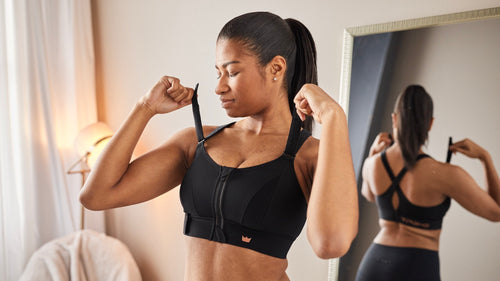
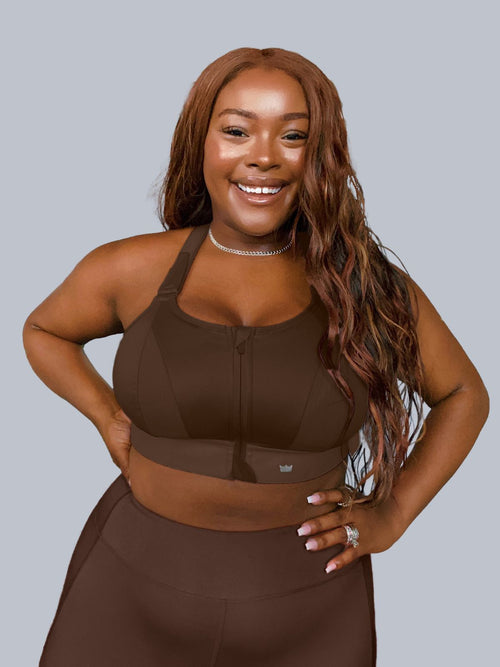
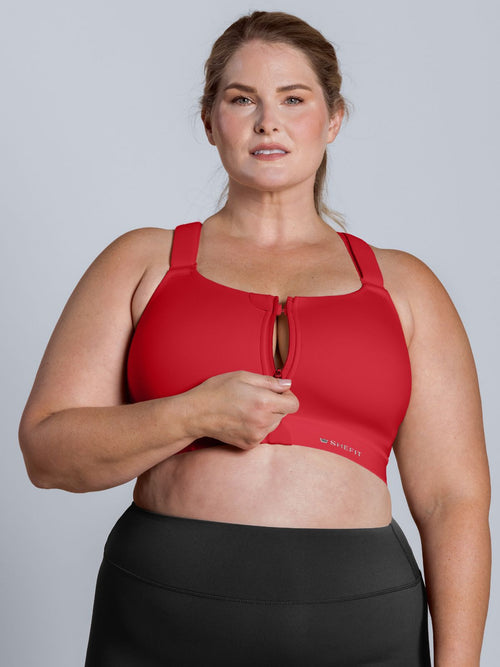
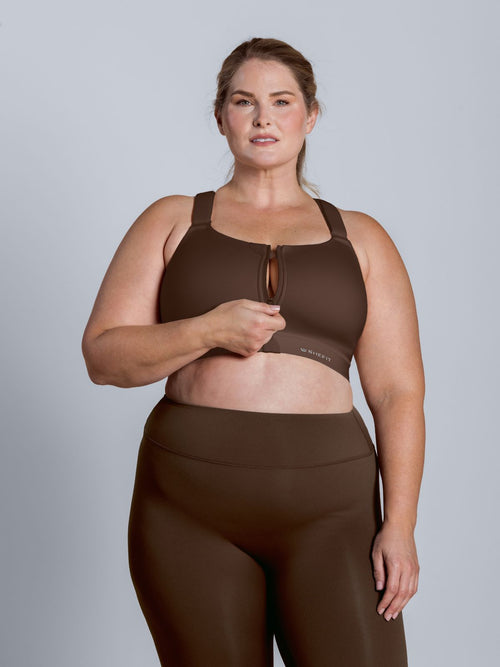
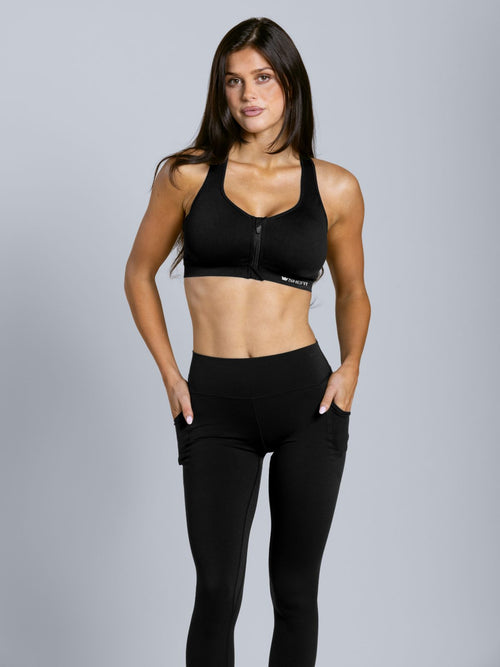
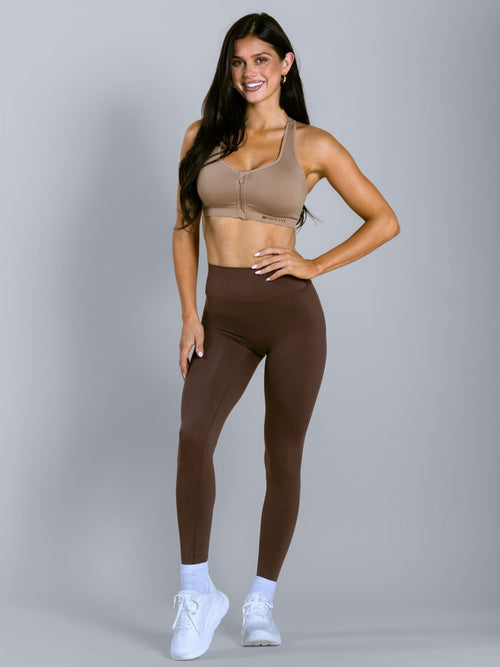
All three bras below run from XS through 6Luxe and start at an AA or A cup depending on the style (the table at the end of this section has each range), so the small end of the chart is a core size for us. Each uses our patented Zip. Cinch. Lift.® adjustability. The front zipper makes the bra easy to get on and off, the cinchable rib band sets your compression and support, and the adjustable shoulder straps set your lift.
Flex™ Sports Bra
Our Flex™ Sports Bra uses smooth, non-padded cups made from four-way stretch fabric and lined with power mesh to reinforce support. The rib band gives you 8" of cinch, and the non-stretch adjustable straps add 15" of lift.
For A-B cups it is rated high impact. We built it to be more supportive than other brands' high-support bras, though not as strong as our highest-support style. It suits yoga, cycling, strength training, and pickleball. Regular price: $69.
Emerge™ Sports Bra
The Emerge™ Sports Bra is built around wire-free, seam-free smooth cups with a light integrated pad, which adds shape and a little structure for a shallow bust. It pairs AdaptiveFit™ Technology with the same Zip. Cinch. Lift.® adjustability, a racerback, and a locking zipper with fold-over garages plus a hidden hook-and-eye.
It sits in the same support tier as the bra above, with a high-support rating for A-B cups and the same activity list. Its newer design is also made to be more comfortable if you want to wear it longer. Regular price: $69.
Ultimate Sports Bra®
The Ultimate Sports Bra® is the highest support in our range, with individually seamed cups, removable padding, power-mesh reinforced cups, and a two-way stretch body fabric.
This is the pick when impact is highest or when a bra has to hold through your hardest sessions: running, HIIT, CrossFit, and horseback riding. Regular price: $69.
Here is how the three compare:
| Bra | Cups | Support for A-B cups | Cup construction | Best for |
|---|---|---|---|---|
| Flex™ Sports Bra | AA-I | High impact | Smooth, non-padded cups lined with power mesh | Yoga, cycling, strength training, pickleball |
| Emerge™ Sports Bra | A-I | High impact | Wire-free smooth cups with a light integrated pad | Yoga, cycling, strength training, pickleball |
| Ultimate Sports Bra® | AA-I | Highest in our range | Individually seamed cups, removable padding | Running, HIIT, CrossFit, horseback riding |
Colors and every size are on our sports bras collection page.
Find Your Size at the Small End of the Chart
Bra sizing isn't regulated, and sizes aren't standardised from one company to the next [5]. A 32A at one brand can fit very differently from a 32A at another, which is why we ask women to measure in inches instead of carrying a cup letter over. Treat the tape as a starting point, then confirm the size with the fit check in the next section.
To measure for a SHEFIT size:
- Wear a non-padded everyday bra. A minimizing or compressive workout bra skews the numbers and gives you a size that is too small.
- Wrap the tape around your back and up to the fullest part of your bust. Keep it flat and level, check it in a mirror, and round to the nearest whole number.
- Repeat directly under your bust for your band (underbust) measurement.
- On our size chart, find where your bust measurement lands first, then use your band measurement to pin down the size.
The band-and-cup figure you get from a tape is a traditional bra size. It isn't a sports bra size, and it won't map neatly onto ours. Our SHEFIT size guide reads inches directly, and our sports bra size chart walkthrough walks through each measurement step.
If you land between two sizes, our rule is: larger size for more coverage, smaller size for more control. Expect a snug fit the first time. Our bras are snug by design, like a hug, or like a running shoe the first time you lace it up. Sharp pain or pinching is a different matter, and a sign to adjust the fit or try another size.
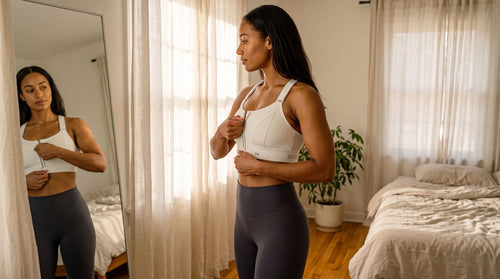
A Five-Minute Fit Check Before You Commit
The University of Portsmouth group reports that over 80% of women are wearing the wrong size bra and that the traditional tape-measure method doesn't give the best fit, so it advocates a set of "Best Fit" criteria instead [4]. Those criteria cover the first four checks below; the rest are movement tests we recommend. Set the band and straps, then stand in front of a mirror.
- The band sits level all the way around and feels firm. The Portsmouth group allows only a small gap, about 5 cm (2 inches), when you pull it away from your body. A band that rides up the back can't hold the cups in place during impact.
- The cups enclose each breast with no bulging and no gaping. Bulging tissue escapes on every landing, and gaping fabric shifts and rubs.
- The centre front lies flat against your sternum. If it floats, the cups aren't sitting where your breasts are.
- The straps feel comfortable and aren't doing the main work. Straps that dig in and pinch point to a size that's too small.
- Raise both arms overhead. The band stays put; if it climbs, it will chafe under your arms by the end of a session.
- Jog or jump in place for 20 seconds. You feel controlled, with no bounce you notice.
- Take a deep breath. You can breathe fully without the band restricting you.
One point trips up a lot of fittings. If you see armpit skin, that's your bra doing its job, lifting you up. Spillage is different: it means tissue pushing over the top or sides of the cup.
Gaping cups can mean the cup shape doesn't match your breast shape, not that you're the wrong size overall. Check the band first, then the straps, and if the gap is still there, try a different cup construction before you size down.
Small Chest Sports Bra FAQ
Do I need a sports bra with a small chest?
Yes, if you want to limit movement and discomfort during exercise. Breasts move in three dimensions at every size, and research links more bounce to more breast pain [1]. How much support you need depends on the activity.
Can I wear a bralette or crop top for working out?
For yoga, walking, or other low-impact sessions, many women with AA to B cups are comfortable in a lighter style. For HIIT, running, and jumping, a stretchy crop top usually falls short. Those sessions call for encapsulation, compression, and non-stretch construction.
Do I need padding?
Padding can do more than change your shape, since padded cups are one of the five characteristics Portsmouth researchers linked to better support. The Ultimate Sports Bra® has removable padding, the Emerge™ Sports Bra has an integrated pad, and the Flex™ Sports Bra has smooth, non-padded cups, so you can choose by feel.
What size sports bra do I need if I'm between sizes?
Go by what you want from the bra: larger size for more coverage, smaller size for more control. Measure in inches first, since a cup letter from another brand won't translate reliably.
Is a high-impact sports bra too much for an A or B cup?
Not if it fits. The Flex™ Sports Bra and Emerge™ Sports Bra both carry a high-impact rating at those cup sizes, and their adjustable band and straps let you set the compression you want.
How tight does a sports bra need to feel?
Snug, like a hug. The band sits level and firm with only a small gap when you pull it away, and you can still breathe deeply. Sharp pain, pinching, or excessive chafing means something is wrong with the fit, so stop and reach out to our team before you keep training in it.
Start With the Workout That Moves You Most
Small busts deserve real support too. Pick the bra that matches your hardest regular workout, then confirm the fit with a measuring tape, a mirror, and a few jumps in place.
Start with the session that asks the most of your bra, set the band, and find your fit.
References
[1] McGhee, Deirdre E., and Julie R. Steele. "Breast Biomechanics: What Do We Really Know?" Physiology (American Physiological Society), 2020. https://journals.physiology.org/doi/full/10.1152/physiol.00024.2019
[2] Nolte, Kim, Sasha Burgoyne, Heinrich Nolte, Julia van der Meulen, and Lizelle Fletcher. "The effectiveness of a range of sports bras in reducing breast displacement during treadmill running and two-step star jumping." University of Pretoria repository. https://repository.up.ac.za/server/api/core/bitstreams/76d2404a-68b4-4cc5-a532-a5156c3b35f3/content
[3] Haworth, Lauren, Robyn Aitkenhead, David Grecic, and Ambreen Chohan. "Understanding experience, knowledge and perceived challenges related to bra fit for sports participation: a scoping review." Research in Sports Medicine, 2022. https://www.tandfonline.com/doi/full/10.1080/15438627.2022.2102922
[4] University of Portsmouth. "Research Group in Breast Health." University of Portsmouth. https://www.port.ac.uk/research/research-groups-and-centres/research-group-in-breast-health
[5] University of Wollongong. "How better-designed sports bras can help women to exercise comfortably." University of Wollongong media, 2020. https://www.uow.edu.au/media/2020/how-better-designed-sports-bras-can-help-women-to-exercise-comfortably.php
[6] Open University. "Supporting female performance in sport and fitness (Session 5)." OpenLearn, Open University. https://www.open.edu/openlearn/mod/oucontent/view.php?id=116022§ion=5