Free shipping on U.S. orders 2 Days Only! Shop Now


On the hang tag, "medium support" reads like a measurement, as settled as the weight stamped on a dumbbell. In a biomechanics lab, those same two words count for nothing until someone has tracked how much the bra reduces breast movement. The tag and the test don't always agree.
We put support ratings on our own adjustable sports bras at SHEFIT, so we have a stake in what that label promises and where it stops.
The plain answer: a medium support sports bra fits low-bounce and moderate-bounce movement, like yoga, cycling, and strength training, and the right level for you also depends on your bust size and your fit.
What "Medium Support" Actually Means
Brands set their own support labels. What the word is meant to tell you is relative: more control than a light-support bra, less than a high-support running bra. Where a given bra sits between those two points is the brand's call, which is why the same words can mean different things from one tag to the next.
The clearest check we know of comes from a lab. In one lab study of 98 bras, published in Ergonomics by Norris and colleagues, breast movement reduction ranged from 36% to 74%. Among bras marketed as high support, 69% landed in the study's high-support group, the ones reducing movement by more than 63% [1].
That finding is about high-support labels specifically, and its lesson is simple: labels and measured performance did not always match. A label is a claim. The measurement comes later, and most of this guide is about running your own version of it.
Which Activities a Medium Support Sports Bra Covers
Medium support typically suits movement where your feet stay close to the ground or your body stays fairly steady. Most women can use the table below as a starting point, then adjust for bust size and fit.
| Activity | Typical support level | What to notice |
|---|---|---|
| Yoga and Pilates | Light to medium | Inversions and forward folds, where a neckline can gape or a band can shift |
| Walking and hiking | Medium | Downhill stretches, where each step lands harder |
| Stationary or road cycling | Medium | Long stretches leaning forward, where the band needs to stay flat and leave room to breathe |
| Strength training | Medium | Overhead presses, which can pull a loose band out of place |
| Pickleball and doubles tennis-style play | Medium | Lunges and overhead reaches, plus the quick stops between them |
| Dance and low-impact aerobics | Medium | Fast turns and small hops |
| Running, HIIT, and jumping | High | Repeated landings and any bounce you can feel |
That last row is where medium support typically stops, and field sports usually sit up there with it. Medium may be insufficient for sustained running and jumping, especially for larger busts, because those movements send your chest up and down again and again.
If your week mixes both kinds of workout, the bra for your hardest regular session is the one to get right. We come back to that rule at the end of this guide.
How Bust Size Changes the Answer
The same activity can call for a different level depending on your bust. A survey of 438 female patients ages 11 to 64 at sports medicine clinics found that 27.4% said lack of breast support kept them from exercising. Those with C-G cups reported it far more often than those with AA-B cups, 58.1% versus 19.1% [2]. That is an association from one survey, and it points the same way as most fit advice:
- Fuller busts often need a level up. An activity listed as medium in the table above may feel better in high support.
- Smaller busts have more flexibility. Even so, HIIT still calls for encapsulation, compression, and non-stretch construction.
You can see this play out on a single garment. Our Flex™ Sports Bra and Emerge™ Sports Bra are each rated medium impact for C+ cups and high impact for A-B cups. Same bra, same activity, a different rating, because the body inside it is different.
Cup letters also travel badly. Bra sizing is not regulated, so the size you wear at one brand does not predict another. We ask women to start from their underbust and bust measurements in inches, since our sizing chart reads inches directly and our sizes run from XS through 6Luxe.
Start with the band when you measure and when you try on. It carries the majority of a bra's support, roughly 80-90% by the figures commonly used in fit guidance, which is why a cup that looks right can't rescue a band that doesn't.
Compression, Encapsulation, and What Else Sets Support
Compression uses one panel to press the chest toward the body. Encapsulation gives each breast its own individual cup space. Many bras combine the two, and our Flex™ Sports Bra and Ultimate Sports Bra® both use an encapsulation and compression design.
Construction goes well beyond that one choice. In the same 98-bra study, five features together accounted for about 37% of the variation in breast movement reduction [1]:
- Encapsulation style
- Padded cups
- Nylon in the fabric
- An adjustable underband
- A high neckline
Read that list as a starting point. About 37% leaves most of the variation to other things, so no single feature, and no checklist of five, tells you how a bra will perform on you.
Here's what that means when you are comparing bras. A padded cup or a high neckline is a good sign, and an adjustable underband is a useful one, because it lets you set the anchor yourself. Straps weren't on the study's list, and we still watch them closely: straps that stretch lose tension over time, and stretch means bounce. Non-stretch straps keep their lift wash after wash, which is why we build ours that way.
Our Picks: Flex™ and Emerge™ Sports Bras
We recommend these two as equals. Each is rated medium impact for C+ cups and high impact for A-B cups, and each is made for yoga, cycling, strength training, pickleball, and varied-intensity workouts. The support tier is the same, so the choice comes down to construction and how you like a bra to feel.
| Bra | Support | Cups | Closure | Price |
|---|---|---|---|---|
| Flex™ Sports Bra | Medium impact for C+ cups, high impact for A-B cups | Smooth, non-padded, four-way stretch fabric lined with power mesh | Front zipper | $69 |
| Emerge™ Sports Bra | Medium impact for C+ cups, high impact for A-B cups | Wire-free, seam-free smooth cups with a light integrated pad | Locking zipper with fold-over garages plus a hidden hook-and-eye | $69 |
Flex™ Sports Bra
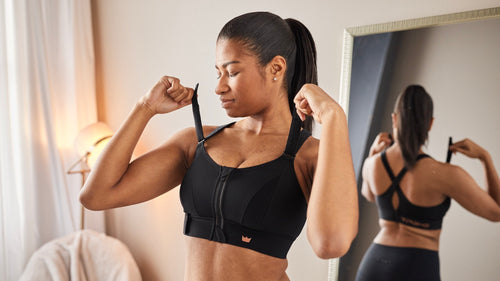
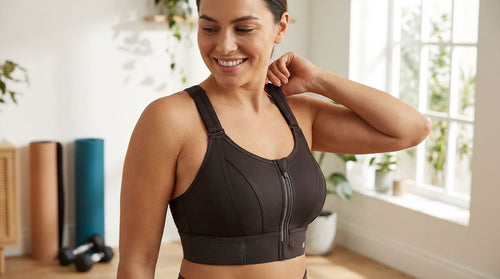
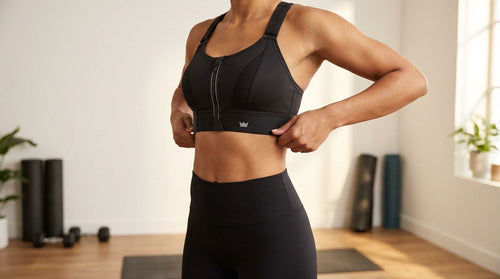
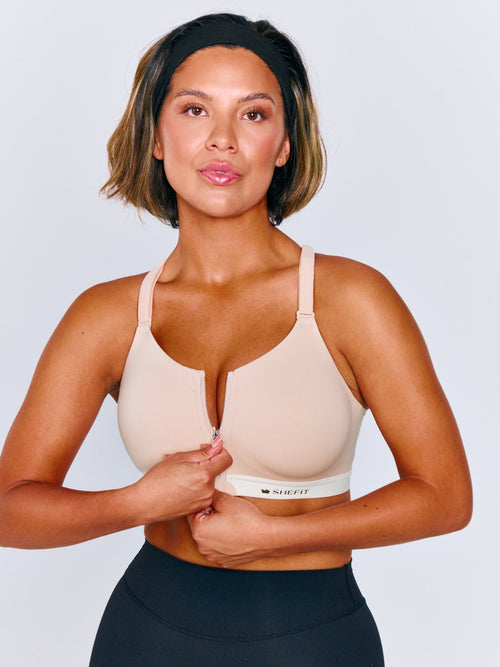
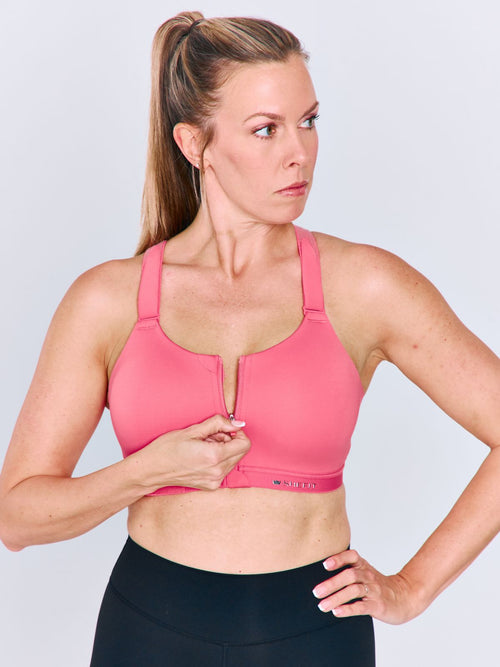
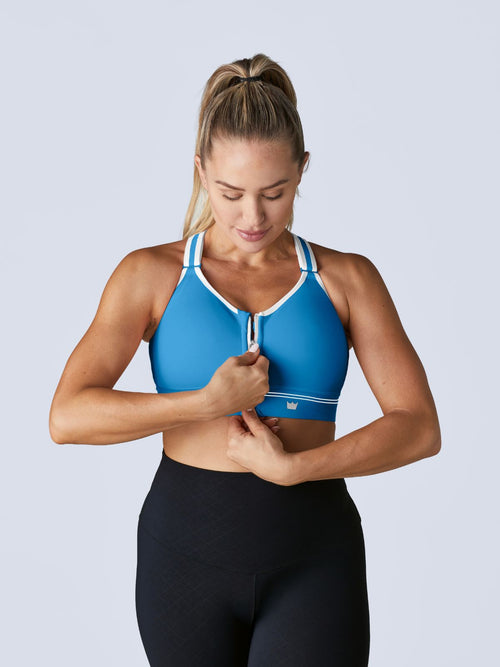
This bra has smooth, non-padded cups made from four-way stretch fabric and lined with power mesh to reinforce support. Its patented Zip. Cinch. Lift.® adjustability comes down to three parts:
- A front zipper for getting in and out easily
- A cinchable rib band with 8 inches of cinch, which sets compression and support
- Non-stretch adjustable straps with 15 inches of lift
Sizes run XS-6Luxe, AA-I cups.
Emerge™ Sports Bra
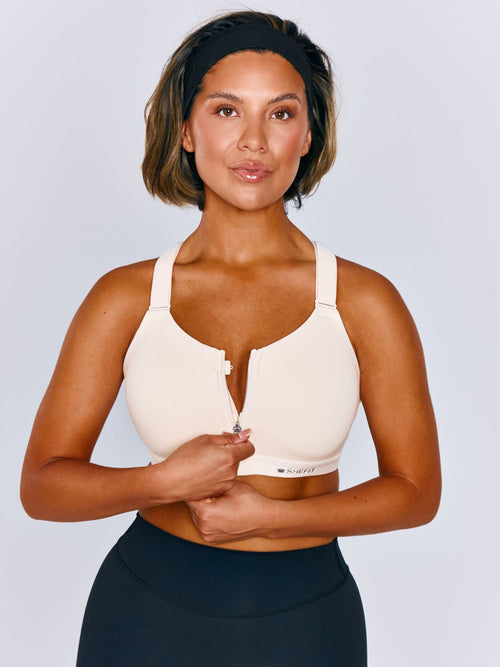
This bra has wire-free, seam-free smooth cups with a light integrated pad, along with a racerback and AdaptiveFit™ Technology. It carries our patented Zip. Cinch. Lift.® adjustability too, and it closes with a locking zipper with fold-over garages plus a hidden hook-and-eye. Its newer design is made to be more comfortable if you want to wear it longer.
Sizes run XS-6Luxe, A-I cups.
Both are built to adjust to your body rather than asking your body to adjust to them. Find your fit in the cup style that feels right to you.
Test the Fit Before You Trust the Label
Fit is the second half of support, and it trips up serious athletes too. In a multi-stage program with elite British athletes (80 in workshops, 60 in surveys, 37 in individual assessments), 83% of those surveyed rated their breast and bra knowledge at or below average. In the program, 51% had experienced breast pain, which affected performance for 29%, and most of those assessed were wearing ill-fitting, unsupportive bras. Education, advice, and fitting resolved most of the problems [3].
You can run a version of that fitting yourself in any medium support bra:
- Band: snug and level all the way around, without riding up your back. A loose band cannot anchor the bra.
- Straps: they stay put without carrying the load. Straps that slide off your shoulders mean the size is too big.
- Cups: they contain you without wrinkles or spill.
- Overall feel: snug like a hug, never painful.
- Movement: jog in place, do a few reaches, and add a squat, for several minutes in all. A bra that rides up into your armpits during this will chafe, and it is too large.
Do this before you take the tags off, in the same conditions you will train in. A bra that passes while you stand still has only passed half the test.
Two more things come up in almost every fitting. If you see armpit skin, that's your bra doing its job, lifting you up. Spillage is different: it means tissue pushing over the top or sides of the cup.
And if you land between sizes, our rule is simple: larger size for more coverage, smaller size for more control. We walk through the whole bra, from band to straps, in our complete sports bra fit guide.
When Medium Is Too Little, and When It Is Too Much
A well-fitted bra at the wrong level still gives you signals. Most of them show up during the workout or the morning after.
Signs You Need More Support
- Bounce you can feel, especially on stairs, jogs, or quick stops
- Straps digging into your shoulders because they are taking load the band isn't
- A band that creeps upward partway through a session
- Soreness after a workout
Running, HIIT, jumping, horseback riding, and larger busts usually need high support. That's where our Ultimate Sports Bra® comes in, with the highest support in our range, individually seamed cups, removable padding, and power-mesh reinforced cups. We also lay out how to judge any high-support claim in our guide to telling a real high support sports bra from a marketing label.
The case for moving up on jumping days has some research behind it. In a study of 14 collegiate athletes by University of Memphis researchers, greater breast support was associated with smaller peak knee valgus angles and moments during landing, meaning less inward tilt and force at the knee [4]. The study compared no, low, and high support conditions, the sample was small, and this is an association, so we read it as a reason to take landings seriously rather than as proof of anything about injury.
Signs It's Too Much, or the Wrong Size
- A tight chest during steady effort
- Breathing that feels restricted
- Pinching along the band or at the cup edges
- A limited range of motion when you reach or rotate
More support doesn't always pay off on every activity. In a study of 23 recreationally active women, finish times in 10-km cycling time trials on a stationary bike did not differ across a professionally fitted high-support bra, a fitted low-support bralette, and each woman's own bra, and the high-support bra produced stronger chest-tightness symptoms [5]. None of those three conditions was a medium support bra, and the result only speaks to those conditions on a bike. It's still a useful reminder to match the bra to the movement.
If you feel these signs in a bra that otherwise suits your activity, try loosening the band or going up a size before you change support levels. Tight-but-correct and too-small can feel alike at first, and pain is the line between them.
How Long a Medium Support Bra Keeps Its Support
Support fades with wear, and a few habits slow it down. Rotating bras spreads the wash cycles across more than one, so no single band takes all the laundry. Wash cold and lay flat to dry. Our bras are built to withstand a low-heat dryer cycle, and lay-flat drying is still what we recommend.
We wash-test our bras to 25 cycles before obvious wear, compared with the typical 5-cycle test, and with proper care they last 12-24+ months.
Whichever bra you own, these are the signs the band has stretched out:
- It rides up your back on workouts where it used to stay put
- You have run out of room to tighten it
- Bounce has returned on movement that used to feel controlled
Medium Support Sports Bra Questions, Answered
Is medium support enough for running?
Medium support may not be enough for sustained running and jumping, especially for larger busts, so we recommend high support for those. Bust size changes the rating, though. The Flex™ Sports Bra and Emerge™ Sports Bra are rated high impact for A-B cups, while C+ cups will want the Ultimate Sports Bra® for running.
How do I know I need medium instead of high?
Start with the hardest movement you do regularly. If it keeps you close to the ground, medium is typically the level to try. If it involves repeated landings, look at high support, and move up a level if you have a fuller bust. The fit check then tells you whether you chose well.
Can I wear a medium support bra all day?
You can, as long as it stays snug without pinching or digging. The Emerge™ Sports Bra is a workout bra first, and its newer design is made to be more comfortable if you want to wear it longer.
Will a medium support bra work for a larger bust?
It can, particularly for lower-bounce activities like yoga, cycling, and strength training. Fuller busts often need a level up as the movement gets bigger, so measure in inches, run the movement test, and step up to high support if you still feel bounce.
How snug should a medium support bra feel?
Snug like a hug, and never painful. If you can't take a full breath or the band pinches, it's too tight. If the band rides up or the straps slide off your shoulders, it's too large.
Pick for Your Hardest Regular Workout
A support label gives you a starting point, and your own movement test gives you the answer. Choose the support level for the most demanding movement you do regularly, weigh it against your bust size, and then confirm it with the fit check: band, straps, cups, and a few minutes of moving around. If your hardest regular session falls in the medium range, find your fit with our Flex™ Sports Bra, set to your body and ready for the workouts you actually do.
References
[1] Norris M, Blackmore T, Horler B, Wakefield-Scurr J. "How the characteristics of sports bras affect their performance." Ergonomics 64(3), 2021. https://pubmed.ncbi.nlm.nih.gov/32981459/
[2] Rizzone KH, Edison B, et al. "Sports Bra Preferences by Age and Impact of Breast Size on Physical Activity among American Females." International Journal of Environmental Research and Public Health, 2021. https://pmc.ncbi.nlm.nih.gov/articles/PMC8657319/
[3] Wakefield-Scurr J, Sanchez A, Jones M. "A multi-stage intervention assessing, advising and customising sports bras for elite female British athletes." Research in Sports Medicine 31(5), 2023. https://pubmed.ncbi.nlm.nih.gov/35164611/
[4] Fong HB, Nelson AK, Storey JE, Hinton J, Puppa M, McGhee D, Greenwood D, Powell DW. "Greater Breast Support Alters Trunk and Knee Joint Biomechanics Commonly Associated With Anterior Cruciate Ligament Injury." Frontiers in Sports and Active Living, 2022. https://pmc.ncbi.nlm.nih.gov/articles/PMC9163541/
[5] Illidi CR, Jensen D, et al. "Supported to perform: sports bras and breast volume do not impair cycling performance in females." Frontiers in Sports and Active Living 6:1439403, 2024. https://pmc.ncbi.nlm.nih.gov/articles/PMC11502316/