Which Bra Is Right for You? Learn More


Walk into almost any activewear section and search for a bra you can actually nurse in. You will find pull-over bralettes, low-impact sleep bras, and pumping hybrids designed for walking the baby and folding laundry. What you will rarely find is a true high-impact option, the kind of bra that actually lets you run a 5K or make it through a HIIT class without the bounce that new moms dread.
That gap is why SHEFIT exists. Our founder, Sara Moylan, built the first prototype while she was pregnant with her first child, stitching an old nursing bra together with a hot glue gun because she could not find a supportive bra that fit her changing body. Two decades later, the nursing sports bra market has expanded, but the high-impact end of it is still underserved. Moms who ran before baby want to run again. Moms who loved HIIT want their class back. They need support that handles the movement AND the realities of a nursing body.
This guide covers what sets the category apart from any other sports bra, how nursing access actually works, why impact level matters more than most new moms realize, and how to check the fit so you get real support without restricting your milk supply.
What Makes a Nursing Sports Bra Different From a Regular Sports Bra
A regular sports bra controls breast movement during exercise. That is one job. A nursing sports bra has to do that job AND handle a few extras that make nursing life workable.
| What a regular sports bra handles | What a nursing version also has to handle |
|---|---|
| Bounce control during activity | Quick nursing access without removing the bra |
| Consistent support through a workout | Daily breast volume fluctuation as milk fills and empties |
| Comfort during one session | All-day wear that moves between workouts and nursing sessions |
| A fixed cup size | A cup size that may change every few weeks as supply evolves |
The extras are the hard part. A bra can nail bounce control and still fail a nursing mom because the cups do not open for feeding, the band cannot tighten as your rib cage contracts postpartum, or the fit compresses the chest so firmly that it limits milk flow. A good one adds flexibility on top of bounce control. A great one is adjustable enough that it keeps working as your body keeps changing.
Nursing Access: The 4 Design Approaches and What Works Best
Every bra in this category uses one of four nursing-access designs. The differences matter more than marketing copy suggests, especially when you are trying to feed a fussy baby with one hand.
Clip-down cup. A plastic clip on the strap releases the cup flap. It is fast, one-handed, and low profile under clothes, though the clips can wear out or break over time. Best for everyday wear, quick feeds, and leisure workouts.
Drop-down with Velcro. A Velcro closure (usually fed through a fabric loop or plastic D-ring) releases the strap. Durable and adjustable with nothing to break, but it can be awkward one-handed, and the Velcro loses grip once it picks up fabric lint. Better suited to higher-impact use and larger cup sizes.
Pull-aside stretch panel. The cup pulls down or to the side to expose the breast. No hardware to break and the simplest design of the four, but stretch means less support, which is why this style usually caps at low impact. Best for low-impact wear, small cup sizes, and sleep.
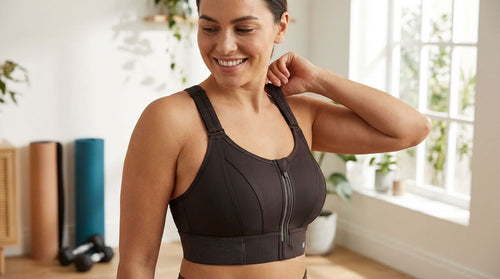
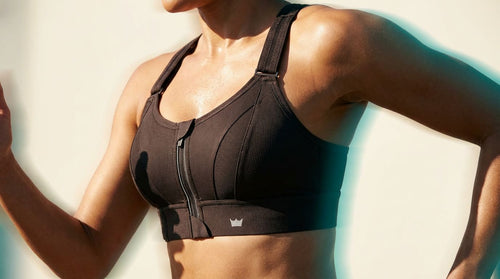
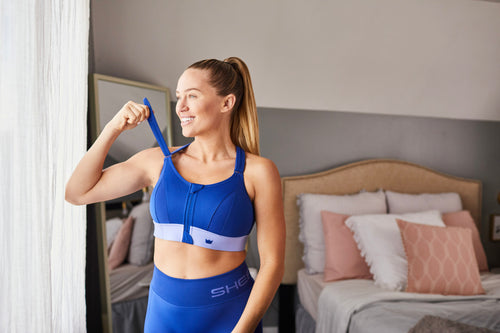
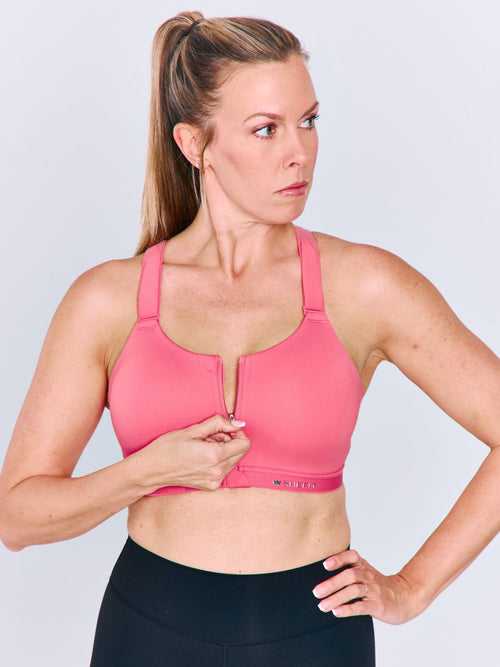
Adjustable strap with front zip. Loosen one shoulder strap, pull the bra aside, and zip back up when done. It works at any impact level and adjusts as the body changes, though it takes a minute or two to re-cinch after feeding. Best for running, HIIT, and any activity where support cannot compromise.
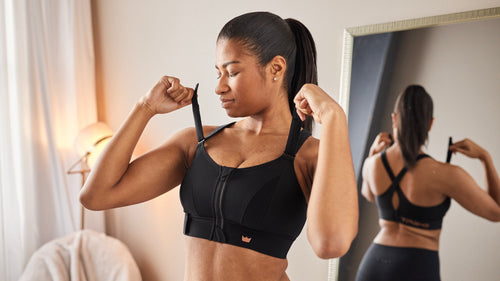
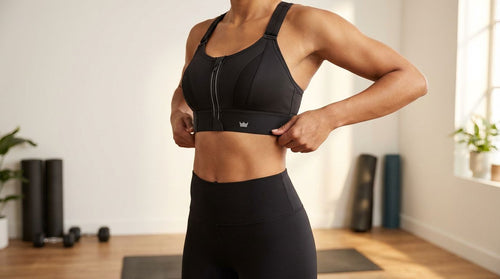
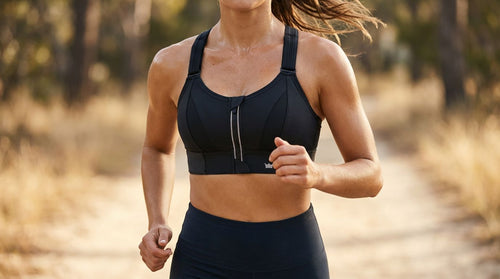
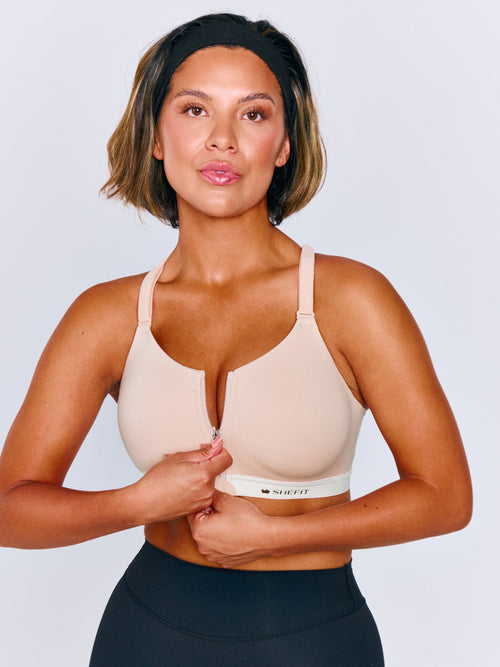
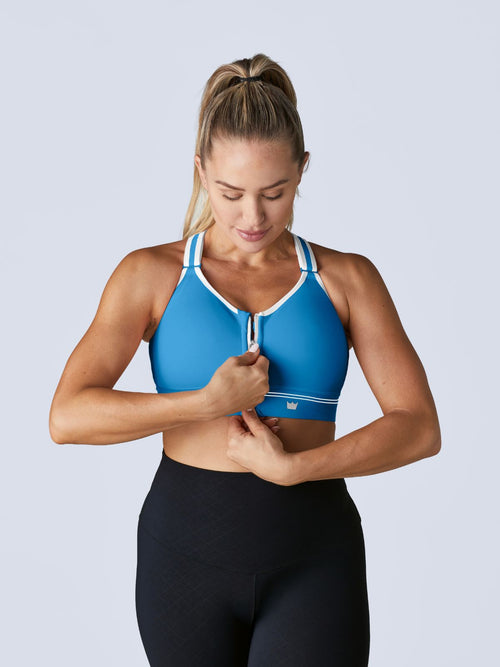
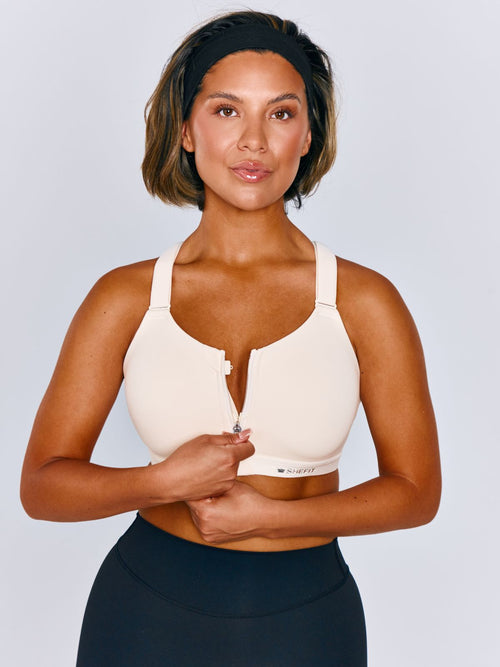
A front zipper paired with adjustable straps is the most flexible mechanism because it separates the nursing action from the support action. You unzip to feed, and the full support structure stays intact when you re-cinch. That is how our Ultimate Sports Bra works, and it is a design choice specifically shaped by nursing moms who needed both.
Why Impact Level Matters More Than You'd Expect for Nursing Moms
Here is where the market has a real blind spot. Most nursing-specific bras cap at low or medium impact. They assume new moms only want to walk and stretch, not run and jump. That assumption leaves a lot of moms stranded.
Impact level is the force your bra has to handle during movement. The mismatch between impact level and activity is what causes bounce, band ride-up, and the discomfort that drives women to skip workouts altogether.
| Activity | Small-to-Medium Bust (AA-C) | Larger Bust (D and up) | Examples |
|---|---|---|---|
| Low impact | Low support | Medium support | Yoga and walking; light pilates |
| Medium impact | Medium support | High support | Cycling and strength training; pickleball |
| High impact | High support | High support | Running and HIIT; horseback riding |
Breast size shifts the whole matrix. A D-cup doing yoga often needs the same support structure a C-cup would need for cycling. During and after pregnancy, most women go up 2-3 cup sizes, which means the impact-level calculus changes even if the activity does not.
Research from the University of Memphis found that greater breast support is associated with reduced peak knee valgus angles and greater trunk flexion during landing, biomechanical profiles linked to lower ACL injury risk [1]. For postpartum women, whose movement patterns are already altered by a shifting center of gravity and core weakness, that finding matters. Support that reduces breast motion helps protect the joints that are working overtime during the return to exercise. For more on how impact levels map to bra construction, understanding impact levels breaks down the full framework.
How Your Nursing Body Keeps Changing and Why Adjustability Matters
Pregnancy reshapes the body over nine months. Nursing continues that reshaping at a different rhythm and on a shorter timeline.
Milk comes in between days 2 and 5, and breast volume can surge enough to make pre-pregnancy cups too small within 24 to 48 hours. Once supply starts to regulate, volume fluctuates daily: fuller in the morning, smaller after a feed, engorged by evening. The torso narrows as organs shift back over the first couple of months, which means a band that fit during pregnancy starts to feel loose. Cup size keeps shifting as supply stabilizes, so a fit that works at week 6 may not work at week 12. What every one of these changes asks of a bra is the same thing: adjustability at the band, adjustability at the straps, and individual cup space that can flex with the body instead of fighting it.
An estimated 85% of women already wear the wrong bra size at baseline [2]. Postpartum, that number almost certainly climbs, because bodies change faster than shopping trips. A fixed-size bra cannot track daily fluctuation. An adjustable one can.
Postpartum fitness specialists note that the rib cage is often restricted after delivery, and support spread across the full garment, rather than concentrated in a narrow chest strap, tends to feel more comfortable and better support core rehabilitation. That is a design principle most nursing bras miss, and it is one of the clearest reasons adjustability beats stretchiness. Stretchy fabric gives when you need it to, then loses tension and leaves you unsupported. An adjustable band stays where you set it.
What to Look For in a Nursing Sports Bra
The features that matter most are the ones that solve the problems above. Here is the checklist, in order of priority.
| Feature | Why It Matters for Nursing Moms | What to Look For |
|---|---|---|
| Adjustable rib band | Your torso narrows postpartum; band needs to tighten over weeks | Continuously adjustable band, not limited to 2-3 hook positions |
| Non-stretch adjustable straps | Breast weight increases as milk comes in; stretch straps lose tension and let bounce through | Non-stretch straps that maintain lift wash after wash |
| Wire-free construction | Underwire can press against swollen breast tissue and contribute to plugged ducts | Structured support without wire |
| Individual cup space | Breasts change volume at different rates during nursing; cups need to adapt separately | Structured cups with room to flex, not fused uniform compression |
| Breathable moisture-wicking fabric | Hormonal shifts increase body temperature; milk leaks add moisture | Moisture-wicking materials that reduce friction |
| Nursing access that works at your impact level | Low-impact pull-aside does not survive a run | Match the access mechanism to how you actually train |
| Inclusive size range | Nursing moms span the full cup spectrum; many go up 2-3 cups from pre-pregnancy | AA through I cups, band sizes that match postpartum reality |
Stretchy straps are the most common shortcut in the nursing bra category, and they are also the most common failure mode. Stretchy straps mean bounce, because the moment the strap stretches, it stops anchoring the bra against your body. Non-stretch straps maintain lift every time, and they hold their tension across the 25+ wash cycles that come with postpartum life. SHEFIT bras are built to hold their shape and tension through repeated wash cycles, so the support does not degrade the way stretch-strap bras typically do. For a deeper walkthrough of features that hold up, 4 tips for a comfortable nursing sports bra covers the core shopping criteria.
The Fit Checklist: How to Tell Your Nursing Sports Bra Actually Fits
Numbers on a size chart are a starting point. A real fit check happens once the bra is on your body. Run through these five points before committing.
- Band sits level across your back without riding up. Two fingers fit under it comfortably, no more.
- Cups contain each breast in its own space. No wrinkles, no gaps, no tissue pushing over the top or sides.
- Straps provide lift without digging into your shoulders. Non-stretch straps hold their tension; stretchy ones will loosen within a workout.
- Coverage does not extend too far under your armpits. Excessive armpit coverage is a sign the size is off, not a sign of extra support.
- Bounce test with 30 seconds of jumping jacks or high knees. Minimal movement means the support is working.
One thing that surprises many women during a fit check: a bra with proper lift raises breast tissue higher on your chest, which can expose skin near the armpit that used to be hidden under the breast. That is not spillage or extra fat. If you see armpit skin, that is your bra doing its job, lifting you up. Spillage is different: it is tissue pushing over the top or sides of the cup.
Tightness deserves its own attention. A nursing bra should feel firm and secure, but never compressive enough to restrict the breast itself. Lactation consultants commonly warn that a bra tight enough to press on milk ducts can contribute to plugged ducts and mastitis risk, and prolonged milk stasis may, in turn, affect supply. The rule is firm at the band, loose at the breast. Our detailed look at whether a nursing bra should fit tightly covers the exact signs to watch for.
Research shows that when breast support is inadequate, women experience increased discomfort and decreased willingness to exercise [3]. The cost of a poor fit shows up as missed workouts and lost confidence during an already demanding season, not only as bounce during the sets you do make it through.
What About Pumping? Nursing Sports Bras With Pumping Access
Pumping is its own category of challenge. A dedicated pumping bra has openings sized for the flanges of a breast pump, so you can pump hands-free while working, driving, or caring for another child. Some nursing sports bras include this functionality; many do not.
SHEFIT bras are not marketed as pumping bras. That is honest positioning. What we do offer is adjustability that can be adapted for pumping in a pinch. A loosened shoulder strap on the Ultimate or Flex creates enough room to position a flange, and many of our customers pair a dedicated pumping bra for session work with a SHEFIT sports bra for workouts. If you want one bra that does both, a dual-function nursing and pumping bra is probably the right tool. If you want a bra that delivers real support during exercise and flexible nursing access for feeds, that is where we fit.
The trade-off comes down to priorities. If pumping sessions happen multiple times a day and hands-free matters more than bounce control, prioritize a pumping-first bra. If workouts matter and pumping is occasional, pairing a supportive sports bra with a separate pumping bra covers both jobs without asking one garment to do two things well.
SHEFIT Sports Bras for Nursing Moms
SHEFIT started because Sara Moylan could not find a supportive sports bra that fit her changing body during pregnancy. She stitched the first prototype together in her own home using an old nursing bra and a hot glue gun, and the adjustability that makes our bras work for nursing moms today is directly descended from that original frustration.
Ultimate Sports Bra
The Ultimate Sports Bra ($69) is our high-impact option and the bra built most directly around nursing realities.
Key features:
- Patented adjustable shoulder straps and rib band for custom fit
- Encapsulation and compression design for complete motion control
- Non-stretch straps that maintain lift wash after wash
- Removable modesty pads for customizable coverage
- Front zipper for easy on and off, which doubles as the fastest nursing access on the market
- Sizes XS-6Luxe, AA-I cups
In biomechanics testing conducted with the University of Memphis Breast Biomechanics Research Center, the Ultimate measured substantial reductions in both vertical and side-to-side breast motion. For a nursing mom returning to running or HIIT, that level of control translates to less back strain, less compensatory movement from a postpartum core that is still rebuilding, and a workout that feels like training instead of managing.
Flex Sports Bra
The Flex Sports Bra (starting at $65) offers patented adjustable features with smooth cups for a sculpted look. It provides high-impact support for smaller bust sizes (32C and under) and medium-impact for larger sizes, though our medium-impact rating delivers support that rivals what other brands call high-impact.
Best for: cycling and strength training, pickleball, and any varied-intensity session through the nursing months.
How They Compare
| Feature | SHEFIT Ultimate | SHEFIT Flex |
|---|---|---|
| Support level | Maximum (all sizes) | High (32C and under), Medium (larger sizes) |
| Adjustable band | Yes (patented) | Yes (patented) |
| Adjustable straps | Yes (patented, non-stretch) | Yes (patented) |
| Design type | Encapsulation and compression | Encapsulation and compression |
| Cup style | Removable modesty pads | Smooth cups, sculpted look |
| Nursing access | Front zip plus adjustable strap loosen | Adjustable strap loosen |
| Size range | XS-6Luxe, AA-I cups | XS-6Luxe, AA-I cups |
| Best activities | Running and HIIT; horseback riding | Cycling and strength training; pickleball |
| Price | $69 | Starting at $65 |
Both bras are designed for all breast types, from small to large, enhanced or natural. They are built for the long haul, engineered to hold tension and shape across repeated wash cycles. With 75,000+ 5-star reviews across our product line, the adjustability works across every body type and every stage of the pregnancy-to-nursing-to-weaning journey.
FAQs About Nursing Sports Bras
Can I wear a regular sports bra while breastfeeding?
You can wear it, but it will not nurse well. Without drop-down access, you have to pull the whole bra up or off to feed, which is uncomfortable and impractical for frequent feeds. A regular sports bra also may not adjust to the daily volume changes that come with breastfeeding.
When should I start wearing a nursing sports bra?
As soon as your current sports bra becomes uncomfortable or your schedule demands nursing access. For many moms, that is within the first week postpartum when milk comes in. Some start in the third trimester if they want one bra that carries through both pregnancy and nursing.
Does a tight sports bra affect milk supply?
It can contribute indirectly. A bra that compresses the breast tissue itself, rather than anchoring at the rib cage, may restrict milk ducts and contribute to plugged ducts or mastitis, and the resulting milk stasis may, in turn, affect supply. The fix is an adjustable band that sits firm against your ribs without pressing on breast tissue.
Can I run while breastfeeding?
Yes, with the right support. High-impact activities require maximum support, a non-stretch strap system, and a secure band. Many moms find that a quick feed before a run leaves them more comfortable through the workout.
Do I need a high-impact sports bra for nursing?
It depends on what you do. Walking and yoga call for low to medium support. Running and HIIT (plus any jumping-heavy workout) require high support. Breast size matters too: larger postpartum busts often need high-impact construction even for activities that seem moderate.
How often should I replace a nursing bra I work out in?
Most sports bras last 6 to 12 months with regular use. Signs it is time: the band rides up, the straps lose tension, or bounce starts showing up in workouts the bra used to handle. Adjustable designs last longer because you can tighten the band and straps as elastic naturally relaxes.
What size should I buy if my pre-pregnancy size no longer fits?
Re-measure before every postpartum purchase. Most women go up 2-3 cup sizes during nursing, and the rib cage shifts separately. If you are between two sizes, an adjustable bra solves the in-between problem because you can dial the fit to your exact measurement.
Your nursing body is doing remarkable work, and the right sports bra should support that work without asking you to give up the training you love. When adjustability is built into the bra, you stop working around it and start focusing on what matters: feeding your baby, getting your movement back, and feeling strong in your body again.
References
[1] Fong, H.B., Nelson, A.K., Storey, J.E., et al. "Greater Breast Support Alters Trunk and Knee Joint Biomechanics Commonly Associated With Anterior Cruciate Ligament Injury." Frontiers in Sports and Active Living, 2022. https://doi.org/10.3389/fspor.2022.861553
[2] McGhee, D.E., & Steele, J.R. "Optimising breast support in female patients through correct bra fit. A cross-sectional study." Journal of Science and Medicine in Sport, 2010. https://pubmed.ncbi.nlm.nih.gov/20451452/
[3] Risius, D., Milligan, A., Berns, J., Brown, N., & Scurr, J. "Understanding key performance indicators for breast support." Journal of Sports Sciences, 2017. https://pubmed.ncbi.nlm.nih.gov/27291899/