Which Bra Is Right for You? Learn More


Most women pick a sports bra based on one variable: how hard the workout feels. Running gets a "high-impact" bra, yoga gets a lighter one, and everything in between gets whatever is clean. The assumption is that impact level is all that matters.
Research tells a different story. The forces your body generates during running are fundamentally different from the forces created by jumping, and activities that combine both create a compounding effect that most sports bras are not designed to handle. At SHEFIT, we engineer our sports bras specifically for these combined demands, because the bra that gets you through a steady 5K may fail completely the moment you add box jumps or burpees into the mix.
This guide explains what running and jumping actually do to your body, why the combination creates unique support challenges, and how to find a sports bra that handles both.
What Running and Jumping Do to Your Breasts
Your breasts are supported by skin and connective tissue called Cooper's ligaments. There is no muscle holding them in place. Every stride and every landing sends forces directly through that tissue, and the direction of those forces depends on the movement.
Running generates repetitive vertical displacement. Your breasts move up and down with each footstrike, and over the course of one hour of slow running, that adds up to an estimated 10,000 bounces. The motion is rhythmic and predictable, but it accumulates.
Jumping adds explosive, multi-directional force. A box jump, a burpee, or a tuck jump launches your entire body upward and then brings it back down. Your breasts move vertically, side to side, and forward and back all at once. The forces are larger and less predictable than running alone.
When you combine running and jumping in the same session, three things happen:
-
Pain compounds. Research shows 72% of women experience breast pain during exercise. Alternating between running intervals and plyometric movements amplifies that pain because the tissue never gets a consistent rhythm to adapt to.
-
Your body compensates. When your brain anticipates breast pain, you shorten your stride, limit your arm swing, and protect your torso. These compensations reduce the effectiveness of every exercise in the workout.
-
Exercise avoidance increases. Over 27% of women report that inadequate breast support directly prevents them from exercising. For women who train with both running and jumping, that barrier grows because the support demands are harder to meet.
The takeaway is straightforward: a bra that works for steady-state running may not control the multi-directional forces of jumping, and a bra that handles single jumps may not hold up across hundreds of running strides.
How Breast Support Affects Running and Jumping Performance
Your sports bra is actively influencing how efficiently your body performs during running and jumping activities. The effect goes beyond comfort.
A 2022 study from the University of Memphis Breast Biomechanics Research Center found that greater breast support reduced oxygen consumption by 7% during treadmill running [1]. That translates directly to better running economy: you use less energy per mile, you fatigue slower, and you maintain form longer.
The injury connection matters even more for jumping. University of Memphis research demonstrates that greater breast support is associated with greater trunk flexion at initial contact and reduced peak knee valgus angles during landing movements [2]. In practical terms, those biomechanical changes are linked to lower ACL injury risk. When you land from a box jump or absorb the impact of a broad jump, the way your trunk and knees absorb force changes depending on how well your breasts are supported.
Dr. Douglas Powell, director of the Breast Biomechanics Research Center at the University of Memphis, puts it clearly: sports bras should be considered sports equipment, given their effect on injury risk and performance.
For women who train with both running and jumping, the performance implications are compounded. Poor support during the running portion wastes energy. Poor support during the jumping portion changes your landing mechanics. Together, they make every rep less effective and every session more taxing on your body.
What to Look for in a Sports Bra for Running and Jumping
Running and jumping create different force profiles, and the bra needs to handle both. Running demands control over repetitive vertical displacement. Jumping demands control over explosive, multi-directional movement. Here is what separates bras that can manage the combination from those that fail under mixed demands.
|
Feature |
What It Does |
Why It Matters for Running and Jumping |
What to Avoid |
|---|---|---|---|
|
Support design |
Controls breast movement |
Hybrid (encapsulation and compression) handles both vertical running forces and multi-directional jumping forces |
Compression only (flattens but fails to control independent breast motion) |
|
Strap material |
Manages lift and upward displacement |
Non-stretch straps maintain consistent tension through running strides AND explosive jump landings |
Stretchy straps that lose tension mid-workout |
|
Band adjustability |
Controls 80% of total support |
Continuously adjustable rib band lets you dial in precise compression for both activities |
Fixed hook closures with only 2-3 positions |
|
Cup construction |
Shapes and separates each breast |
Individual cup space prevents breast-to-breast friction during lateral jumping movements |
Single-compartment compression designs |
|
Closure type |
Affects security during movement |
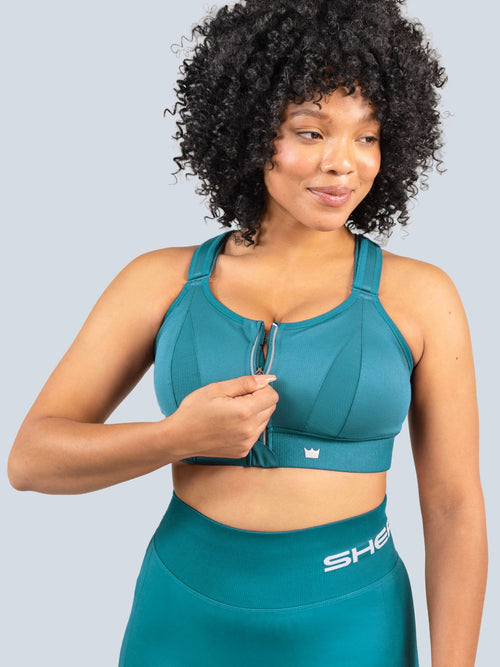
Front zipper with adjustable band stays secure through transitions between running and jumping |
Pull-on styles that stretch and shift over time |
Research confirms that breast movement reduction varies not only by bra design, but by activity type and speed [3]. A bra that tests well during treadmill running at one speed may perform differently during star jumps or at faster paces. That variability is why adjustability matters: you need the ability to fine-tune your fit for the specific combination of movements in your training session.
How Your Breast Size Changes Your Support Needs
Your breast size determines your personal support threshold independently of the activity. A D-cup walking needs more support than an A-cup doing jumping jacks. When running and jumping are combined, breast size becomes an even more important factor.
-
A-C cups have more flexibility in bra style for low-to-medium impact activities. For HIIT or CrossFit sessions that combine running and jumping, proper encapsulation and compression are still necessary, but lighter options may work for standalone yoga or walking days.
-
D+ cups need hybrid support (encapsulation and compression combined) for virtually all activities, including activities that seem moderate. Compression-only designs flatten the chest without controlling independent breast movement, which increases discomfort and alters gait during running and landing mechanics during jumping.
-
All breast types benefit from adjustability. Whether you are small to large, enhanced or natural, your ideal tension changes with your menstrual cycle, hydration levels, and the specific demands of each workout. Running days may need slightly different tension than days that mix running with plyometrics.
For recommendations by cup size and activity level, understanding impact levels explains how to match your breast size to the right support category.
Measuring and Fitting Your Sports Bra for High-Impact Activities
An estimated 75-85% of women wear the wrong bra size [4]. When the activity involves both running and jumping, an inaccurate fit shows up immediately: bounce during the running intervals, shifting during the jumps, and chafing everywhere the bra moves against your skin.
How to measure:
-
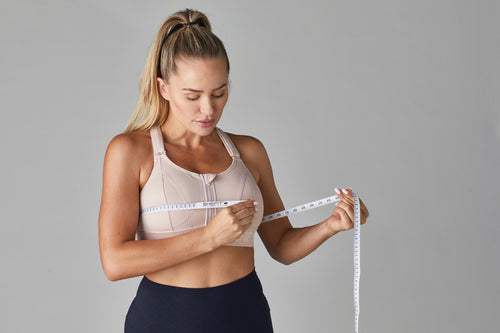
Band size. Wrap a flexible measuring tape snugly around your ribcage directly under your breasts. Round to the nearest even number. This measurement should feel firm, not loose.
-
Cup size. Measure around the fullest part of your bust without pulling the tape tight. The difference between this number and your band size determines your cup: 1 inch = A, 2 inches = B, 3 inches = C, and so on.
-
Check the brand's size chart. Sizes are not standardized across brands. Use the manufacturer's guide rather than your everyday bra size. For a step-by-step walkthrough, finding your perfect SHEFIT size covers the full measurement process.
The fit checklist for running and jumping:
-
Band sits level across your back, not riding up
-
Each strap provides lift without digging into shoulders
-
No spillage over the top or sides of cups
-
Coverage does not extend too far under armpits
-
Two fingers fit under the band comfortably
-
Each breast sits in its own cup space
A note on armpit skin. A bra with proper lift raises your breast tissue, which can reveal armpit skin that was previously hidden. Many women see this and assume it is fat or breast tissue spilling out. It is neither. It is normal skin that becomes visible when the bra is actually doing its job.
The 30-second jump test. Once you pass the checklist standing still, run 30 seconds of combined movement: jumping jacks, high knees, and a few tuck jumps. These replicate the multi-directional forces of a real workout. If anything shifts, tighten. If anything digs, loosen. A bra that passes this test can handle whatever your training session throws at it.
SHEFIT Sports Bras Built for Running and Jumping
Every feature discussed above (hybrid support design, non-stretch straps, adjustable band, encapsulation with compression) exists in our product line because the science demanded it. Our Ultimate Sports Bra reduces vertical breast displacement by more than 50% compared to other brands' high-support options, and University of Memphis research shows that greater breast support is associated with biomechanics linked to lower ACL injury risk.
The Ultimate Sports Bra
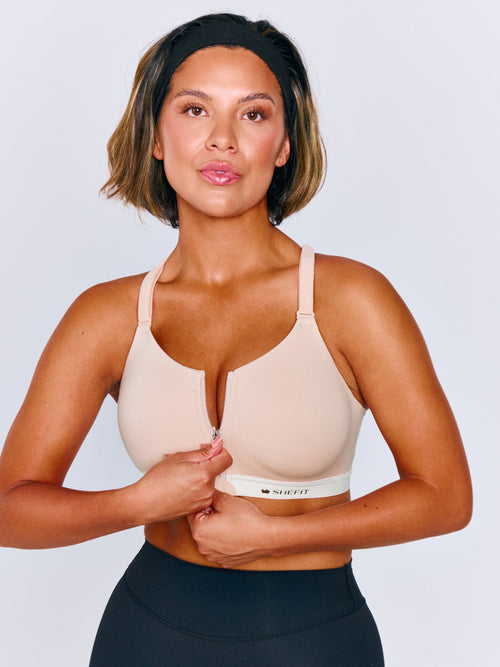
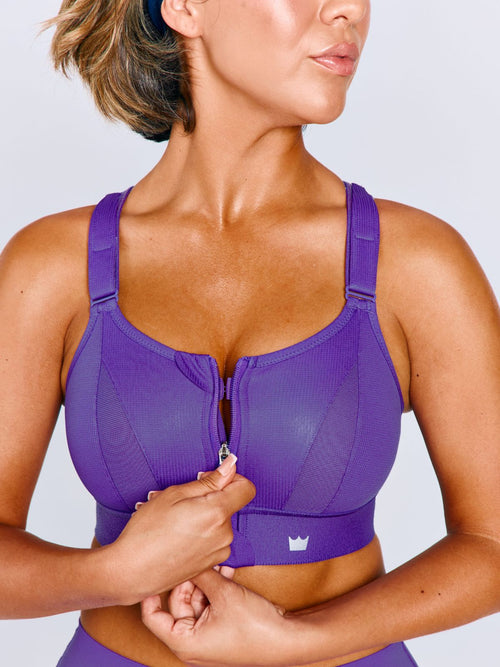
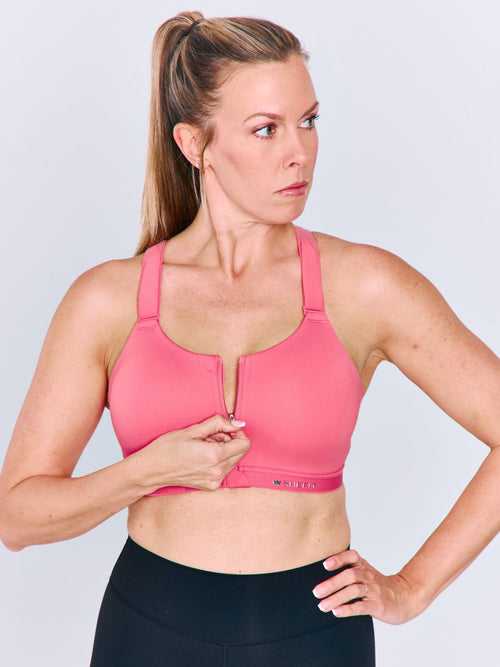
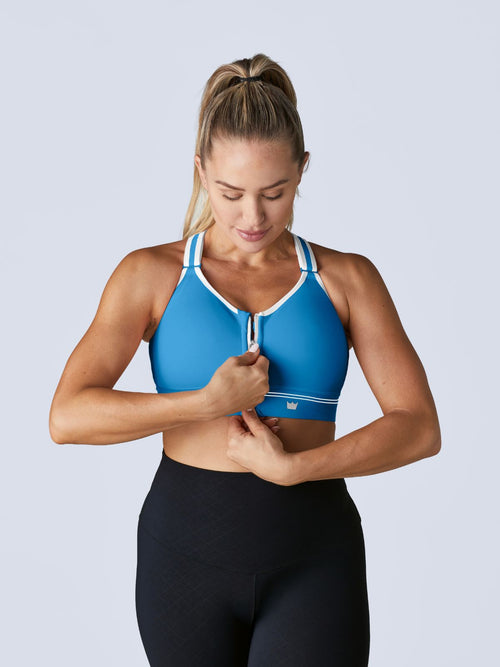
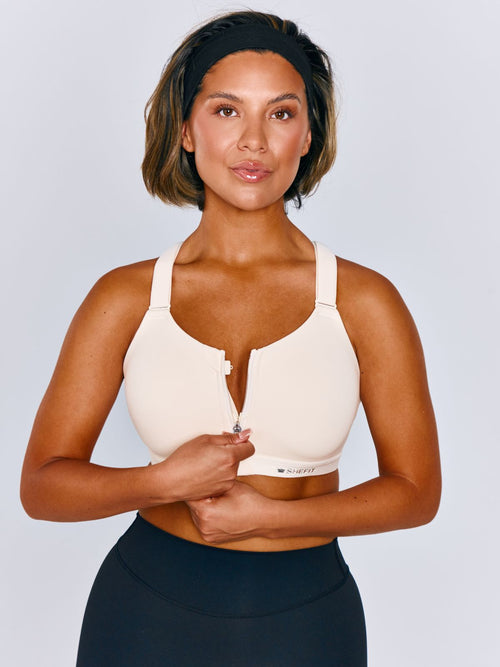
The Ultimate Sports Bra ($69) is our maximum-support solution for activities that combine running and jumping.
Key features:
-
Patented adjustable shoulder straps and rib band for custom fit
-
Encapsulation and compression design for complete motion control
-
Non-stretch straps that maintain lift wash after wash
-
Removable modesty pads for customizable coverage
-
Front zipper for easy on and off
-
Sizes XS-6XL, AA-I cups
The Ultimate handles everything from running intervals to box jumps to CrossFit WODs to horseback riding. With 75,000+ 5-star reviews, it has proven effective for all breast types, from small to large, enhanced or natural.
The Flex Sports Bra
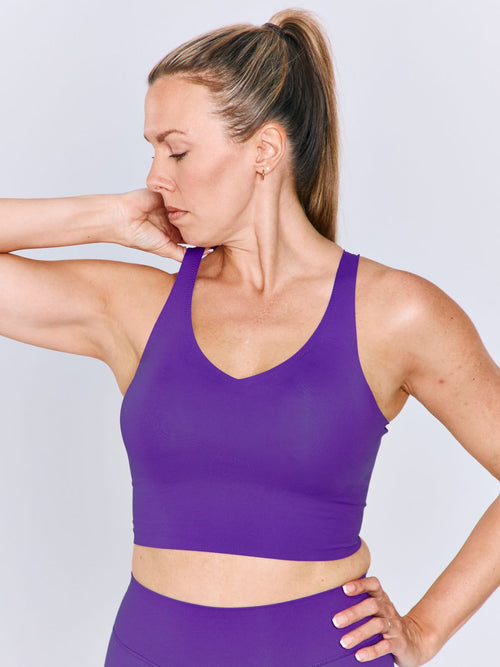
The Flex Sports Bra ($65) offers patented adjustable features with smooth cups for a sculpted look. It provides high-impact support for smaller bust sizes (32C and under) and medium-impact for larger sizes. Worth noting: our medium-impact rating delivers support that rivals what other brands call high-impact.
Best for: cycling and strength training, pickleball, or any varied-intensity session that includes moderate jumping.
How They Compare
|
Feature |
SHEFIT Ultimate |
SHEFIT Flex |
|---|---|---|
|
Support level |
Maximum (all sizes) |
High (32C and under) / Medium (larger sizes) |
|
Adjustable band |
Yes (patented) |
Yes (patented) |
|
Adjustable straps |
Yes (patented, non-stretch) |
Yes (patented) |
|
Design type |
Encapsulation + compression |
Encapsulation + compression |
|
Cup style |
Removable modesty pads |
Smooth cups, sculpted look |
|
Size range |
XS-6XL, AA-I cups |
XS-6XL, AA-I cups |
|
Best for running + jumping |
Yes (maximum support for combined forces) |
Moderate jumping with smaller bust sizes |
|
Durability testing |
25 wash cycles |
25 wash cycles |
|
Price |
$69 |
$65 |
Both bras are wash-tested to 25 cycles before showing obvious wear, compared to the industry standard of roughly 5 washes. Adjustability extends lifespan further: as elastic naturally relaxes over time, you compensate by tightening rather than replacing.
FAQs About Sports Bras for Running and Jumping
Can the wrong sports bra actually hurt my running performance?
Yes. Research shows proper breast support can improve running economy by up to 7% through reduced oxygen consumption and improved knee joint mechanics. A bra that fails to control breast movement forces your body to compensate, wasting energy on stabilization instead of forward motion.
Do I need different bras for running vs jumping exercises?
Not if you choose a bra that handles both force profiles. Running creates repetitive vertical forces. Jumping creates explosive multi-directional forces. A bra with encapsulation and compression design, non-stretch straps, and an adjustable band controls movement across both patterns. The Ultimate Sports Bra is engineered for exactly this combination.
How do I know if my sports bra provides enough support for plyometrics?
Run the 30-second jump test: do jumping jacks, high knees, and tuck jumps. If you notice bounce, shifting, or the need to adjust mid-movement, your bra is not providing enough support. Tighten straps and band first. If the issue persists, the bra may lack the structural design needed for explosive movements.
Why do my breasts still bounce even in a "high-impact" sports bra?
Not all bras labeled "high-impact" actually control multi-directional movement. Compression-only designs flatten the chest but fail to control independent breast motion, especially for D+ cups. Look for bras that combine encapsulation (individual cup space) with compression (overall secure hold) and use non-stretch straps.
How often should I replace my sports bra if I run regularly?
Quality bras last 12-24+ months with proper care. Wash in cold water on a delicate cycle and air dry instead of using a dryer. When you notice reduced support or the need to constantly adjust during workouts, it is time for a replacement.
Can I wear the same bra for a morning run and an evening HIIT class?
Yes. Adjustable straps and band let you modify tension for different activities throughout the day. Tighten for the high-impact intervals and explosive jumps in your HIIT session. Loosen slightly for a steady-pace run. One bra handles both when the adjustability gives you that range.
Running and jumping demand more from your sports bra than any other combination of movements. When the support is engineered for those specific forces, you stop thinking about what you are wearing and start thinking about your next rep, your next mile, your next personal record. Your training deserves that kind of freedom.
References
[1] Pattillo, A. "Your Sports Bra Could Level Up Your Running Game: With The Right Support." Women's Running, 2023. https://www.womensrunning.com/health/wellness/your-sports-bra-could-level-up-your-running-game/
[2] Fong, H.B., Nelson, A.K., Storey, J.E., Hinton, J., Puppa, M., McGhee, D., Greenwood, D., & Powell, D.W. "Greater Breast Support Alters Trunk and Knee Joint Biomechanics Commonly Associated With Anterior Cruciate Ligament Injury." Frontiers in Sports and Active Living, 2022. https://doi.org/10.3389/fspor.2022.861553
[3] Nolte, K., Burgoyne, S., Nolte, H., Van der Meulen, J., & Fletcher, L. "The effectiveness of a range of sports bras in reducing breast displacement during treadmill running and two-step star jumping." Journal of Sports Medicine and Physical Fitness, 2016. https://pubmed.ncbi.nlm.nih.gov/26765495/
[4] Porter, A. "Bras: The Continuing Research Saga." Texas A&M University Graduate School, 2024. https://grad.tamu.edu/aggie-life/aggie-voice/bras-the-continuing-research-saga