Which Bra Is Right for You? Learn More


Most women pick a sports bra the way they pick a t-shirt: by color, by brand, by whether it looks good in the mirror. Almost nobody buys one by asking the question that actually decides whether it works, which is how the bra is built. Two bras can sit on the same rack, cost the same, and look nearly identical, yet manage your movement in completely different ways once you start to sweat.
At SHEFIT, we have spent years inside that gap between how a sports bra looks and how it performs. The construction is the part nobody talks about, and it is the part that determines whether you finish a workout focused on the workout, or spend it tugging straps and bracing against bounce. Choose by style and you are guessing. Choose by construction and you actually know what you are getting.
This guide walks through the three ways sports bras are built, how impact level and cup size change the equation, and how to tell whether the one you own is doing its job.
The 3 Types of Sports Bras by Construction
Sports bras are built in three ways, and the difference is mechanical, not cosmetic. Compression bras press both breasts against the chest wall as a single unit. Encapsulation bras give each breast its own cup and support it individually. Combination bras do both at once. Academic research confirms this framework: sports bras are generally classified into compression and encapsulation designs, with encapsulation shown to be more effective at controlling breast movement [1].
The table below maps how each construction works and who it serves. Both our Ultimate and Flex bras use that third approach, an encapsulation and compression design, and then add a layer most bras skip entirely: adjustability.
Construction Type |
How It Works |
Best Cup Size |
Best For |
Typical Closure |
|---|---|---|---|---|
Compression |
Presses both breasts flat against the chest as one unit |
A-C |
Low-to-medium impact |
Pullover |
Encapsulation |
Gives each breast its own cup and supports it separately |
C+ |
All impact levels |
Band, hook, or zip |
Combination |
Compresses against the torso and encapsulates each breast |
All sizes |
High impact |
Zip or hook |
Compression Bras
A compression bra works by flattening. It pulls both breasts toward the chest wall and holds them there as one mass, which is why these bras are usually pullover styles with alpha sizing (XS, S, M, L) and no individual cups. For smaller busts during lighter movement, that is often enough.
The limitation shows up as cup size climbs. Compression controls vertical bounce reasonably well, but it does nothing to manage each breast independently, so lateral and forward movement still slips through. For a fuller bust, compressing without encapsulating means the support is incomplete.
Most compression bras are best treated as a starting point, not a ceiling. If you find yourself adjusting or re-centering during a workout, that is usually the signal that the construction has reached its limit for your body.
Encapsulation Bras
An encapsulation bra treats each breast separately. Every breast gets its own cup, the way a regular bra does, except the structure is engineered for movement rather than for sitting still. These designs typically use band-plus-cup sizing, which allows a far more precise fit than alpha sizing can.
This is the construction that becomes essential past a C cup, because individual cup space is the only way to control each breast on its own terms. Our encapsulation design gives each breast its own supportive space without relying on underwire, so you get the separation and structure of a traditional bra with none of the digging.
Band-plus-cup sizing is also what makes encapsulation bras easier to fit accurately. A 34D and a 36C are not the same chest, even though they share a cup letter. The right size is the intersection of both measurements, and encapsulation construction is the only build that can honor that distinction.
Combination (Hybrid) Bras
A combination bra is the most complete construction available. It compresses against the torso and encapsulates each breast at the same time, which is why it handles the widest range of cup sizes and the highest impact activities. For a fuller-busted woman running, doing HIIT, or riding horseback, this is the gold standard.
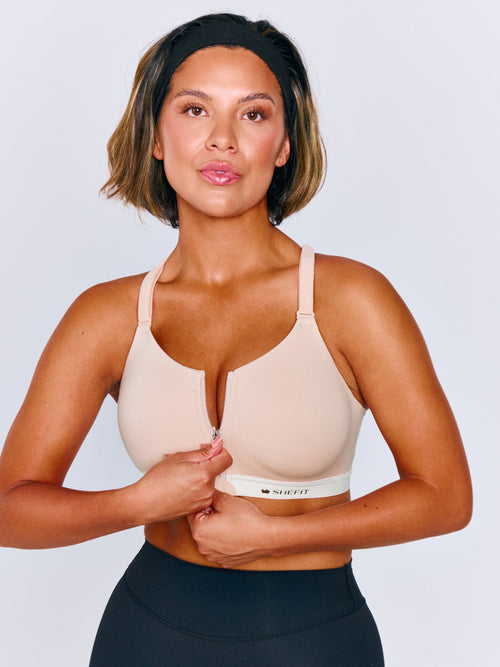
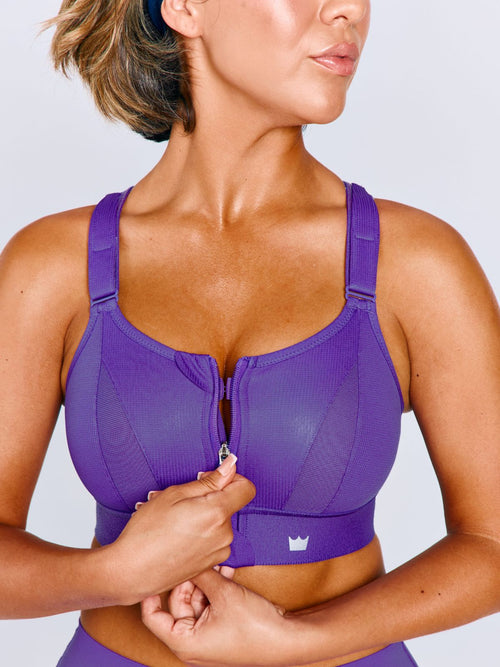
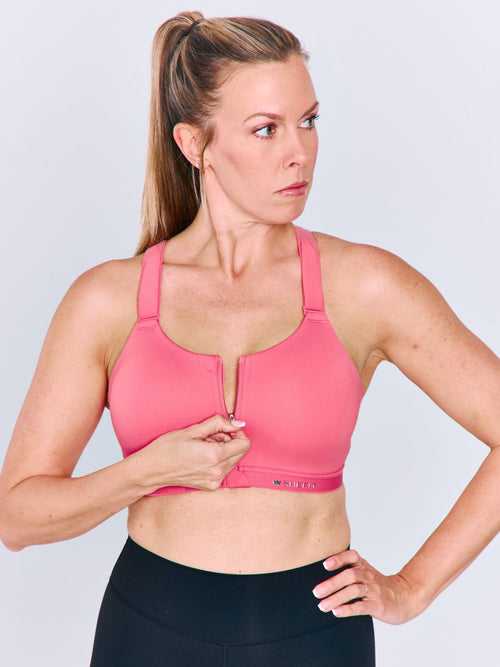
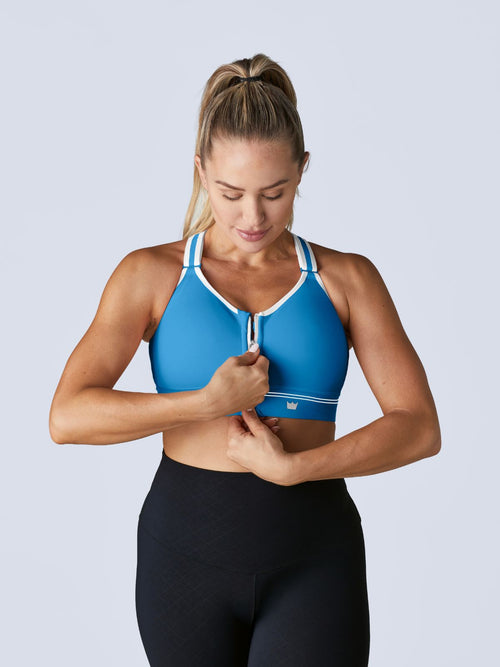
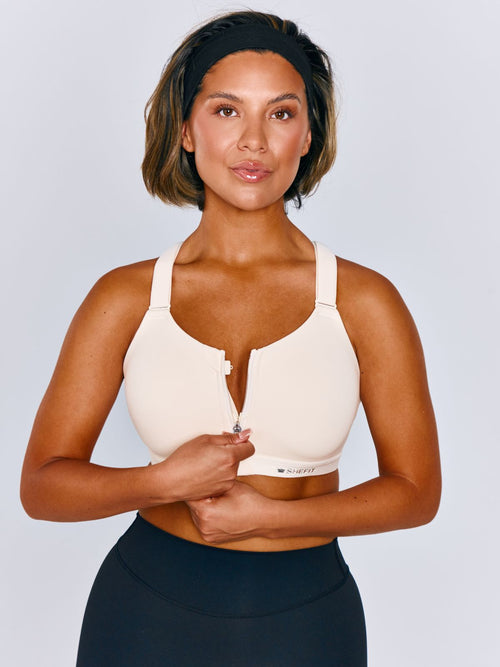
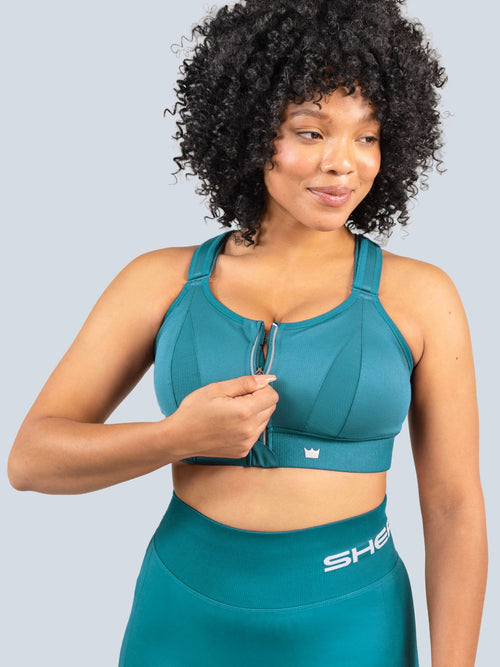
Our Ultimate Sports Bra and Flex Sports Bra both use this combination approach, then add a third dimension on top of it. The rib band cinches to set compression, the non-stretch shoulder straps set lift, and the front zip handles access, so the same bra can be dialed to your body instead of locking you into a fixed shape.
Impact Levels: Low, Medium, and High
Impact is the force your bra has to manage while you move, and it scales with how much your body leaves the ground. Low-impact activities call for light support. Medium-impact calls for structured support. High-impact demands maximum support, because that is where the forces are largest [2].
Impact Level |
Activities |
Cup Size Consideration |
|---|---|---|
Low |
Walking and yoga; Pilates and stretching |
Smaller busts have the most flexibility here |
Medium |
Cycling and strength training; hiking and pickleball |
Fuller busts often need a high-impact build for these |
High |
Running and HIIT; CrossFit and horseback riding |
Every cup size needs maximum support |
Here is the part most guides skip: cup size shifts the entire matrix. A woman with a D cup doing yoga often needs the same support structure a C cup would need for cycling. The activity alone does not set your impact level. Your bust does, too.
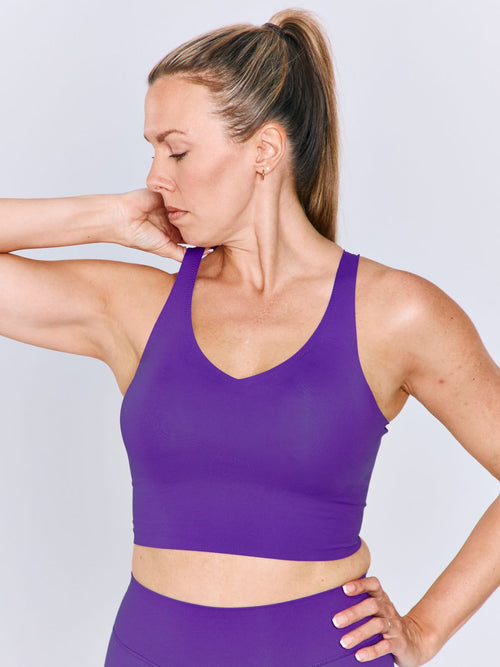
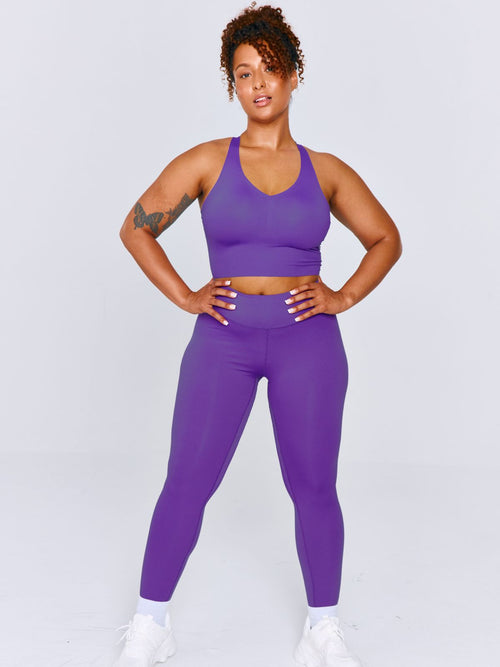
That is also why support ratings are not interchangeable across brands. Our Flex Sports Bra carries a medium-impact rating, yet that rating delivers support that rivals what other brands call high-impact. Flex handles yoga and cycling, strength training and pickleball, and if you wear an XXSmall to Medium, you can even run in it. The Ultimate is built for the top of the scale: running and HIIT, CrossFit and horseback riding, where bounce control has to be absolute.
Design Styles That Change the Fit Experience
Beyond construction and impact, sports bras differ in how they close and how their straps are routed. These choices do not change the core support mechanism, but they change how the bra feels and how easily you get in and out of it.
Racerback: straps converge toward the center of your upper back in a Y or T shape, pulling weight off the outer shoulder.
Crossback: straps form an X across the back for added stability and a different range of motion.
Front-close: a zip or hook in front, so you put the bra on and take it off without reaching behind you.
Pullover: no hardware at all; simplest to make, but the least adjustable once it is on.
Longline: the band extends down the torso for extra coverage and a more anchored feel.
Front-close bras, including our zip-front design, put everything where you can see it, which matters a lot more after a heavy workout than before one. Strap routing is its own decision, and how the straps adjust often matters as much as where they sit on your back.
A few notes on which style tends to fit which need best. Racerback routing is well suited to overhead movements and lifting, because the straps stay out of the way of the shoulder joint. Crossback tends to feel more secure for lateral or fast-direction-change activities. Longline is worth considering if band migration has been an issue, since the extra torso coverage gives the band more contact area to anchor against. Front-close wins on practicality, particularly for anyone who finds getting in and out of a tight pullover taxing after a workout.
How Cup Size Changes Everything
Cup size changes more than which support level you need. It changes which construction type can actually work for you, and that is the distinction most sports bra guides bury in a footnote. Compression alone serves an A or B cup well. As the bust grows, compression starts to fall short, because pressing tissue flat is not the same as supporting each breast on its own.
The practical rule: women with fuller busts often need to step one impact level higher than their activity would suggest for a smaller bust. A larger-busted woman cycling may need what a smaller-busted woman wears for running. We built our product around exactly this problem, engineering our size range, XS through 6Luxe, A through I cup, so that every size has access to genuine high-impact support, including the sizes the industry treats as too hard to fit. Our all sports bras collection shows what genuine high-impact support looks like across every size.
There is one fit signal worth clearing up here, because it trips up a lot of women. If you see armpit skin after putting on a properly fitted sports bra, that is the bra doing its job, lifting breast tissue up and back to where it belongs. Spillage is a different thing entirely: that is breast tissue pushing over the top or sides of the cup, and it signals a size or cup-depth issue, not proper lift.
The Research Behind Why It Matters
Support is about far more than comfort. The science on breast movement is specific, and it connects to performance and injury risk in ways that are easy to underestimate.
Start with how much movement is actually in play. Research by Joanna Wakefield-Scurr indicates that an ill-fitting bra can shorten a runner's stride by 4 centimeters [2]. That stride loss is a direct hit to how efficiently you move.
The stride shortening finding is worth pausing on. A 4-centimeter reduction per stride compounds across every step in a run. It is not a minor inefficiency. It is a measurable mechanical cost that adds up over distance, and it comes from support alone, not from footwear or training load.
The injury connection goes further. A 2022 study from the University of Memphis found that greater breast support is associated with reduced peak knee valgus angles, biomechanical profiles linked to lower ACL injury risk, while lower support was tied to the movement patterns that raise that risk [3]. University of Memphis research has also confirmed that our Ultimate Sports Bra reduces breast motion by more than 50% during landing movements.
Fit is the foundation under all of it, and most women never get it right. Research published in the Journal of Science and Medicine in Sport found that an estimated 85% of women are wearing the wrong bra size [4]. Sports bras compound that problem, because they need a tighter, more precise band fit than everyday bras to control movement at all.
How to Tell if Your Sports Bra Fits
A good fit check takes about thirty seconds. The classic version is the bounce test: jump up and down a few times, and if there is noticeable movement, the bra is not controlling impact. But the static checks tell you just as much.
One thing worth knowing before you run the checklist: most women start with their straps and work their way down. The fit logic goes the other way. The band is your anchor. If the band is right, the straps follow. If the band is wrong, tightening your straps only adds pressure without adding support.
Run through these four checkpoints:
The band sits level all the way around. It should not ride up in the back, because a band that climbs cannot anchor the bra during impact.
The straps stay put without digging. Straps that slide off signal a band that is too loose, not straps that are too tight.
The cups contain all breast tissue without gapping. No spillage over the top or sides, and no empty space wrinkling the cup.
You can fit two fingers under the band, no more. Looser than that and the band cannot do its job.
The band is doing most of the heavy lifting here, literally. As bra-fit expert Jené Luciani Sena puts it, the band provides about 80% of a bra's support, which is why a loose band undermines everything else. It is also why strap quality matters: non-stretch straps maintain lift wash after wash, where stretchy straps lose tension and let bounce creep back in.
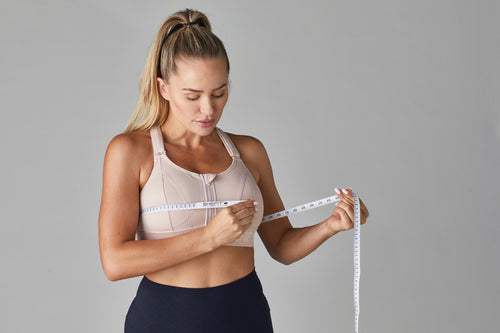
If you want to pressure-test your current bra against a full checklist, our guide on whether your sports bra fits right walks through it, reading directly from your measurements in inches rather than a cup letter that does not travel reliably between brands.
Find Your Type
The trouble with the "just pick a type" approach is that most bras lock you into one fixed fit the moment you pull them on. A compression pullover gives you exactly the compression it was cut for, nothing more. The construction is decided for you before you ever try it.
Our system flips that. You set the compression at the rib band, the lift at the shoulder straps, and the closure at the front zip, so the same bra adapts to your body, your activity, and even the days your size shifts up or down. That is the real answer to "which type supports you," because the best type is the one you can adjust to fit. Find your fit.
References
[1] Gorea, Adriana; Baytar, Fatma; Sanders, Eulanda A. "Experimental design and evaluation of a moisture responsive sports bra." Fashion and Textiles (Iowa State University / University of Delaware), 2020. https://dr.lib.iastate.edu/server/api/core/bitstreams/cd0efa9d-30bd-4431-8d31-8fb0b5f46361/content
[2] Research Group in Breast Health, University of Portsmouth. "Breast biomechanics and sport performance." University of Portsmouth. https://www.port.ac.uk/research/research-groups-and-centres/research-group-in-breast-health
[3] Fong, Hailey B.; Nelson, Alexis K.; Storey, Julie E.; et al. "Greater Breast Support Alters Trunk and Knee Joint Biomechanics Commonly Associated With Anterior Cruciate Ligament Injury." Frontiers in Sports and Active Living, 2022. https://doi.org/10.3389/fspor.2022.861553
[4] McGhee, Deirdre E.; Steele, Julie R. "Optimising breast support in female patients through correct bra fit. A cross-sectional study." Journal of Science and Medicine in Sport, 2010. https://pubmed.ncbi.nlm.nih.gov/20451452/