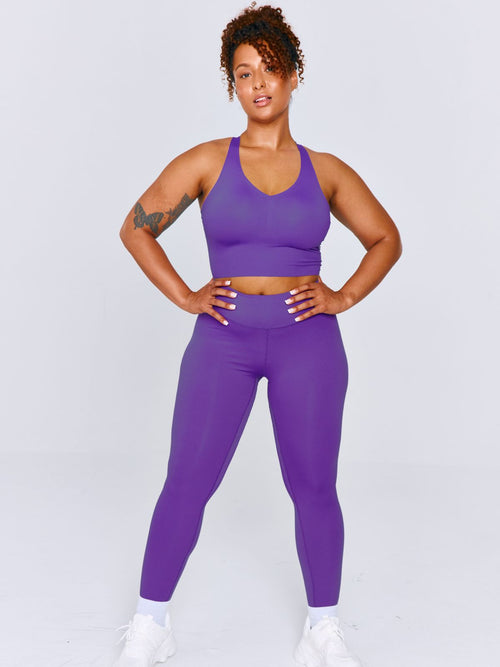
Which Bra Is Right for You? Learn More


You lace up your running shoes, ready to crush your workout. Three minutes in, you're adjusting your sports bra for the fifth time. By mile two, you're more focused on bounce than your pace. If this sounds familiar, you're not alone. The right high-impact sports bra can make the difference between a workout you power through and one you cut short.
High-impact activities like running and HIIT demand sports bras designed for maximum support. With countless options claiming to deliver, knowing which features actually matter makes all the difference. Understanding what separates true high-impact support from marketing claims helps you choose a sports bra that works with your body, not against it.
What Are High-Impact Sports Bras?
High-impact sports bras are designed to control breast movement during activities that involve jumping, running, or intense bouncing. Unlike low-impact bras meant for yoga or walking, or medium-impact options for cycling and strength training, high-impact bras provide maximum support to minimize motion in all directions [1].
Think about what your body experiences during a burpee or sprint interval. Each landing, each jump, each change of direction creates forces that cause breast tissue to move. Without proper support, this repeated motion can lead to discomfort and even long-term tissue stretching.
How High-Impact Bras Control Movement
High-impact bras use three main approaches:
-
Encapsulation gives each breast its own supportive cup space, maintaining natural shape while controlling bounce. Works for all sizes.
-
Compression holds everything firmly against your chest. Simple and effective for smaller busts, but can feel restrictive for larger sizes.
-
Hybrid combines both approaches for the best of both worlds. This is the gold standard for high-impact activities across all breast types.
The most effective high-impact bras use a hybrid design. You get the shaping and lift of encapsulation plus the lockdown support of compression, working together to minimize bounce from every angle.
Research shows breast motion during exercise happens in three dimensions, not just up and down. Without adequate support, breasts move vertically, side to side, and forward to back simultaneously. That's why high-impact bras need structured designs addressing movement from all angles.
Support Level by Breast Size
|
Breast Size |
High-Impact Requirement |
Key Features Needed |
|---|---|---|
|
32C and under |
Recommended for running, HIIT, plyometrics |
Encapsulation + compression, non-stretch straps |
|
34D to 38DD |
Required for all high-impact activities |
Individual cups, wide adjustable band, dual design |
|
38DDD and above |
Required even for low-impact activities |
Maximum adjustability, reinforced band, full encapsulation |
Key Features to Look For in a High-Impact Sports Bra
Not all sports bras labeled "high-impact" deliver the same level of support. Several specific features separate bras that truly control movement from those that fall short.
Essential Support Features Checklist
☐ Adjustable straps in non-stretch material (maintains lift without loosening)
☐ Wide rib band minimum 2-3 inches (provides 80% of total support)
☐ Dual design with encapsulation + compression (controls all motion angles)
☐ Moisture-wicking fabric (reduces friction and regulates temperature)
☐ Removable pads for customizable coverage
☐ Band that adjusts independently from straps (non-negotiable for proper fit)
The Non-Negotiables: Straps and Band
Non-stretch shoulder straps that adjust allow you to customize lift and support to your exact body. Stretchy straps may feel comfortable initially, but they lose tension over time and can't provide the secure hold needed for high-impact movement. Non-stretch straps maintain their support level workout after workout, wash after wash.
The band provides most of your support, not the straps. Many people assume shoulder straps do the heavy lifting, but biomechanically, the band around your ribcage anchors the entire bra and prevents it from riding up during movement. An adjustable rib band lets you dial in the perfect fit around your torso, preventing the bra from shifting against your skin during intense activity.
Design and Fabric Essentials
Look for bras that give each breast individual cup space while also providing compression to limit overall movement. This dual approach offers more comprehensive support than either method alone. Encapsulation prevents breast-to-breast friction while providing proper lift, and compression holds everything firmly in place.
Materials that pull sweat away from your skin reduce friction and help regulate body temperature. Look for fabrics specifically designed for athletic performance rather than cotton, which retains moisture and can feel heavy during extended activity.
Types of High-Impact Sports Bras
High-impact sports bras come in several style variations, each with advantages depending on your preferences and needs.
Sports Bra Style Comparison
|
Style |
Motion Control |
Ease of Use |
Best For |
|---|---|---|---|
|
Racerback |
Superior shoulder stability |
Overhead removal required |
Running, CrossFit, throwing |
|
Front-Zip |
Same as pullover when well-designed |
Easy on/off post-workout |
Sweaty workouts, limited mobility |
|
Fully Adjustable |
Maximum customization |
Requires initial setup |
Body changes, precise fit needs |
|
Compression-Only |
Inadequate for larger sizes |
Simple design |
A-B cups only |
|
Encapsulation-Only |
Good shaping and lift |
Standard |
All sizes, may need compression layer |
|
Hybrid |
Best motion control |
May need fitting |
All breast types, all impact levels |
Racerback styles feature straps that converge between your shoulder blades. This design keeps straps securely on your shoulders and allows full range of motion for your arms. Racerbacks work well for running and activities requiring overhead movement like CrossFit workouts or throwing exercises.
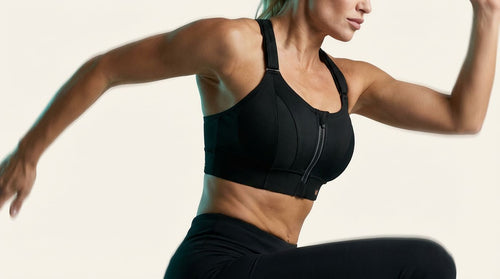
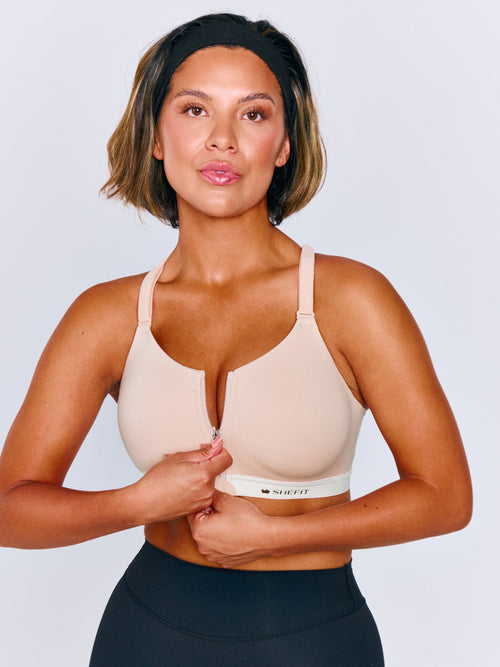
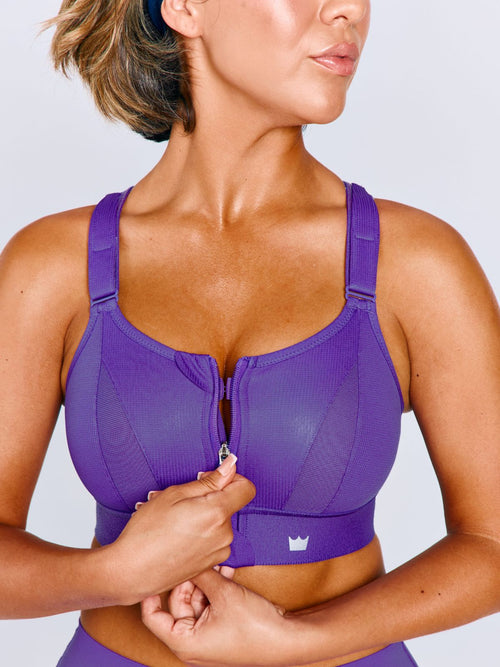
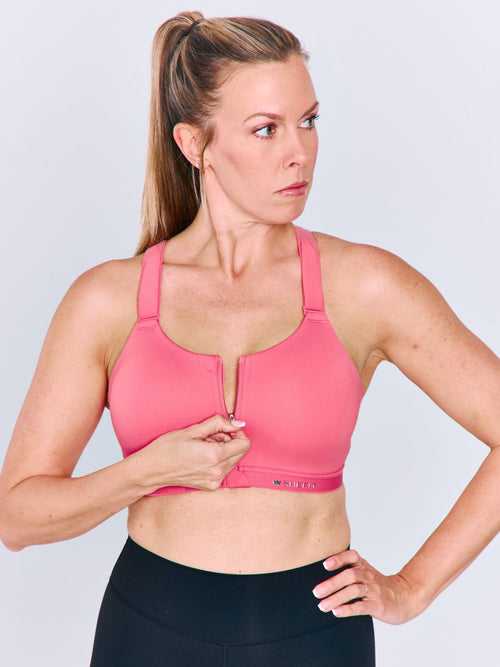
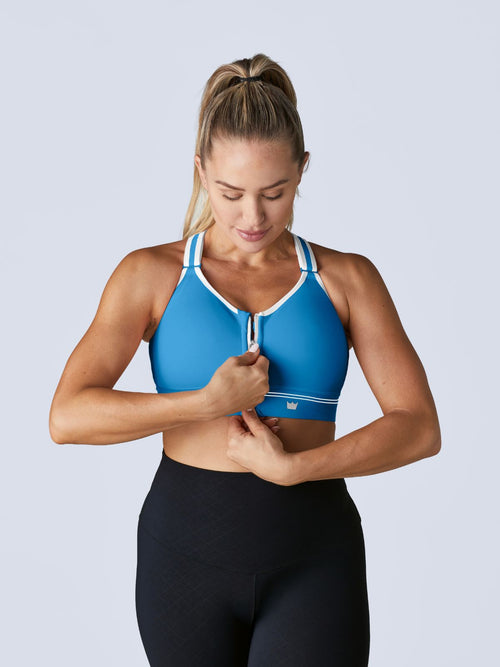
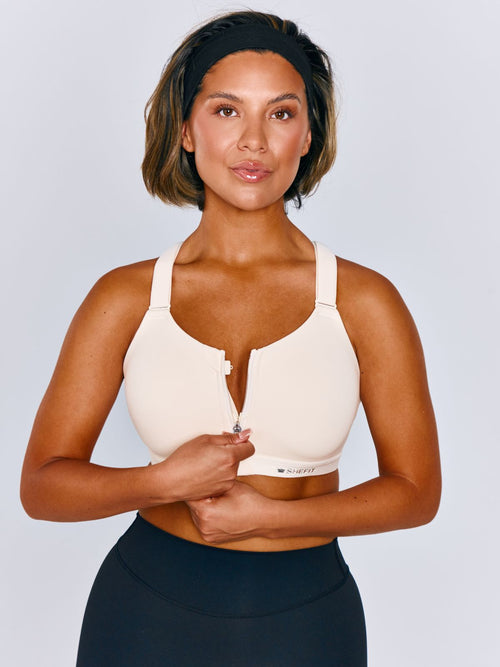
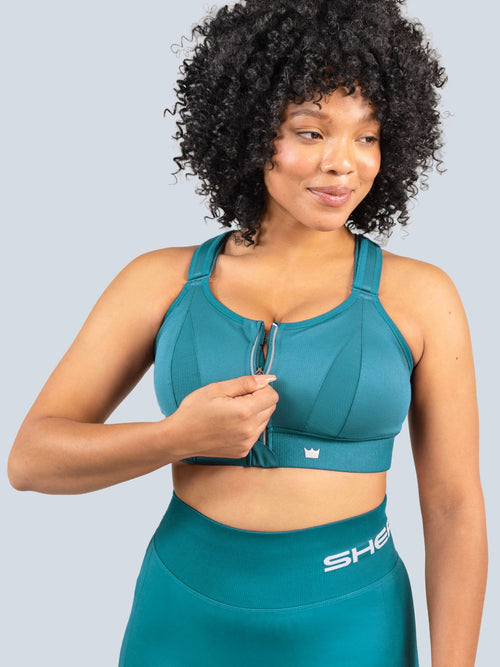
Front-zip bras make getting in and out easier, especially after a sweaty workout when pulling a tight sports bra over your head feels impossible. The zipper placement doesn't reduce support if the bra is well-designed with proper compression and encapsulation features. Look for front-zip options with protective zipper guards to prevent skin pinching.
Fully adjustable high-impact bras let you customize both shoulder straps and the rib band. This level of adjustability means the same bra fits you even when your bra size changes up or down. For active moms dealing with postpartum body changes or anyone experiencing weight fluctuations, this adaptability provides long-term value.
The best high-impact sports bras combine adjustability with both encapsulation and compression in one design. You get the shaping and support of encapsulation plus the movement control of compression, all customizable to your exact body.
Benefits of Wearing a High-Impact Sports Bra
Proper high-impact support delivers benefits extending beyond basic comfort during your workout.
Research-Backed Benefits
|
Benefit |
What Research Shows |
Source |
|---|---|---|
|
Injury Prevention |
Reduced knee valgus angles and ACL injury risk patterns |
University of Memphis |
|
Performance Efficiency |
Improved running efficiency, reduced energy expenditure |
Movement Science Studies |
|
Pain Reduction |
Eliminates exercise-induced breast pain for most users |
Sports Science Research |
|
Movement Mechanics |
Affects trunk, pelvis, and arm kinematics during running [2] |
Biomechanics Research |
|
Participation Rate |
Removes discomfort/embarrassment barrier to exercise |
Clinical Studies |
What This Means for You
University of Memphis research shows that proper breast support actually changes how your body moves during exercise. Better support means better landing mechanics, which may help protect against knee injuries. Your whole body benefits when your chest is properly controlled.
Here's the real difference: when you're not fighting against bounce, you can put that energy into your workout. Your running gets more efficient [3]. Your movements get sharper. You stop modifying exercises to manage discomfort.
And maybe most importantly, you stop avoiding workouts altogether. Too many women skip the activities they love because their sports bra can't keep up. The right support removes that barrier and gives you the confidence to go all in.
How to Choose the Right High-Impact Sports Bra
Selecting a high-impact sports bra requires attention to several fit factors beyond just picking your usual size.
Start with accurate measurements of both your band size and cup size. Studies show that up to 85% of women wear the wrong bra size [4], which means most people need to reassess their measurements rather than assuming their current size is correct.
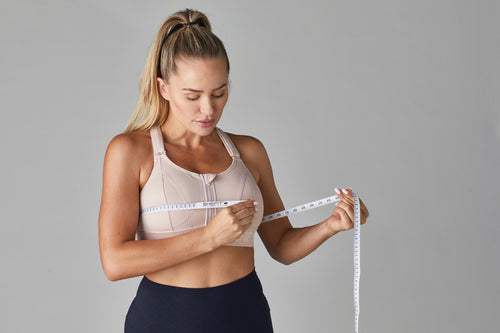
Measure your band size by wrapping a measuring tape snugly around your ribcage directly under your breasts, then round to the nearest even number. For cup size, measure around the fullest part of your bust and calculate the difference from your band size. Each inch of difference represents one cup size.
What Support Level Do You Need?
|
Your Size |
Running, HIIT, Plyometrics |
Yoga, Walking, Light Cycling |
|---|---|---|
|
32C and under |
High-impact required |
Medium-impact acceptable |
|
34D to 38DD |
Maximum support required |
High-impact recommended |
|
38DDD and above |
Maximum support required |
Maximum support required |
The table reveals an important pattern: larger bust sizes need maximum support features for virtually every activity. That means individual cups, a wide adjustable band of at least 2-3 inches, and dual-design construction combining encapsulation with compression. Smaller sizes have more flexibility for low-impact days but still need proper high-impact support for running and HIIT.
Check armpit coverage during fitting. Coverage that extends too far under your armpits indicates a fit problem. The bra should provide secure support without digging into your underarm area or restricting arm movement.
Look for finding the right fit guidance that accounts for adjustability. A bra with patented adjustable shoulder straps and rib band allows you to create a custom fit that stays in place, even when your body changes.
The Fit Tests
Test the band fit specifically. The rib band should feel snug but not restrictive. You should be able to fit two fingers under the band comfortably. If the band rides up your back during movement, it's too loose and won't provide adequate support.
Try the jump test. When trying on a sports bra, do a few jumping jacks or run in place. Pay attention to how much movement you feel and whether the bra shifts position. A proper high-impact bra should minimize bounce and stay exactly where you positioned it.
Finally, pay attention to signs of inadequate support. Excessive bounce, strap slippage, band riding up, spillage out of cups, and shoulder or neck pain all indicate your current sports bra isn't providing the high-impact support you need.
Top Sports Bras for High-Impact Sports
If you've tried countless sports bras that promised high-impact support but delivered disappointment, you're not alone. That frustration is exactly why the SHEFIT Ultimate Sports Bra exists.
The Ultimate features patented adjustable shoulder straps and rib band that let you dial in your perfect fit. You customize both the lift from the straps and the compression from the band. One bra adapts to your body instead of forcing your body to adapt to the bra.
SHEFIT Ultimate vs. Traditional High-Impact Bras
|
Factor |
SHEFIT Ultimate |
Traditional Fixed-Size |
|---|---|---|
|
Motion reduction |
31% better than leading brands |
Baseline |
|
Size adaptability |
Adjusts 1-2 sizes up/down |
Single size only |
|
Wash durability |
25 cycles before visible wear |
5 cycles industry standard |
|
Lifespan |
12-24+ months |
3-6 months typical |
|
Band/cup fit |
Adjust independently |
Choose band OR cup fit |
The Ultimate uses both encapsulation and compression design. Each breast gets individual cup space for proper shaping and lift, while compression controls overall movement. This dual approach is why University of Memphis research shows the Ultimate Sports Bra provides more than 50% greater reduction in vertical breast displacement compared to high-support options from other leading sportswear companies [5].
Non-stretch shoulder straps provide secure, personalized lift that doesn't loosen over time. The breathable, moisture-wicking fabrics reduce friction while removable modesty pads give you coverage options without adding bulk.
With 75,000+ 5-star reviews, the Ultimate delivers for activities ranging from running to HIIT and horseback riding. The size range of 2XS-6XL and AA-I cups means every woman can find her fit, regardless of size.
At $74, the Ultimate is an investment that pays off. SHEFIT bras are wash-tested to 25 cycles compared to the industry standard of 5, typically lasting 12-24+ months with proper care. When you calculate cost per wear, you're paying less than you would for multiple cheaper bras that lose support after a few months.
SHEFIT Flex for Smaller Bust Sizes
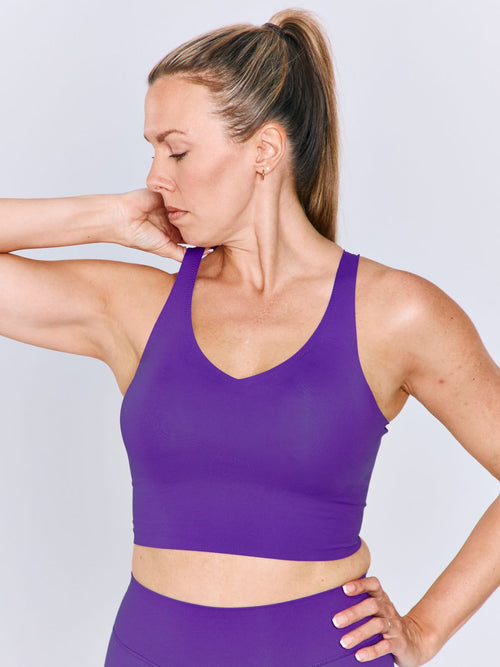
For smaller bust sizes (32C and under), the SHEFIT Flex Sports Bra offers high-impact support at $65. The Flex features patented adjustable features with smooth cups for a sculpted look. It uses encapsulation and compression design like the Ultimate, making it suitable for high-intensity interval training and other demanding activities.
For larger bust sizes, the Flex provides medium-impact support, making it ideal for yoga, strength training, and pickleball. Both options come in the same size range (2XS-6XL, AA-I cups) and share the adjustability that lets one bra fit you even when your size changes.
Frequently Asked Questions
How long should a high-impact sports bra last?
With proper care, a quality high-impact sports bra should last 12-24+ months. SHEFIT bras are tested to 25 wash cycles before showing obvious wear, compared to most brands that only test up to 5 washes. Signs your bra needs replacing include loss of elasticity in the band, stretched-out straps, and reduced support during activities.
How should I wash my high-impact sports bra?
Hand washing or using a delicate cycle in cold water extends your sports bra's lifespan. Avoid fabric softener, which breaks down elastic fibers and reduces the very compression and support you're paying for. Air dry instead of using a dryer, as heat degrades elasticity and support over time. Consider using a mesh lingerie bag even for delicate cycles.
What if my sports bra fits well at first but becomes uncomfortable during my workout?
This indicates the bra is shifting or moving during activity. A proper high-impact bra should maintain its position throughout your entire workout. Look for designs with adjustable rib bands that you can tighten to create a custom fit that stays in place. The movement creates friction that leads to chafing and discomfort.
Do I need different sports bras for different high-impact activities?
Not necessarily. A well-designed high-impact sports bra with both encapsulation and compression features works across multiple activities. The SHEFIT Ultimate provides sufficient support for running and HIIT without needing separate specialized bras for each activity. Instead of five different specialized bras, you can rely on one or two high-quality adjustable options.
How tight should a high-impact sports bra feel?
Your sports bra should feel snug and secure without restricting breathing or movement. The band should stay in place horizontally around your ribcage, and you should be able to fit two fingers under it comfortably. Straps should provide lift without digging into your shoulders. If you feel like you can't breathe normally, the band is too tight. If the band shifts during movement, it's too loose.
Can a high-impact sports bra help prevent breast pain during exercise?
Yes. Research shows that adequate breast support significantly reduces breast pain and discomfort during physical activity. Proper high-impact support controls movement in all three dimensions, minimizing the stretching and pulling of breast tissue that causes pain during exercise. Many women find that upgrading to a true high-impact bra eliminates the pain they previously accepted as normal.
What's the difference between high-impact and maximum support?
These terms are often used interchangeably, but maximum support typically indicates the highest level of control available. Not all bras labeled high-impact provide maximum support. A true maximum support sports bra combines encapsulation and compression with adjustable straps, a wide adjustable band, and non-stretch materials in the straps.
How do I know if I need high-impact support or if medium-impact is enough?
Your breast size and your activity both determine the answer. Larger bust sizes need high-impact support for virtually all exercise beyond gentle yoga or walking. Smaller bust sizes have more flexibility but should still choose high-impact for activities involving running, jumping, or quick direction changes. When in doubt, more support is better than less.
The right high-impact sports bra changes everything. Instead of constantly adjusting, managing discomfort, or cutting workouts short, you focus on what matters: your performance, your goals, your best workout yet.
When choosing a high-impact sports bra, prioritize adjustability, combined encapsulation and compression design, non-stretch straps, and a wide adjustable band. These features work together to give you the control you need for activities that demand maximum support.
Your body changes over time, through different life stages, fitness phases, and even throughout each month. A sports bra that adapts to those changes keeps working for you instead of becoming another disappointment in your drawer. That's the difference between a sports bra you tolerate and one that actually supports your active life.
References
[1] Norris, M., Blackmore, T., Horler, B., & Wakefield-Scurr, J. "How the characteristics of sports bras affect their performance." Ergonomics, 64(3), 410-418, 2021. https://pubmed.ncbi.nlm.nih.gov/32981459/
[2] Milligan, A., Mills, C., Corbett, J., & Scurr, J. "The influence of breast support on torso, pelvis and arm kinematics during a five kilometer treadmill run." Human Movement Science, 42, 246-260, 2015. https://pubmed.ncbi.nlm.nih.gov/26079773/
[3] Risius, D., Milligan, A., Berns, J., Brown, N., & Scurr, J. "Understanding key performance indicators for breast support: an analysis of breast support effects on biomechanical, physiological and subjective measures during running." Journal of Sports Sciences, 35(9), 842-851, 2017. https://pubmed.ncbi.nlm.nih.gov/27291899/
[4] McGhee, D.E., & Steele, J.R. "Optimising breast support in female patients through correct bra fit. A cross-sectional study." Journal of Science and Medicine in Sport, 13(6), 568-572, 2010. https://pubmed.ncbi.nlm.nih.gov/20451452/
[5] Fong, H.B., Nelson, A.K., McGhee, D., Ford, K., & Powell, D.W. "Increasing breast support is associated with a distal-to-proximal redistribution of joint negative work during a double-limb landing task." Journal of Applied Biomechanics, 2022. https://www.memphis.edu/healthsciences/pdfs/jab-biomech-2023.pdf